Do you find yourself dragging throughout the day more often than not? Following these fundamental guidelines could spell more energy from sunrise to sunset.
Add Produce
The nutrients in fruits and vegetables are essential for nourishing your body. Aim to eat at least two cups of each daily.
Bend and Stretch
At the start of each day, stand up, take a deep breath, then touch your toes. This and other stretches will engage your muscles and get your blood flowing to ignite your morning.

Cool down
No matter the season, keep a moderately cool sleep environment of around 65 degrees, which will optimize your core body temperature, encouraging healthy rest.
Do affirmations
To foster a more optimistic mindset, practice repeating positive statements like “I will tackle all my tasks today.” Science has linked such a habit with greater motivation, academic performance, and more.
Eat healthy fats
Lean sources of fat, such as turkey, salmon, and nuts, help fight fatigue by fueling your body with filling, nutritious energy. Swap out heavier fats like red meat and full-fat dairy products for these more wholesome options.

First things first
Making your bed in the morning can kick off your day right by completing a basic task, motivating you to tackle the next one. Even something as simple as draping a quilt across your bed can satisfy this chore.
Go for a walk
For another simple yet impactful habit, take a thirty-minute daily stroll. A little movement can transform your wellness by protecting your mental health, boosting your mood, and promoting a healthy weight, all of which could lead to a more energetic you.
Hydrate well
Dehydration may be to blame for your daily exhaustion, but, thankfully, there’s a simple solution: fuel up on H2O! Drinking water right after you awaken can eliminate fatigue and prepare you for the hours ahead, and staying hydrated throughout the day can sustain your vigor.

Invest in blackout drapes
Just as a cool environment promotes sleep, a dark room can make it deeper and more fulfilling. That’s because your body produces more melatonin in the dark. Cover your windows with light-blocking treatments, and you may wake up feeling rested and ready to go.
Just say no
As if there weren’t already enough reasons to avoid smoking, tobacco also acts as a stimulant, disrupting your slumber and making your daily energy levels go up in smoke. If needed, talk to your doctor about establishing a simple and achievable quitting plan.
Know the cause
Various health conditions, including diabetes and fibromyalgia, are associated with chronic fatigue. Discuss with your family doctor what the underlying cause of this symptom could be—you may need to begin treatment with a sleep expert or other specialist.
Lay your phone down
The stimulating light on your device, not to mention its access to news, social media, and entertainment, can perk up your mind rather than winding it down for bed. Refrain from using your phone two hours before going to sleep, and consider leaving it outside your room to avoid temptation.

Mind your caffeine
This is a perfect example of irony: the more caffeine you consume, the worse you may sleep, and, therefore, the more caffeine you’ll need to feel energized. To break the cycle, avoid coffee, soda, energy drinks, and the like after 2:00 p.m. or even try swearing off them altogether.
Nix the alcohol
The depressant effects of these beverages can lull you into an energy crash in the hours after consumption, so always drink moderately (if at all) to prevent them from dragging you down.
Open up your schedule
If you’re consistently feeling drained, you may be overscheduling your days. Identify at least three daily tasks that you can shift around, ask for assistance with, or eliminate altogether.
Play music
Motivating tunes can seriously enhance your mood, drumming up some oomph you can apply to your work, exercise, and other tasks. Any genre is effective as long as you enjoy the melody hitting your ears.

Quiet down your sleep space
Even if noise doesn’t wake you up, it can prevent you from descending into the deeper sleep stages. Wearing noise-suppressing earplugs or using a white-noise machine can filter out disturbances like creaky windows and loud traffic for better slumber.
Rest your muscles
Your body needs to recover after intense exercise, so take at least one day a week off to help it bounce back. Plus, this practice can actually improve your performance on workout days.
Stay active
On that note, it’s time to start a fitness routine if you don’t currently have one! According to the American Heart Association, living an active lifestyle can lead to enhanced energy and greater productivity. Aim to meet its recommended goal of getting at least 150 minutes of moderate-intensity exercise or 75 minutes of intense exercise every week.

Try a new clock
Upgrade from your phone’s alarm to a dedicated bedside one, seeking a smarter option with features like dimmable nighttime lights and adjustable sound settings for a more pleasant waking experience.
Up your nutrients
Certain compounds, such as vitamin B12, can actually fuel your day. The next time you see your doctor, discuss any deficiencies you may have along with potential dietary changes or supplements that could support you with more nutrients.
Venture outdoors
Spending time in fresh air and connecting with nature has been shown to restore the body and improve attention, memory, and cognitive function. If possible, take brief nature walks during breaks in your day to feel mentally refreshed when you return indoors.

Write it down
Having a concrete idea of your goals can fuel you to pursue them more vigorously. Start by putting your top professional and personal aims down on paper, then outline daily steps to tackle them.
X-pect the best
Did you know that your mood can actually affect your energy? To sustain your motivation and efficiency, work to identify any negative self-talk throughout your day and give it a positive spin (e.g., “This task is too hard for me!” versus “This may seem tough, but I will be proud of myself for overcoming it.”).
Your favorite pastime
We all need to balance daily responsibilities with relaxation and recovery. Slot some soothing hobbies into each day, whether that includes playing with your dog, streaming a TV series, or doing a crossword puzzle.

ZZZs
Finally, be sure to establish a consistent and sufficient sleep schedule. The CDC recommends that adults get at least seven hours of sleep per night, depending on their age and health needs. One of your foundational wellness objectives should be hitting this time target—no matter what.
When the days get busy, these two cozy, family-friendly recipes from The Simplified Cookbook deliver big flavor with minimal effort. From warm, banana-rich pancakes to playful meatloaf “cupcakes,” this little collection brings ease, comfort, and a dash of fun to your table.
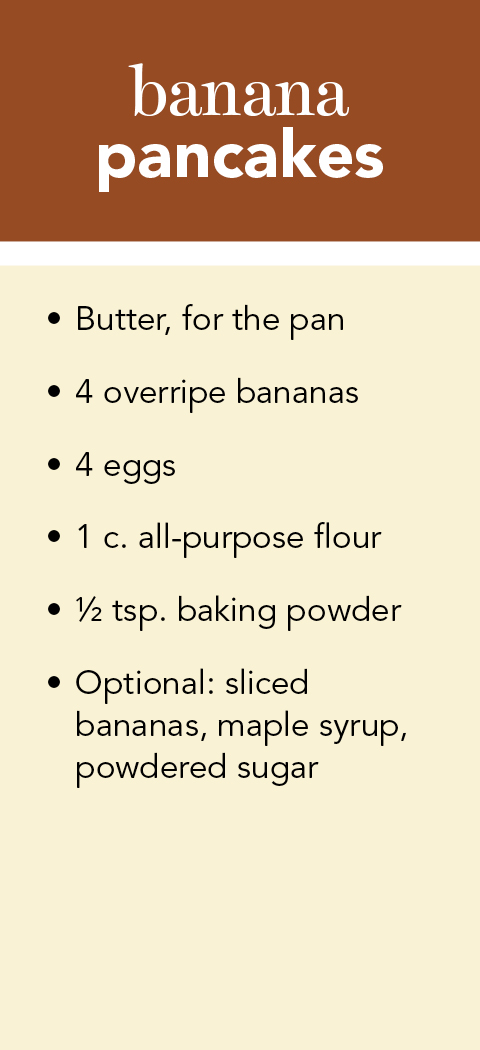
Soft, golden, banana-packed pancakes that come together fast and feel like a warm hug for breakfast.
A whimsical twist on classic meatloaf—easy to bake, fun to serve, and guaranteed to spark smiles.

Recipes from The Simplified Cookbook by Emily Ley. Thomas Nelson, 2025. Photography by Kris D’Amico, Whitney Hawkins, and Carly Tanner.
Does anyone else start singing the Jack Johnson song when you see these words? Just me? These easy pancakes were one of my oldest’s favorites when he was smaller. Now that he’s a teenager (gracious), he still loves them just as much.

Servings: 4


Ma! The meatloaf?! Anybody? Okay, that was a reference to Will Ferrell’s character in Wedding Crashers (you must watch it). Everyone loves meatloaf, but meatloaf “cupcakes” are next-level fun. These freeze great too!

Servings: 6
PRO TIP:
To turn these muffins into cupcakes, make mashed potatoes (or, if you’re me, warm up a pan of Bob Evans premade mashed potatoes), and put them in a plastic bag. Snip one corner to use it as a piping bag. Pretend those potatoes are icing and ice your “muffins.” If you’re feeling extra fancy, place one pea on top of each muffin. Your kids will get a big giggle. If you’d like to serve these with a dipping sauce, combine equal parts ketchup and brown sugar.


The southeastern corner of the United States is renowned for its beaches, particularly its islands. From the Outer Banks in North Carolina to Florida’s Key West, there’s no shortage of places to bask in the sun.
One that may top them all, however, is Georgia’s Golden Isles. When you visit this coastal paradise—consisting of Little St. Simons, St. Simons, Sea, and Jekyll Islands along with the port city of Brunswick—you’re sure to find the perfect combination of serenity and adventure. From lounging on a private beach to losing yourself in history to taking nature treks, you’ll always discover something to indulge in.

The Golden Isles is a collection of five places nestled off the Georgia coast, conveniently located approximately ninety minutes south of Savannah and seventy-five minutes north of Jacksonville. As is the case with many Southern destinations, temperatures here can get quite hot in summer months despite ocean breezes blowing through the area’s one hundred miles of coastline. However, if you travel during spring or fall, you can likely expect beautifully moderate weather, with highs settling into the seventies or low eighties.
So what actually makes these isles “golden”? The moniker is largely earned by their natural phenomena, namely the hue their vast marshes and beaches turn in the sun. But some people also give credit to an eighteenth-century Scotsman who used the term when writing to entice wealthy Londoners, hoping to garner their support for an established colony. The islands are still known for their beauty today as well as their historic landmarks, upscale resorts, and ample shopping, eating, and golfing opportunities. Travel + Leisure even named the Golden Isles the best islands in the continental United States in 2024, an award it has won multiple times, confirming what millions of travelers already know: there’s no place in the country quite like this.
Despite being so closely condensed, the islands and their common port all offer remarkably distinct experiences—allowing you the option of settling into one of them or taking in the uniqueness of each.

Little St. Simons Island
The northernmost of the Golden Isles, Little St. Simons Island is a privately owned, limited-access, nature-focused retreat with minimal development and maximum opportunities for wildlife observation. Within its seven miles of beaches and 3,000 acres of forests and upland, you can spot everything from birds to alligators to turtles, especially if you explore via a guided tour. Keep in mind, though, that you must book a day trip to or an overnight stay at Little St. Simons in advance to visit the island, which is only accessible by boat.

St. Simons Island
The largest and most residential of these islands, St. Simons offers seemingly endless leisurely activities to enjoy. You can shop at Pier Village, while away an afternoon at the fishing pier, traverse twenty miles of bike trails, or savor exquisite food at one of the nearly one hundred restaurants. Don’t overlook the historic landmarks, either—two must-sees are the eighteenth-century Christ Church and the St. Simons Island Lighthouse. Built in 1872, the latter houses a fascinating museum and 129 stairs that carry you to breathtaking views of the Atlantic Ocean. And speaking of the ocean, keep an eye out for bottlenose dolphins and even right whales!

Sea Island
Sitting to the east of St. Simons Island is the area’s land of luxury. An exclusive private resort, Sea Island is an impressive combination of history (founded nearly one hundred years ago) and Forbes Five-Star amenities, among which you’ll find fourteen high-end restaurants and to-die-for spa treatments. Plus, with three championship courses, it’s a golfer’s dream escape. You can even partake in a falconry program to get up close and personal with one of these majestic birds. But perhaps the best example of Sea Island’s high-end hospitality is the Cloister, its original 250-room property, where presidents and grande dames alike have laid their heads to rest.

Jekyll Island
Finally, there’s the southernmost island, Jekyll Island, an eclectic one-and-a-half-mile wide stretch of land teeming with natural beauty, historic wonder, and family-focused fun. Concerning the former, you can enjoy freshwater bodies of water as well as ten miles of Atlantic Ocean coast, including Driftwood Beach and its iconic wooden namesakes. However, if man-made water thrills are what you seek, head over to Summer Waves Water Park, which is open from mid-May through Labor Day.
Similarly, history buffs can wander through—or take a lovely trolley tour of—Jekyll Island’s National Historic Landmark District to get a glimpse of a bygone era, such as opulent mansions once owned by aristocrats like the Rockefellers. In contrast, the island’s history museum, Mosaic, welcomes you to learn about the past in an interactive indoor setting. Want to enjoy the very latest offerings instead? Wander through the District Shops at Historic Pier Road, which were opened just last year. And be sure to visit the Georgia Sea Turtle Center to learn more about how these creatures are preserved—with their nesting season starting in May, you may even get a glimpse of them gathering on the beach if you visit during summer.

Brunswick
The hub of this entire area is the historic port city of Brunswick, known as the Gateway to the Golden Isles. But it’s so much more than a mere travel-through point. For example, its Old Town Historic District, listed on the National Register of Historic Places, is clad in Victorian splendor while offering a plethora of dining, shopping, and entertainment options. Among the possibilities here are seeing a movie at the nineteenth-century Ritz Theatre, rock climbing at Brunswick Rocks, and gaming at Pinball Palace. The majestic Sidney Lanier Bridge, which brings you to the Golden Isles from I-95, is particularly awe-inspiring, offering breathtaking views of the Brunswick River when you arrive and depart.
It has been said that variety is the spice of life, and Georgia’s Golden Isles is a prime example of it. From unspoiled beaches to upscale accommodations, this Southern piece of paradise offers something for everyone, making it a golden travel opportunity indeed.
For more info, visit goldenisles.com
My family has a long history of collecting. My brothers and I accumulated baseball cards as kids, our mother has a massive stock of Precious Moments figurines, and our grandfather gifted his grandchildren toy trucks every Christmas. My daughter even continues this tradition today with Pokémon cards.
Apparently, we’re the rule, not the exception. A 2022 survey commissioned by MagnifyMoney found that over 60 percent of Americans consider themselves collectors and only 32 percent of them do it with dreams of getting rich. (That said, the global market is around $500 billion today and is expected to be over $750 billion by the end of 2033, per Market Decipher and KD Market Insights, respectively).
So why do so many people spend valuable time and energy hunting down memorabilia? You may be surprised to find that there’s a plethora of perks to be gained by it, many of which can help improve everyday life.

Accomplishment
From an early age, we learn that earning an A in school or a badge from the scouts provides a sense of pride in a job well done. Collecting offers such satisfaction in spades—there really is nothing like completing a set.
Escapism
Simply put, this activity is fun. Some people continue it because of nostalgic reasons—they did it as a kid and maybe with a parent—while others pick it up because they’re intrigued by the subject matter and the pastime allows them to take a deeper dive into it.
Persistence
As any enthusiast will attest, a never-give-up attitude is usually necessary, whether you’re trying to attain an entire coin set one by one, compiling a doll collection, or seeking out a one-of-a-kind sports card.
Serenity
Perhaps unsurprisingly, there’s a level of peace you can experience whenever you block out the world and lose yourself in your collection. Much like with painting, playing music, and other hobbies, hours can drift away when you’re doing something you love.

Attention to detail
Depending on how serious you are, you’ll need to sweat the little things as you hunt down your treasures. Examples include finding the P, D, or S mint mark on a coin (indicating its minting origin) and being cognizant of the slightest crease in a rare baseball card.
Decision-making
Simply put, you have to take responsibility for your potential haul from prepurchase (e.g., Is it worth the marketed price?) to postpurchase (e.g., How will you store it after buying it?).
Expertise
The above two benefits cannot happen without knowing your subject, making the art of collecting an opportunity to bask in the love of learning—while also uncovering fascinating tidbits about your finds.

Belonging
Hobbies are an easy, natural way to connect with others about a shared interest the general public may not understand. For example, multiple people struck up conversations about my daughter’s stuffed companion, Wooper from Pokémon, when we vacationed far from home.
Expression
Sharing your compilation is sharing something about you, whether your Christmas ornaments reflect your travels or your choice of vinyl records from the seventies reveals which music you love.
Collectibles are often associated with profits, but the activity itself goes well beyond the potential financial boon. So the next time you open a pack of trading cards, admire the figurines in your hutch, or sit back and flip through your stamp collection, do so knowing just how much it adds to your joy and overall well-being.