+
+
+
The arrival of September brings crisp air, golden leaves, and fresh opportunities to explore and indulge in the comforts of the season. This issue of American Lifestyle is packed with inspiration, from breathtaking stargazing locations to the best spots for leaf-peeping in New England—and more!
For those who dream of seeing the night sky in its full brilliance, escaping the glow of city lights is a must. The enclosed guide highlights some of the best dark-sky areas across the nation, whether you prefer a West Coast or East Coast excursion. With tips on when to go, what to bring, and how to make the most of your experience, you’ll be ready for an unforgettable celestial adventure.
If you’ve ever wanted to try baking sourdough but felt intimidated by the process, the article inside has you covered. Using just flour, water, and a little patience, you can create a thriving starter that brings homemade bread to life. Get all the details on the steps for mixing your first batch along with strategies for maintaining your starter for future bakes.
With the temperature cooling, there's no better time to embrace hearty, flavorful meals. The featured recipes from the Tastemaker cookbook offer the perfect blend of comfort and creativity. Try the bold naan pizza with crispy prosciutto for dinner, then savor the decadent s’mores dip that transforms the classic treat into a shareable delight for dessert.
As autumn paints the landscape with vibrant reds, oranges, and yellows, New England becomes a prime destination for anyone eager to relish the beauty of fall foliage. This issue takes you through the top places for leaf-peeping, including the rolling hills of Vermont’s Green Mountain National Forest and the towering peaks of New Hampshire’s White Mountains.
Here’s to a season of wonder, warmth, and discovery! As always, it’s a pleasure to send you this magazine.
+
“The sight of the stars always makes me dream.” —Vincent van Gogh
Like Van Gogh, I’ve always loved looking at the stars. To this day, whenever I am outside in my suburban Philadelphia yard on a clear night, I’ll make sure to spend a few minutes gazing upward. If I’m lucky, I can see hundreds of stars and quite a few constellations sweeping across the black expanse.
Bettymaya Foott, an engagement associate for DarkSky International, has had quite a different experience. Growing up in rural Utah, she spent countless nights lying on her trampoline and admiring a sky filled with not only stars as far as her eyes could see but also heavenly bodies like the Milky Way. The difference? Her hometown was located in a dark-sky area of the country.
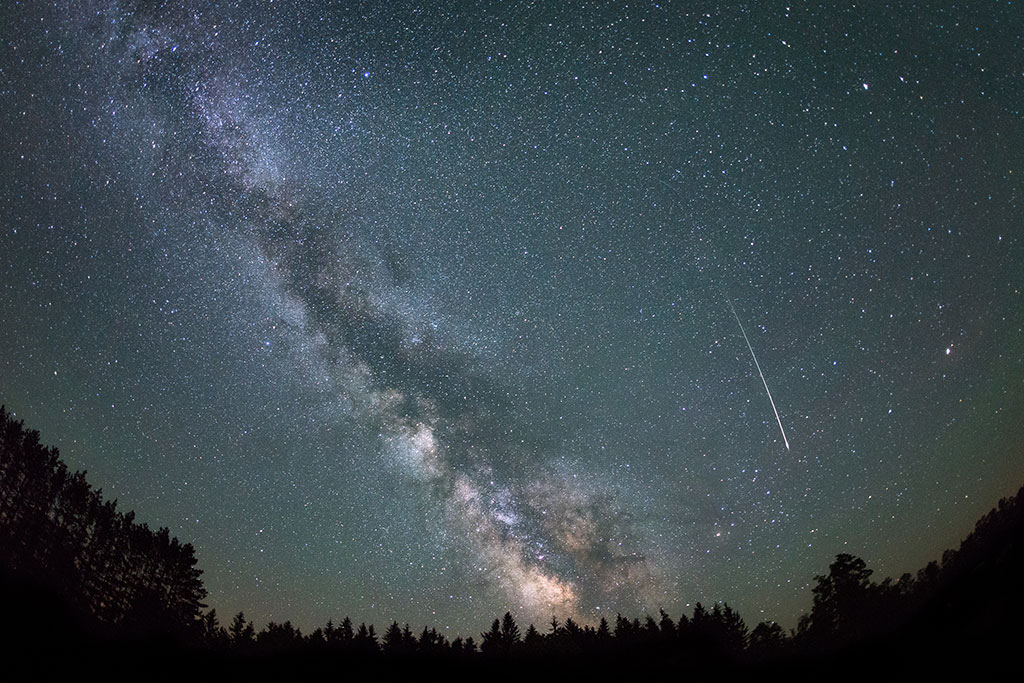
If you’re willing to travel, there are dozens of such places waiting to be explored: a total of 247 certified dark-sky sites exist across the globe, more than half of which can be found in the United States. And the experience is like, well, night and day. You can see around 50 stars from dusk until dawn in an urban area affected by light pollution and 500 in a suburban one, but in a truly dark sky, the number of visible stars can expand to 15,000—making these spots must-see destinations for young and old alike.
So how should you begin your stargazing adventure? The best first step is to visit the DarkSky website, which features a map of International Dark Sky Places. “Look up events hosted at dark-sky parks near you, or just go on your own self-guided tour of the night sky,” Foott suggests. Once you’ve decided on your location, determine the best time to go. Ideally, you’ll want to visit when the skies are clear, though that can be difficult to plan for given the weather’s unpredictability. However, you can keep in mind the phases of the moon; take your trip during the new moon when it is practically invisible, and you can prevent its brightness from interfering with your view. Check out this lunar calendar to verify the timing for your chosen locale.
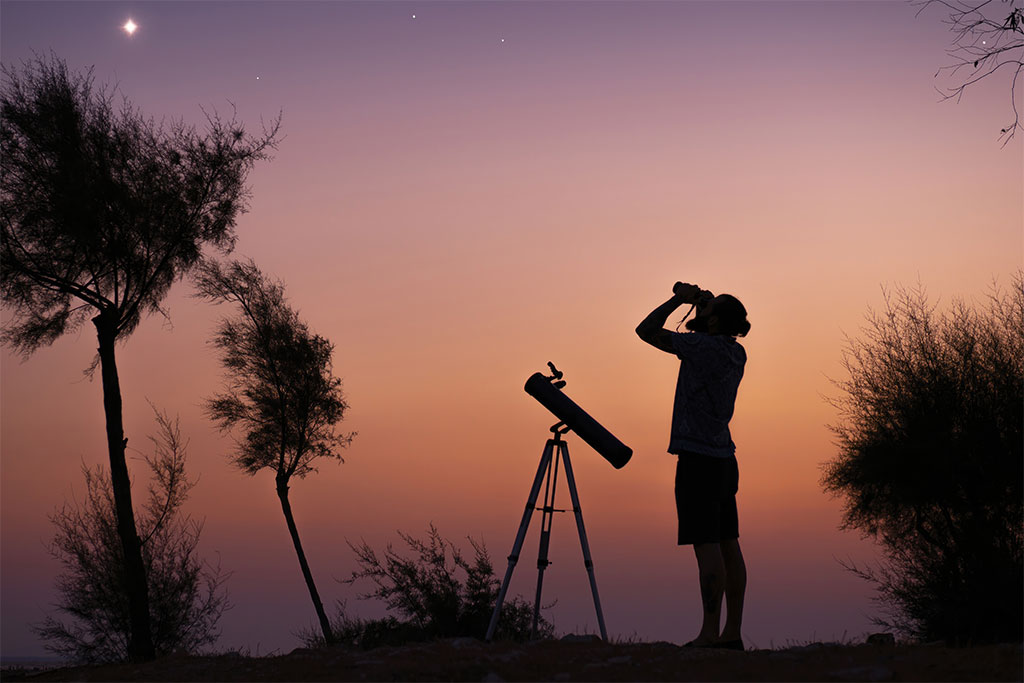
Further, make sure to brush up on your etiquette so you don’t disturb your fellow stargazers. Namely, try to minimize your light pollution as much as possible: arrive before dark, park with your headlights facing away from the site for when you leave, and utilize flashlights with red filters. Look into your destination’s regulations as well—some may have specific rules and be more or less strict than others. And don’t forget your binoculars or telescope! “I would also recommend using one of the many free planetarium apps that tell you what constellation, star, or planet you’re looking at when you point your phone to the night sky,” Foott adds. “It’s really fun.”
Most dark-sky areas are clustered in the western third of the country, but you can find them from coast to coast. Not surprisingly, the majority are national and state parks. Here are just some of the notable star-filled sites where seeing is believing.
Cherry Springs State Park (Pennsylvania)
The only Dark Sky Place in the Northeast outside of Maine, Cherry Springs’ stargazing field can be found atop a 2,300-foot mountain, providing a 360-degree view of the stars above. You can choose to settle in at its short-term spot or at either of its two campgrounds: one with loose guidelines for casual astronomers and one with firm restrictions for serious observers.
Big Cypress National Preserve (Florida)
Florida features three destinations for peak stargazing, with Big Cypress being the southernmost. It hosts free monthly educational events for the public from December through March, including a ranger-led astronomy program and constellation tours. Note that there is no seating available, so don’t forget to bring your own. (Another essential to remember: bug spray to ward off hungry mosquitoes.)
Big Bend National Park (Texas)
Big Bend holds the distinction of having the least light pollution of any national park unit in the continental United States, ensuring that every visitor gets an otherworldly experience. Can’t wait or are unable to visit? Explore its Nighttime Sky Quality map, which tracks the visibility of the stars in the area and how that has changed over time.
Glacier National Park (Montana)
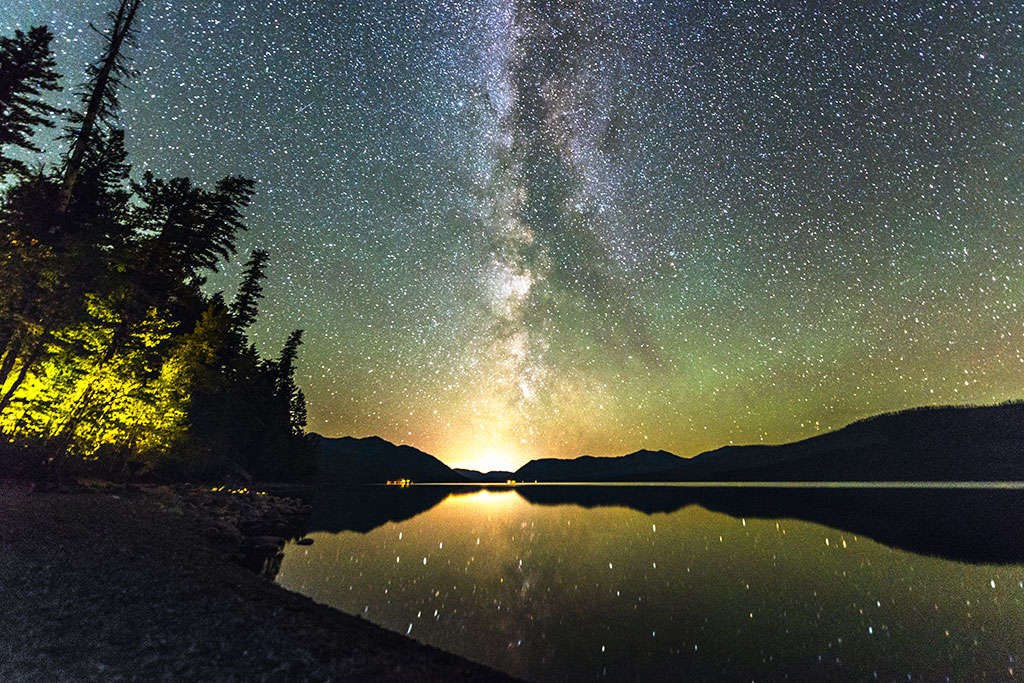
Though this location may be chillier than other options, it’s well worth a trip for the unique experience of setting up at the edge of Lake McDonald and seeing the stars reflected in the water. Glacier National Park is also unique in that it has a dark-sky sister park, Waterton Lakes National Park, about an hour across the Canadian border, allowing you to potentially double up on your celestial experience.
The Colorado Plateau
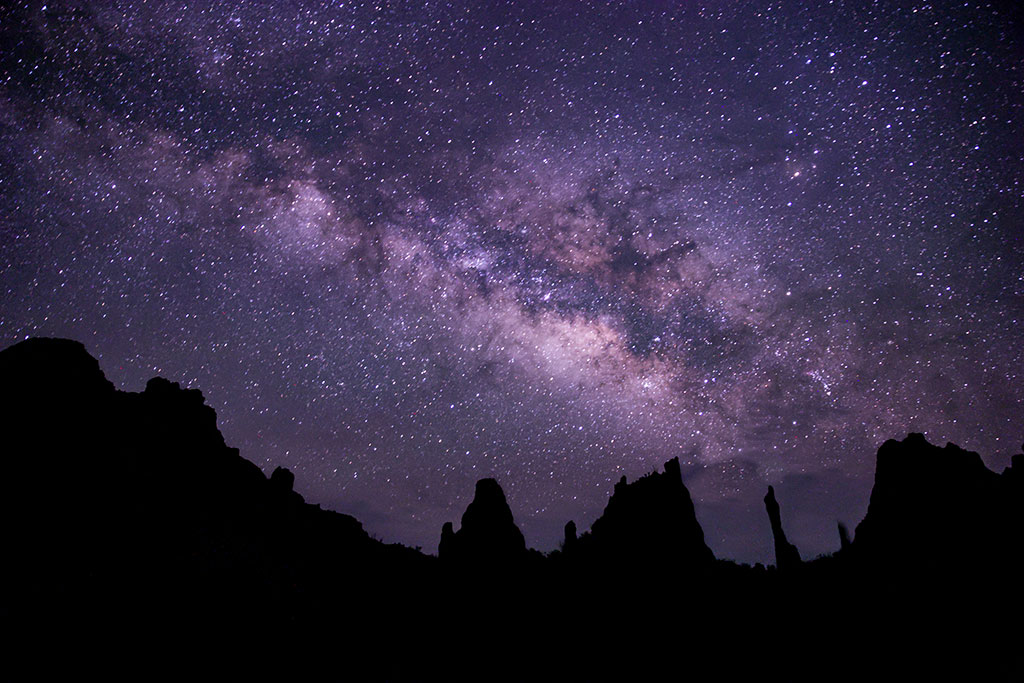
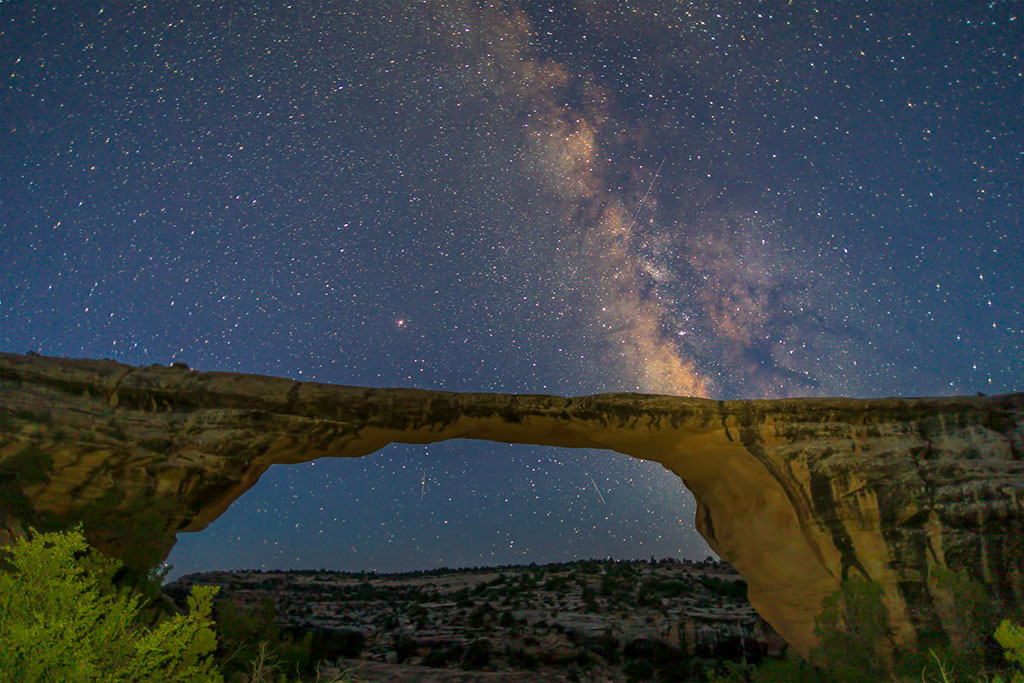
Foott highly recommends this area for a scenic stargazing adventure. “Here you have a juxtaposition of the incredible night sky and the beautiful rolling canyons, arches, red rocks, and rivers,” she says. “It’s the coolest combination in the world.” Amid the 240,000-square-mile expanse that includes parts of Colorado, Utah, Arizona, and New Mexico, you’ll find many locales offering such breathtaking settings. Consider Chaco Culture National Historical Park in New Mexico; Colorado’s Mesa Verde National Park, the world’s one-hundredth Dark Sky Park; Grand Canyon National Park in Arizona; and Utah’s Natural Bridges National Monument, the first-ever Dark Sky Park. (“It’s super dark and super beautiful,” Foott adds.)
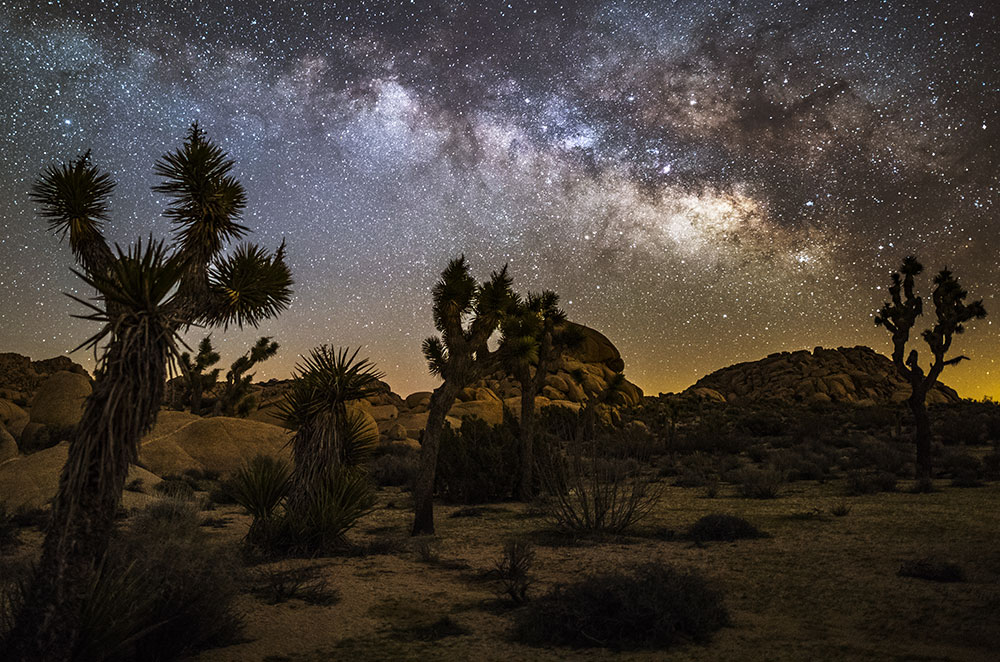
Joshua Tree National Park (California)
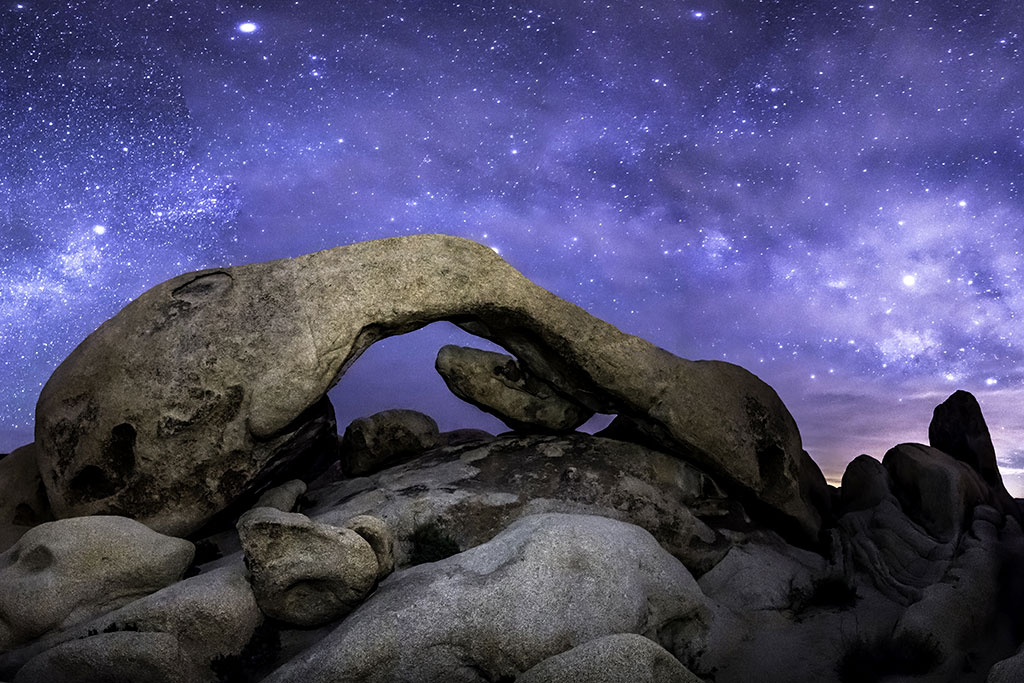
Located in the Southern California desert, Joshua Tree is excellent for stargazing in part because it is located 3,000 to 6,000 feet above sea level, depending on where in the park you are. It’s recommended that you venture to the east end to see the stars—being 300 miles from the nearest city, the area is ultradark.
The night sky is a constant source of awe and inspiration, but you may need to travel some distance to experience it in all its glory. By visiting a Dark Sky Place, you’ll give yourself access to not only the infinite vastness of the cosmos but also the endless wonder that accompanies it.
For more info, visit darksky.org
+
There’s something irresistible about the aroma and taste of freshly baked bread. Warm, golden, and crunchy on the outside, it’s enough to drive anyone to learn to make their own. However, the baking process can sometimes feel intimidating—especially when it comes to sourdough, which relies on a starter that requires constant care and attention. The good news? With the right tools and instructions, creating and maintaining one may be simpler than it seems.
Sourdough is the oldest known type of leavened bread, but unlike others, it doesn’t contain baker’s yeast. Instead, its key ingredient is a starter: a basic mixture of water and flour that cultivates wild yeast and bacteria present in the environment, triggering a natural fermentation process that produces lactic acid. This is what gives sourdough its signature tangy flavor.
As a bonus, the process also breaks down certain acids commonly found in other breads, increasing the nutrients in sourdough and reducing its overall gluten content, which may make it a good option for those with such a sensitivity. And once established, a healthy starter can keep for years, with some even lasting for generations. In fact, there’s even one that originates from ancient Egypt, dating back over 4,500 years.
As noted above, a starter generally consists of only two main ingredients, though for the purpose of speeding up fermentation, this recipe will use two types of flour: whole-wheat flour at the beginning to create it and unbleached flour later to feed it. As for the steps, they likewise are not overly complex but do require careful attention over the course of a week. Give it the proper time and patience, and you can develop a high-quality, long-lasting starter for baking fresh sourdough bread whenever the whim strikes you.
Ingredients:
Equipment:
Instructions:
Day 1: Using your digital scale to measure, add 60 grams of whole-wheat flour and 60 grams of water to your glass jar. (Make sure to press the tare button after setting your jar on the scale to reset it to 0 before adding the ingredients.) Stir everything together using the fork until fully combined, creating a thick mixture. Loosely close the lid, and let it sit at room temperature (approximately 70–75°F).
Day 2: Allow the mixture to rest for a full day, only stirring it once or twice to oxygenate it. You may see some bubbles forming, which is a sign that it’s beginning to ferment.
Day 3: After another twenty-four hours, your starter should have more bubbles. You may also notice a brown liquid on top that has a very pungent smell. This is completely normal and, like the bubbles, is an indication that it’s time to start the feeding process; you’ll just want to pour it off before you begin.
To feed, discard half of your starter, then add 60 grams each of unbleached flour and water, using the scale to weigh out the correct amounts. (Note: it’s extremely important that you don’t skip the discard since this could lead to underfeeding your starter or creating an overly acidic mixture.) Stir well—you should have a thick, pancake-like consistency after this and subsequent feeds. Scrape down the sides of the jar with the rubber spatula, and loosely close the lid.
Days 4–7: Continue feeding your starter as outlined in Day 3. It should gradually rise and form more bubbles. You can track its growth by placing a rubber band on the outside of your jar when you’ve completed each feed.
Day 8: At this point, your starter should have plenty of small and large bubbles, a spongy texture, and a tangy aroma. This means that it’s likely active and ready for baking! You can confirm by doing a float test, which involves placing a teaspoon of starter in a bowl of water and seeing if it floats on top. Another option is to feed it one more time and check if it doubles in size after four to twelve hours. If neither yields positive results, you can repeat the feeding process as outlined above for another day or two.
After your starter becomes active, feed it regularly to keep it healthy. If you bake a few times a week, store it at room temperature and feed it once or twice a day; conversely, if you bake only occasionally, store it in the refrigerator and feed it once a week, allowing it to come back to room temperature before using it for baking. When feeding, always discard half of your starter and refresh it with equal parts flour and water to ensure that it remains balanced.
Throughout the process of maintaining your starter, there are a few common problems you may encounter, including:
Creating and maintaining a sourdough starter requires patience, but the reward is fresh, flavorful bread made with simple ingredients. Even better, its uses go far beyond making a classic loaf—explore endless baking possibilities, including scones, pancakes, focaccia, bagels, donuts, and so much more!
+
Summertime is in the rearview mirror, which means that the “brr” months—starting with September—are here, inviting us to enjoy comfortable clothes and comforting food. Concerning the latter, these recipes from the Tastemaker cookbook perfectly fit the bill, offering options that are both belly warming and tasty.
This recipe ups the wow factor on the traditional pie thanks to its distinctive ingredients, which include luscious layers of sauce, delicate arugula, zesty meat, and an airy flatbread crust.
The classic components of rich chocolate and fluffy marshmallow are given a new twist, melding into a delightful dip for graham crackers.
Recipes from Tastemaker: Cooking with Spice, Style & Soul by Scot Louie. Weldon Owen, 2024. Photography by Biz Jones. Text © 2024 Scot Louie and Photography © Weldon Owen.
+
recipe by scot louie
photos by biz jones
Between the light and fluffy naan, the crispy prosciutto, and the tangy marinara, it’s hard to decide what makes these naan pizzas so delicious. Each ingredient here is really working together to achieve the cheesy, flavorful greatness. My favorite part, aside from eating it, is topping it off with that final sprinkle of salt and pepper and a smooth drizzle of olive oil.
Makes 2–4 servings; 2 naan pizzas
+
recipe by scot louie
photos by biz jones
I’m always looking for something good and easy when it comes to desserts. Hand to God—I’m not the best baker, but I’m working on it. However, this S’mores Dip is an easy and delicious dessert for anyone to make. Minimal prep time, minimal ingredients, and maximum flavor.
Makes 8–10 servings
+
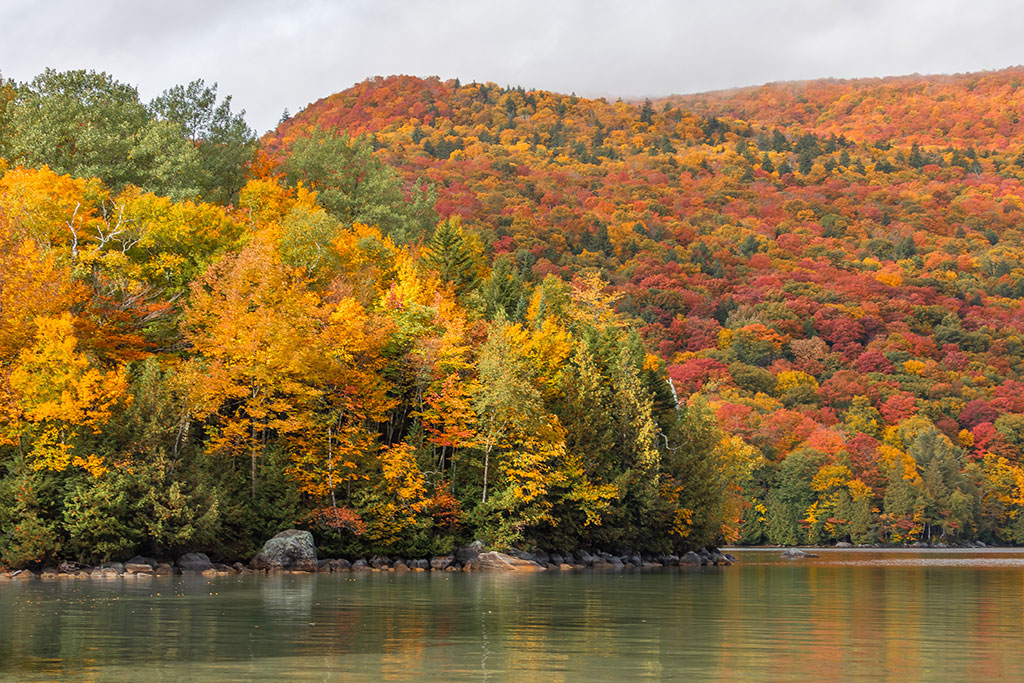
Soon after the crisp autumn air sets in, New England transforms into a multicolored masterpiece—a veritable fireworks display of flamboyant hues, courtesy of the area’s overabundant leaf-shedding deciduous trees like birches and sugar maples. Whether you’re a seasoned peeping enthusiast or planning your first excursion, get to know a little more about this Northeastern paradise rife with sights everyone should experience at least once.
The foliage in New England usually becomes prominent in mid-September and fades in late October, but peak timing can change depending on the location, altitude, and weather. Generally, the region’s three northern states—Maine, Vermont, and New Hampshire—climax in September to early October, while Massachusetts, Connecticut, and Rhode Island are most colorful a few weeks later, around mid-to-late October. High- and low-elevation destinations follow a similar pattern, with mountain forests usually transitioning before sea-level ones.
Additionally, rainfall conditions and average temperatures play a significant role in the leaf-changing pattern and intensity; for instance, a wetter spring and summer followed by warm fall days and cool nights typically nurture a more impressive showing. Because this factor can vary greatly from year to year, you may want to check foliage reports, which are widely available through state tourism websites and resources like The Old Farmer’s Almanac, before officially booking a trip.
To soak in the best this region has to offer, drive to New England if possible—or rent a vehicle if you’re flying in. While major cities like Boston will host some autumn scenery, you’ll naturally find a higher volume of colors in rural areas and remote forested parks. Securing your own transportation allows you to access numerous such leaf-peeping spots in a single trip while also giving you an easy way to take in the sights as you cruise down roads that wind along the vibrant landscape.
Be sure to pack attire for a variety of weather conditions as well, especially if you’re interested in hiking under the foliage and taking photographs. While the Northeastern fall air is famously refreshing, temperatures can fluctuate and rainfall may occur, most notably in the mountains, so bring clothing that you can layer for multiple situations. Then just add in a pair of hiking boots or quality tennis shoes so you can safely enjoy rugged trails, and don’t forget to hydrate and wear sunscreen—even on a cloudy day.
Virtually anywhere you venture in New England may produce gorgeous scenery worth feasting your eyes on, but here are some particularly charming spots to consider this time of year.
Green Mountain National Forest, Vermont
Arguably the epicenter of the region’s fall foliage, this park offers some of the most spectacular vistas in the Northeast. Its trails weave through approximately 400,000 acres of rolling hills and dense forests that turn into a patchwork of fiery reds, sunny oranges, and golden yellows come late September. You can even hop onto a portion of the 272-mile Long Trail, which is designated as America’s oldest long-distance hiking path and runs from the bottom edge of the state to the top.
For incredible leaf-peeping by car, take the Route 100 Byway along Green Mountain National Forest, giving you a full extended view of the park’s majesty. Need a place to stay after your excursion? The highway also feeds into the charming town of Stowe to the north, whose iconic avenues featuring boutique shops, hotels, and bed and breakfasts could make it the perfect center point of your trip. As a bonus, it is just a short drive away from the scenic Mount Mansfield, from which you can actually spot colorful sights across the Canadian border.
White Mountains, New Hampshire
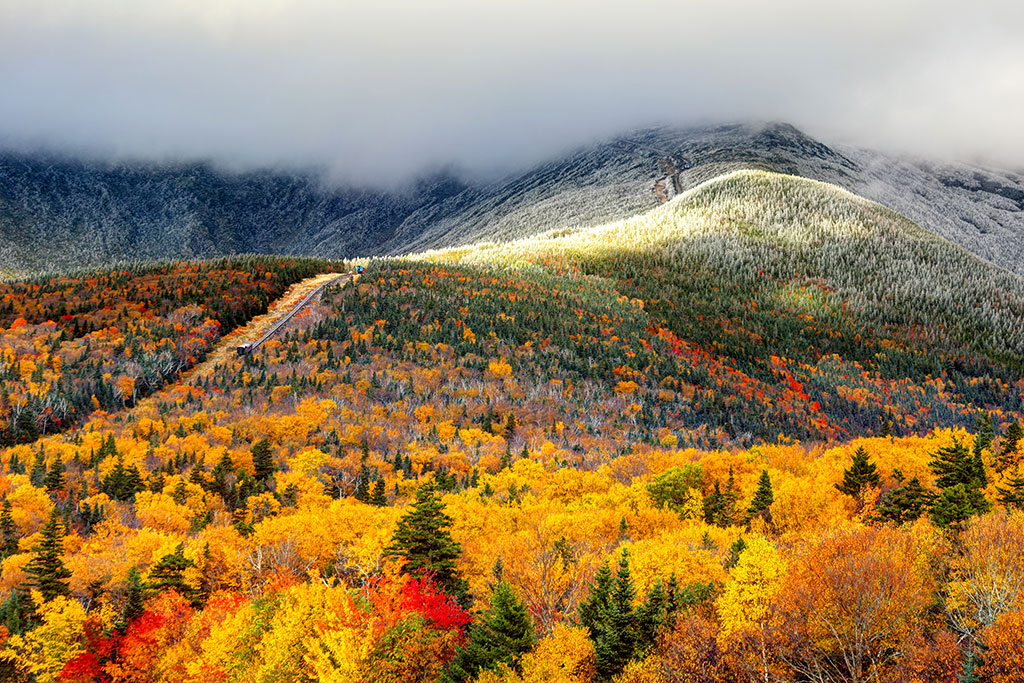
Despite what its name suggests, this range boasts absolutely legendary foliage. Rugged peaks, steep valleys, and winding rivers wonderfully frame the seasonal transformation, especially along the Kancamagus Highway, a 34.5-mile stretch that tours directly through the core of White Mountain National Forest. The drive yields impressive up-close panoramas of the trees as well as access to numerous hiking trails that lead to exceptional overlooks, including the crystal-clear mountain ponds in the park’s Sandwich Range Wilderness.
Perhaps the best vantage points, however, can be found at the top of Mount Washington, the highest peak in the Northeast. Scale to the summit using any of the available paths—though be aware that they are generally rough and steep—or the 7.6-mile Auto Road (typically open through the end of October). Or for a less active way to savor autumn wonders, hop aboard the Conway Scenic Railroad’s popular Mountaineer, a 1950s-era train that takes you on a four-hour-plus round trip along the rocky Crawford Notch.
The Berkshires, Massachusetts
A famous fall-foliage hot spot, this area in western Massachusetts has earned nationwide acclaim for its charming small towns peppered among colorful landscapes. The former offers cultural attractions like the Norman Rockwell Museum, while the latter provides ample opportunities for hiking, biking, and driving through vibrant forests. Consider, for instance, the path to Race Brook Falls; along the way, you can listen for the waterfall’s roaring among the quiet trees to help guide you to the tremendous spectacle.
Additionally, hiking to Mount Greylock, the highest peak in Massachusetts, rewards you with 360-degree views of the surrounding mountains and valleys. You can also access it via the Mohawk Trail, a winding roadway that courses for about an hour through tiny villages like historic Williamstown and hilly overlooks, making it one of the most scenic drives in the United States. It’s perhaps best known for its hairpin turn, a tight, 180-degree bend with roadside views of the vast Hoosac Valley below.
The Quiet Corner, Connecticut
Concealed in the northeastern part of this small state, the Quiet Corner presents the perfect travel spot for those seeking a tranquil leaf-peeping experience. This often-overlooked scenic escape features virtually untouched woodlands and gentle knolls, which you can tour by taking a leisurely drive down Route 169. A national scenic byway, it offers pristine overlooks for witnessing the area’s unforgettable foliage, particularly its plentiful birch trees.
Sprinkled among the lush scenery, you’ll find occasional (and adorable) homesteads, antique shops, and apple farms ripe for exploration. And to perfectly complement the picturesque landscape, you can spot authentic Colonial architecture and manicured gardens, such as those at Roseland Cottage’s public grounds.
Pay a visit to New England this time of year, and you’re likely to fall in love with this getaway filled with extraordinary sights. In fact, you might even make an autumn pilgrimage to the region part of your annual routine.
+