February is a time to embrace love, warmth, and beauty, and this issue of American Lifestyle offers inspiration for all three. You’ll find a celebration of craftsmanship, a guide to help you choose your next vehicle, two delicious recipes for winter, and advice for selecting artwork for your home.
Based in Oregon, DC Builders and DC Structures craft custom heavy-timber homes and barns as well as pre-engineered kits, with standout projects including a 36,000-square-foot home and equestrian facility in Oregon City. Inside, learn more about how their work blends time-honored craftsmanship with modern design, resulting in spaces as beautiful as they are enduring.
If you’ve been weighing the choice between an electric and gas vehicle, you’re not alone. The enclosed article examines what factors to consider, from cost to safety to environmental impact, so you can determine the best fit for your lifestyle and the planet.
Winter often calls for cozy evenings at home with loved ones, and the included recipes from A Cookbook for Winter are the perfect centerpiece. Warm up with a classic French onion soup, and savor a robust pie filled with lentils and vegetables—both are simple yet satisfying dishes worth indulging in.
If you’re settling into a new home or refreshing your current space, adding artwork is a guaranteed way to instantly transform it. Whether you’re drawn to impressionistic landscapes or modern abstracts, the guide in this issue offers tips for purchasing the right ones for you and your abode.
Here’s to a wonderful month spent with those who mean the most to you! As always, it’s a pleasure to send you this magazine.
For thousands of years, timber frame construction and its principles have been utilized across the world. And it’s no wonder why, considering the material’s quality, immense strength, durability, and beauty. One leading entity that has mastered this method in the twenty-first century is the DC family of companies: DC Builders, which primarily crafts heavy-timber homes, barns, and other facilities, and its sister company, DC Structures, which specializes in pre-engineered barn and home building kits.
Taking his years of hands-on construction experience, president and CEO Dustin Gruetter, with the help of vice president Cole Hansen, founded the former in 2002 and the latter in 2015, turning what was originally a local Oregon endeavor into nationwide enterprises. Learn about each company, their amazing projects, and the overall mission behind it all to get a glimpse of the possibilities and impact of this time-honored craft.
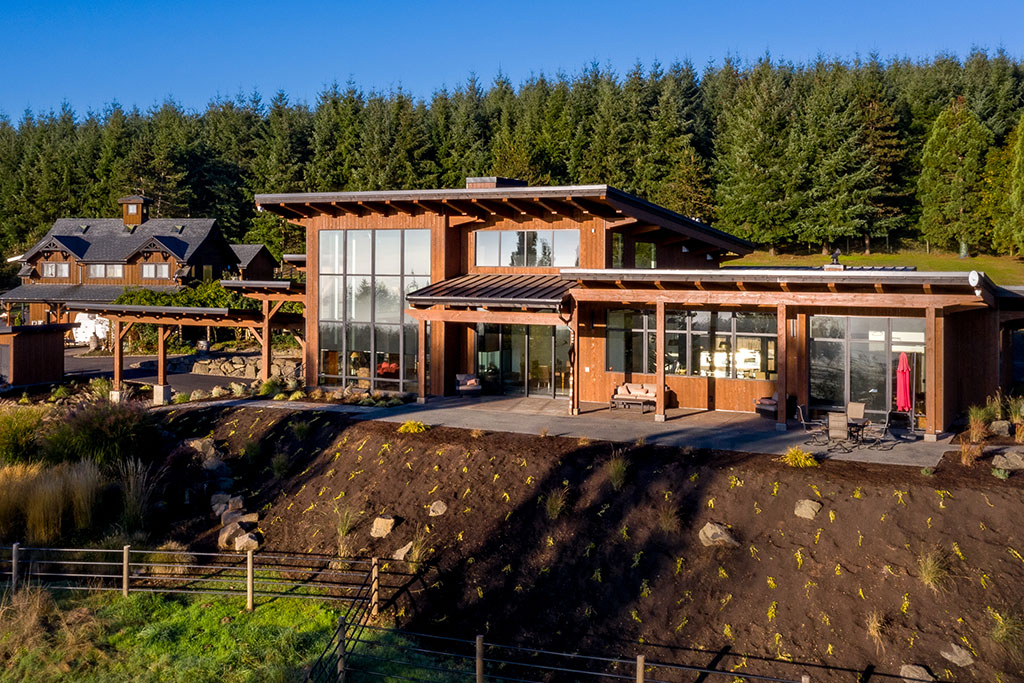
The DC Builders arm of this duo does design and construction work with an emphasis on creating high-end timber frame and post-and-beam structures, both for people and horses as well as for residential and commercial purposes. The company’s primary focus is on quality craftsmanship—one look at its hundreds of completed projects makes that quite evident—but it also prides itself on its innovation and passion for the trade. It’s the go-to of the pair if you want your home to be planned and built from the ground up. Its other service offerings include framing, installation, and general contracting.
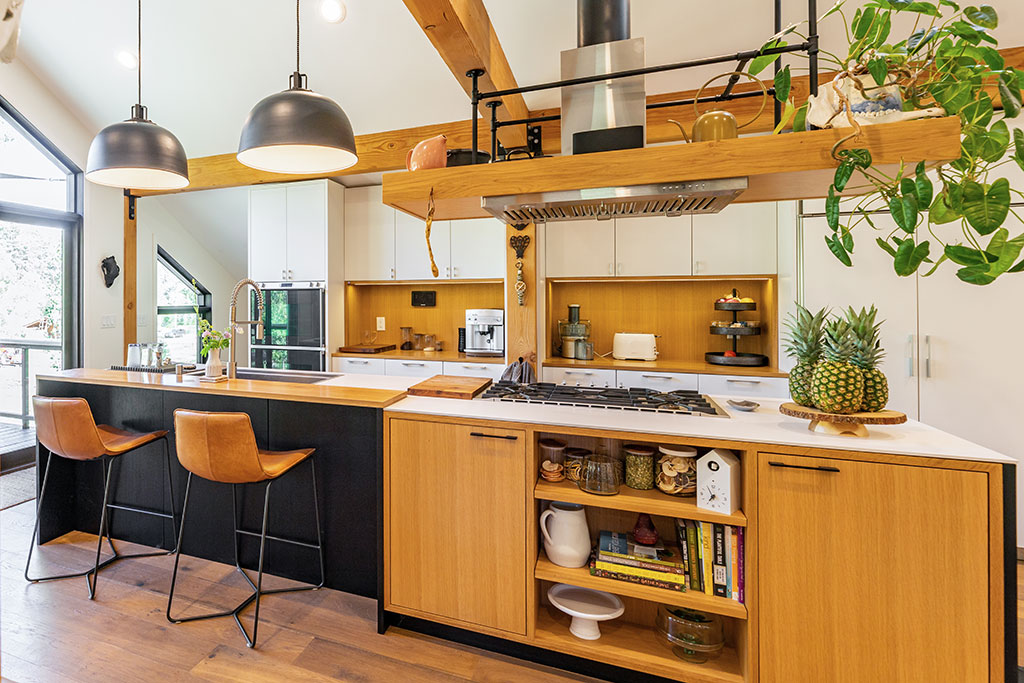
If you’d prefer to go with a predesigned building rather than starting from scratch, DC Structures has you covered. Its line of pre-engineered heavy timber packages offers customers a huge range of building models, from barns and cabins to homes and garages, making the choices feel virtually endless. After getting through that difficult but fun selection process, you can customize your kit any way you like; there’s even the option of bringing on DC Builders to do it for you. The materials, including windows and doors, are then procured and every piece of lumber for the project is precisely cut before being packed and shipped to your property for your general contractor or one in DC Structures’ own network to assemble.

As touched on earlier, the sheer array of projects completed by these companies is breathtaking—not only because of the quality, craftsmanship, and beauty but also because of just how much each one was fine-tuned to suit the client’s every whim.
As an example, consider a barn-style home DC Structures made for a client living in Durango, Colorado. Beginning with an open-concept building model, the company worked closely with the homeowner to reshape it with personalized touches and turn it into something uniquely dazzling. Some of the more notable changes included making post-and-beam design the focal point of the main floor, staining the siding, and adding a drive-through garage bay and a huge deck.

Then there’s the impressive equestrian-focused project in Carmel-by-the-Sea, California, where DC Builders constructed not one but four timber frame buildings for the residential community, including a riding arena that’s almost 13,000 square feet. And a few hours north in Bethel Island, California, lies a DC Structures–DC Builders masterpiece: the Delta Coves Community Center. For this project, the former provided six pre-engineered kits as the starting point and then the latter took care of the custom alterations and construction. The end result includes a jaw-dropping main building complete with a club room, gym, and open-air picnic pavilion.
Perhaps the best example of what can emerge when these two companies join forces, though, is the largest structure the DC team has built to date: a 36,290-square-foot totally customized, painstakingly detailed home and equestrian facility in Oregon City, Oregon. Among its unique features is the overall layout. The whole bottom floor is the equestrian facility and contains every imaginable need for horse owners, and the 5,000-square-foot-plus house sits atop it. The home even has a balcony that overlooks the riding arena.

The final piece of the DC puzzle is its focus on family, one of the duo’s core values. Many people on both teams have worked together for several years while also building lasting client relationships, creating strong bonds within and outside the companies’ shared walls in Damascus, a town just outside Portland. As the DC Builders website puts it, being part of the DC family means “cultivating meaningful relationships to create a deeper sense of purpose and community within our company.” Proving that “family” and “community” extend to the surrounding area, DC Builders also gives back to Portland by helping Habitat for Humanity build homes, partnering with the child-focused Maurice Lucas Foundation, and hosting an annual holiday toy drive.
What once started as a humble means to help others has, much like the majestic buildings they offer and create, become a symbol of quality and durability across the nation. In this way, DC Builders and DC Structures carry on a centuries-old craft that’s custom-made for life in the twenty-first century and beyond.
For more info, visit dcbuilding.com and dcstructures.com
From the legendary muscle cars of the 1960s to the family-friendly SUVs of the 2000s, automobiles have changed drastically over the decades. Today, we’re seeing another shift with the rise of environmental consciousness and sustainability. More and more consumers are considering switching from gas-powered to electric vehicles (EVs), weighing essential factors such as the wider effects on the planet, their expenses, and their lifestyle.

There are numerous reasons for the growing curiosity about electric cars. First, many buyers are looking for greener substitutes, and these types of vehicles produce zero tailpipe emissions—thus lowering their carbon footprint. That said, the production of EV batteries can involve the extraction of certain raw materials like lithium and nickel, which is thought to negatively affect the environment; in addition, there’s the challenge of disposing of such batteries. When you consider these factors and the fact that the energy used to manufacture and charge such vehicles depends on the energy sources in any given region, the electric vehicle choice may not seem as clear-cut.
Of course, gas vehicles’ impact on the planet, including relying on fossil fuels and increasing air pollution and greenhouse gas emissions, also begs serious questions about their viability. This factor alone can sway the average consumer to opt for an EV.

One of the most important benefits of electric autos is that they can be charged at home, which can be done overnight and usually costs less than refilling a gas-powered car. In addition, the increasing ubiquity of charging stations facilitates easier travel across great distances for owners of electric vehicles.
Still, there are some drawbacks. For example, even if current models have ranges of between 200 and 350 miles on a single charge, range anxiety—the stress of running out of battery power—remains a reality. In addition, as indicated earlier, it still takes longer to charge EVs compared to pulling up to a pump and refilling within minutes, which is especially crucial in areas where there are fewer fast-charging stations. In contrast, gas-powered options tend to be advantageous when it comes to fuel prevalence, thanks to our nation’s well-established, gas-station-centric infrastructure.

Electric vehicles have a lower center of gravity because of their battery placement, which, along with being heavier, helps to improve stability and lessen their rollover risk. Many of them also feature modern safety systems such as accident detection and autonomous braking. In addition, battery fires are somewhat rare, even though they have caught people’s attention, especially in relation to major accidents. (Also of note: some people report feeling motion sickness when traveling in an EV.)
Gas vehicles are generally considered passenger safe and offer many of the same safety features as EVs, such as airbags, stability control, and driver assistance systems. Unsurprisingly, though, considering the flammable fluids they contain, the risk of fuel fires is always a concern for people who own traditional vehicles.

Typically speaking, an electric vehicle’s starting cost is going to be higher, primarily because of the battery. Whereas the starting price of a new small gas-powered car could vary anywhere from around $20,000 to $30,000, an electric counterpart is usually between $30,000 and $40,000. And since EVs have fewer moving parts and are, on average, less expensive to maintain, the lifetime cost of gas and electric vehicles balances out somewhat.
Ultimately, which side you come down on in this ongoing dilemma largely depends on your individual priorities and lifestyle. Do your homework and stay informed about automotive trends, and you can make the best vehicle-buying decision for you and the planet.
During the dead of winter, there’s nothing quite like a hearty meal to bring extra warmth and comfort into your home. And these savory recipes from A Cookbook for Winter deliver on both counts by offering tasty takes on two beloved meals.
This version of the classic cheesy soup features tender, slow-braised onions, garlic, and thyme to amp up the flavor even more.
This robust and flavorful pie is packed with lentils and vegetables, making it the perfect option for a satisfying dinner.

Adapted from A Cookbook for Winter: More than 95 Nurturing & Comforting Recipes for the Colder Months. Published by Ryland Peters & Small.
Slowly braised onions are truly one of life’s pleasures, especially in this classic, comforting soup, with its topping of melted cheese.

Serves 4




This harvest pie is packed with canned lentils and vegetables and uses potato and leek soup to bring everything together for a hearty and savoury supper. If you were short on time, you can mix the filling directly in the pastry case and just top with a pastry lid, then into the oven for a quicker fix.

Serves 4


Art has the awesome power to inspire and touch our emotions, but there is something especially profound about an original piece. With such a vast pool of amazing works to choose from, selecting just one to start your collection with can be a daunting and expensive experience. If you’re looking to add a high-end and unique composition to your home, utilize this guide to streamline the process and help you choose something that can enhance your life for years to come.

A critical first step in buying art is getting to know what speaks to you most. For example, if you enjoy the serenity of impressionistic nature scenes, a painting reminiscent of Claude Monet’s The Water-Lily Pond might be a good choice. Meanwhile, an abstract creation similar to Jackson Pollock’s colorful Convergence may be more fitting if you’re looking for something more modern. Also factor in your preferred medium, whether you’d want a painting, photographic print, sculpture, or another art form. To get a feel for what you might like, consider browsing galleries and museums or peruse online platforms like Pinterest, Instagram, and Etsy to discover up-and-coming artists and browse their portfolios.
Think about where the art will live in your home, taking into account the room’s style and color and whether you want the work to complement those factors or contrast them for a more vibrant look. Just as importantly, measure the space where you intend to display your new acquisition to ensure that it will fit perfectly; this will help you avoid the common mistake of choosing one that’s too small, which may cause it to be dwarfed by empty space. As a general guideline, any artwork mounted on a wall should cover about 60 to 75 percent of it, excluding areas obscured by furniture or moldings. An alternative is to combine it with other pieces to create a gallery wall that fits an equivalent amount of space.

Given that original art can vary widely in cost, it’s essential to set a budget before you shop. Having one can help you identify the best places for you to search for art within your price range—such as at a high-end gallery or an art school showing.
What you can expect to pay will depend on factors like the artist’s celebrity, the medium, and how in demand or rare their work is. For help finding fine art that fits both your budget and aesthetics, consider hiring an art consultant or interior designer to select and price pieces for you. Another option is to shop at an online retailer like Artfinder, where you can find abstract paintings, sculptures, and collages signed by artists for anywhere from about $90 to tens of thousands of dollars. Works at art fairs tend to have a smaller range: from around $100 to a couple thousand dollars. Vintage or preowned works, which you may find at secondhand shops, are another affordable consideration.
No matter what you decide to spend, though, aim to buy art that brings you happiness rather than trying to identify something that may make a profit since it could take years, or even generations, to increase in value—so focus on the impact it can have on you right now in your home.

As with any other important purchase, be sure to do your due diligence. If possible, view any piece you’re contemplating in person before buying it to fully gauge its craftsmanship and personal impact. It’s also wise to research its artist and seller to ensure their credibility; always ask for a signed certificate of authenticity (COA) to verify the artwork’s origin and pertinent history, including previous ownership.
Selecting and purchasing art for your home can be a complicated and long journey, but if you’ve carefully done your research, it will bring joy and beauty to your space for years to come.