Nestled in the secluded, red-tinted rock country of Utah sits a luxe resort like no other in the world. Amangiri’s concrete walls of contemporary structures stand cradled amid jagged canyons, offering a total escape from life’s stressors. By day, the landscape lends opportunities for both serenity and adrenaline-fueled adventure. And at night, fireside patios alight the peaceful desert sands below fields of stars.
Retreating to this awe-inspiring locale will yield a vacation you may never want to return from. Each moment of your stay, the resort will challenge you to weigh alluring options: luxuriate in your accommodations or gather your hiking gear to trek across the sunbaked sands. However you choose to enjoy yourself, a stint at Amangiri is sure to reset your mind, body, and soul.
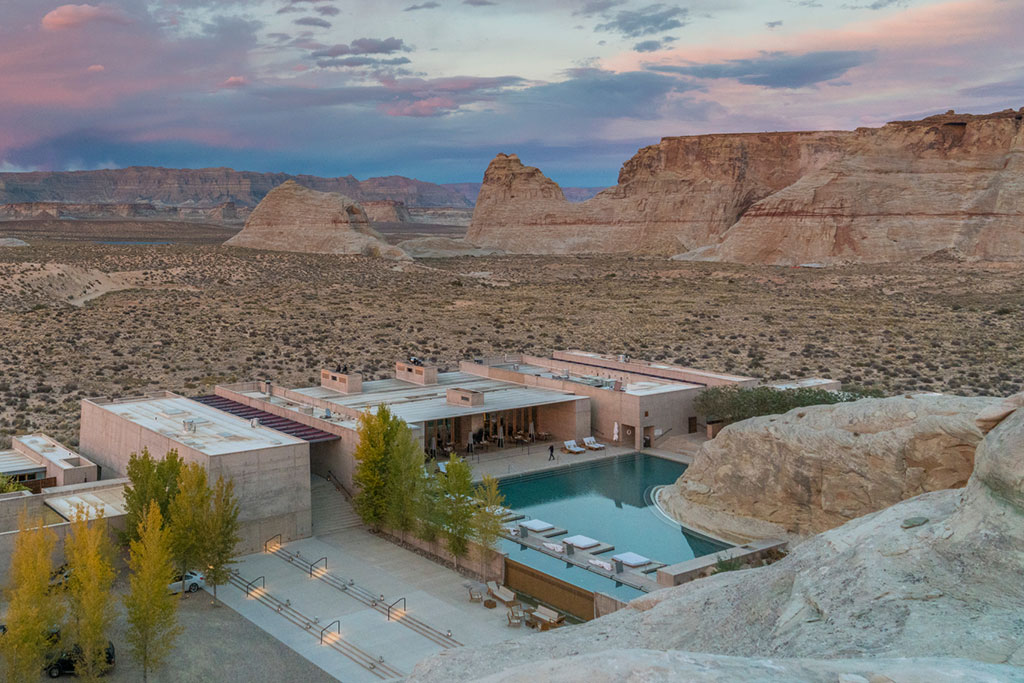
Amangiri’s location in remote Canyon Point, Utah, makes it the perfect place to truly get away. It sits approximately twenty-five minutes north of the town of Page, Arizona, where visitors may find the nearest airport, and is a relatively short drive from Bryce Canyon National Park and Zion National Park, two unique sites for witnessing the breathtaking rock formations of the American Southwest. Meanwhile, the nearby Navajo and Hopi reservations entice visitors with fascinating cultural experiences and hypnotizing scenery like the red sandstone of Antelope Canyon.
Not that you need to go far from the resort to experience stunning views. It offers a master class in fine architecture, featuring clean-lined structures that blend seamlessly with the surrounding sands. Inside these minimalist dwellings are heavenly interiors that are sure to make you feel right at home: their white stone floors, neutral decor, and natural timber accents will swathe you in peace and elegance.

The resort’s accommodations include a small handful of luxurious suites, each of which has been meticulously designed to harmonize with the resort’s natural surroundings while being perfectly balanced with modern comforts. Some of the various options include:
Each stay provides more than just a place to lay your head. Reservations also include delicious meals for two at Amangiri’s on-site restaurant, which rotates seasonal menus of American Southwest cuisine. Additionally, you can enjoy free in-room refreshments and independent access to the many trails that weave throughout the resort grounds.
Though travelers in search of peace and repose can certainly find satisfaction whiling away the days in the comforts of their suites, don’t miss the opportunity to attend one of Amangiri’s many famous wellness sessions, each of which promises ultimate renewal.
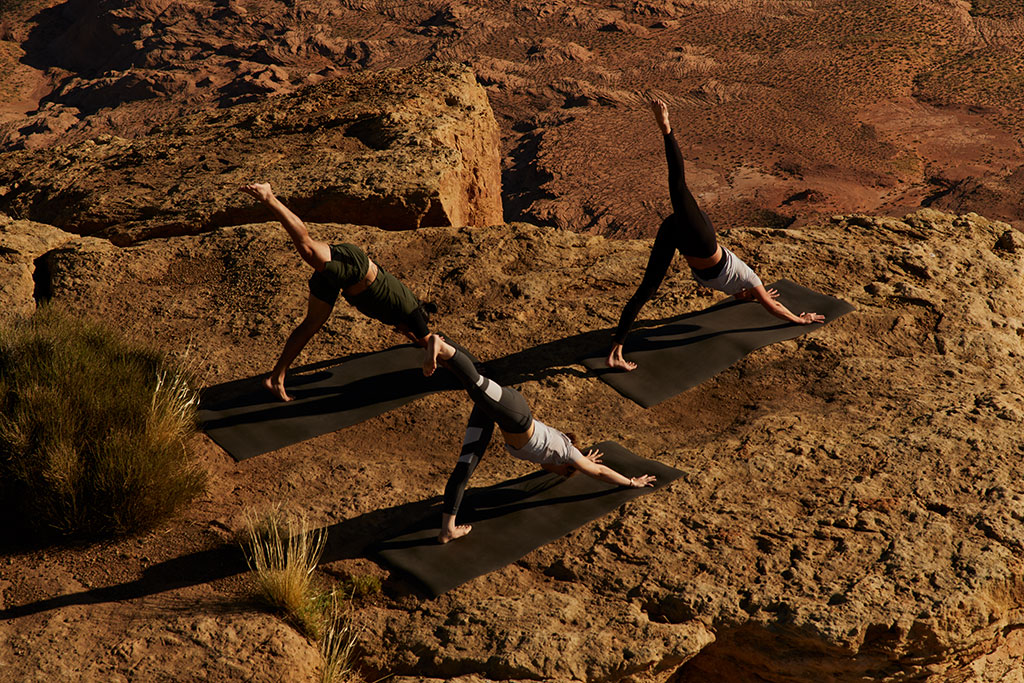
If you’re eager for a true reset, grab some water and a complimentary towel and head for the unique self-care experience of your choosing. “Amangiri has always focused on creating a serene setting for relaxation and rejuvenation, with the Aman Spa at Amangiri becoming a destination in its own right,” the resort website states. “Our holistic and integrative wellness experiences draw on the natural elements of earth, wind, fire, and water.” While such an emphasis may seem geared toward the spiritual voyager, anyone can benefit from these treatments that alternatively challenge and recenter the body.
Yoga on the Rocks sessions, for example, offer a one-of-a-kind take on the ancient practice. After taking a scenic hike up to the pinnacle of a desert mesa, you’ll stretch and breathe as you enjoy 360-degree views of the Grand Staircase-Escalante National Monument. The on-site fitness and yoga specialist leads each personalized movement session “using the visual reference of the horizon for deeper balance and grounding,” says the resort website.
Meanwhile, fire and water elements converge in Thermal Therapy. Amangiri’s expert practitioners welcome you to join their sauna, steam room, and cold-plunge activities, which both aid in physical recovery and promote mental clarity.
If these sessions don’t tempt you, maybe you’d prefer one of the multitude of other options, including Ai Chi hydrotherapy or a soothing aqua Shiatsu massage, both available for those in suites with a private pool.

“The wide-open horizon and remote silence found in the heart of Amangiri’s desert landscape encourage a relaxed pace,” says the resort website of its many “grounding practices.” Among its top options are group mindfulness walks that invite visitors to stimulate their senses outdoors, Intentional Silent Time to help them detoxify from the overstimulation of the modern world, and Dark Exposure Sessions—meditative breathing exercises in a lightproof space that foster balance and harmony. In addition, you can experience special ASMR Wellness Sessions, during which you’ll meditate among soothing sensory effects such as harmonious chimes, gentle speech, and serene lighting, triggering feelings of immense stress relief and connection with your inmost self.

Whether you’re in search of an escape from busy urban life, an active retreat in a picturesque environment, or simply a unique vacation unlike any other, Amangiri guarantees a moving experience you won’t forget. Even in the upcoming fall months, temperatures can remain warm so you can, as the website states, “enjoy the hotel’s high-adrenaline outdoor adventures . . . ranging from via ferrata [rock climbing] hikes and horseback riding to touring the stunning slot canyons.” Various wellness options also await at its sister property, Camp Sarika, located just a mile up the road.
No matter when you visit, your time at Amangiri is sure to not just reset you but leave you with a lasting impact on your mind, body, and soul, a transformation only a select few may have the luxury to experience.
For more info, visit aman.com/resorts/amangiri
At first glance, reconciling sustainability and the affluent lifestyle, specifically as it relates to the purchase of high-end properties, may seem challenging. According to a recent Pew survey, 75 percent of all consumers are concerned about helping the environment as they go about their daily lives; however, only 20 percent admit to actually making an effort to protect the planet.

Luxury homes are discretionary, and what one consumer deems a luxury, others take for granted as an essential in their daily lives. Indulgence, by definition, is something you enjoy that may result in a negative consequence—which, in the world of luxury real estate, has historically included a lack of sustainability.
Fortunately, there have been significant changes over the last two decades to create opportunities that embrace sustainability without sacrificing the conveniences and benefits that luxury homes provide.
By nature, luxury real estate has always incorporated advances in comfort and convenience, dating back to such innovations as electric lights and indoor plumbing. Historically, these homes have also incorporated the newest advances in construction, and it is still true today as technological improvements continue to evolve in home building.
This is important because building and construction account for 38 percent of global carbon emissions—which is estimated to generate six hundred tons of waste each year, based on data from the United Nations. So how do we support sustainability while continuing the quest to lead a comfortably luxurious life?

Fortunately, there are many in the real estate industry now leading this charge. From the selection of building materials to the decision of where new properties are built, developers and home builders are stepping up. And many luxury homeowners are making an effort to reduce their daily carbon footprint and consumption of natural resources and energy.
This global phenomenon is very prevalent in the European Union, which was quick to incorporate advances in technology for heating and cooling homes, due in part to higher electric costs. The United States has caught up with new regulations for high-efficiency heating and cooling systems and LED lighting; there has also been an increased adoption of solar panels to supplement what luxury homes demand from the energy grid.
New homes are required to incorporate water-efficient appliances and plumbing fixtures. And due to innovations in the stylish design, operation, and comfort available with new plumbing fixtures and appliances, it makes sense to retrofit your home and begin a more sustainable lifestyle even if you live in an older or historically significant property (as allowable with the latter).

Vast gardens and lush lawns are a frequent mainstay of luxury properties and have been the subject of considerable research. We now have a better understanding of the wide variety of drought-tolerant flowering plants and shrubs available for beautiful landscaping that allow for a reduced reliance on water. These enhancements are not only for homes in areas prone to water shortages; we also have a new awareness of grasses and plants that are resistant to growth deterrents and don’t require repeated applications of chemicals to produce picture-perfect outdoor living.
Lastly, there is a wonderful trend toward repurposing and reusing all things luxury—and while the traditional use of antiques is no longer as popular, there is growing interest in vintage and midcentury furniture and decor. The number of estate-quality pieces that can be found in consignment stores and through online purveyors continues to increase, providing an opportunity to acquire one-of-a-kind case goods, unique pieces of furniture, and even vintage barware. Repurposing, consigning, or donating items that we no longer need is another approach to remaining eco-conscious.
These are just some of the ways those seeking a luxury lifestyle can do so without sacrificing sustainability.
Kirsten Blazek discusses her unconventional road to success and her design philosophies, which are featured in her first book, A 1000 X Better: A Rebel by Design.

Tell us about yourself:
There has always been something creative in me: I was good at art and loved rearranging my bedroom while growing up in Scotland. My parents worried that art wouldn’t be a stable living, though, so I followed my gran and mom into health care. I was an ICU nurse for a long time in Scotland and then here in America before having my kids.
Years later, I was getting a divorce and needed to go back to work. I began looking for jobs in nursing again, but I just couldn’t go back. Instead, I started my business in my late thirties without having a clue where it would take me. It’s been a pretty crazy journey.

What was your first design project?
Technically, my own home in Altadena. Another mom from school loved what I did and insisted that I help a friend of hers in Malibu. I told her it was ridiculous because I had never decorated someone else’s house before. Her reply? “Don’t worry about it. You’ve either got it or you don’t—and you’ve got it.” It wasn’t a big job; I did it for practically no money to get my portfolio started. After that, I staged a house for a real estate friend, which led me to originally found A 1000 X Better as a staging company.
What is the purpose behind your book?
My partner, Jake, is an amazing writer. He and I looked at a lot of coffee-table books and design books, many of which felt impersonal. It was important to both of us that we created something inspirational, helping people realize that it’s never too late to take a risk, follow your gut, and do something different by telling the story of a woman who wouldn’t take no for an answer.

In it, you say that you “listen to what a house wants.” How so?
People get overwhelmed because there are so many design resources available today; they’re inundated with imagery on Instagram and Pinterest that’s not necessarily right for them or their house. So we always ask new clients to share examples of things they like, and quite often they’re all over the place. Getting them to understand what they like for their home can be challenging.
That’s why I listen to houses. I really believe that they are living, breathing entities, especially old ones. If you ignore the home’s essence when decorating or designing, the project can get very unfocused and feel inauthentic. There must be a balance between meeting the needs of modern living and being respectful of the structure.
One chapter is titled “Color Is Everything.” Do you consider yourself to be an artist?
I like that analogy. Starting a design is like starting a painting for me. Much like a painter with a blank canvas, I instinctually get a sense of what I can do and how the space can work. And because colors are so nuanced, they can go so right or so wrong with just one shade. When I look at a color, I see not only the hue itself but also all the other ones within it, such as a brown that has too much green or purple in it.
You include interesting details in your projects. How do you make such choices?
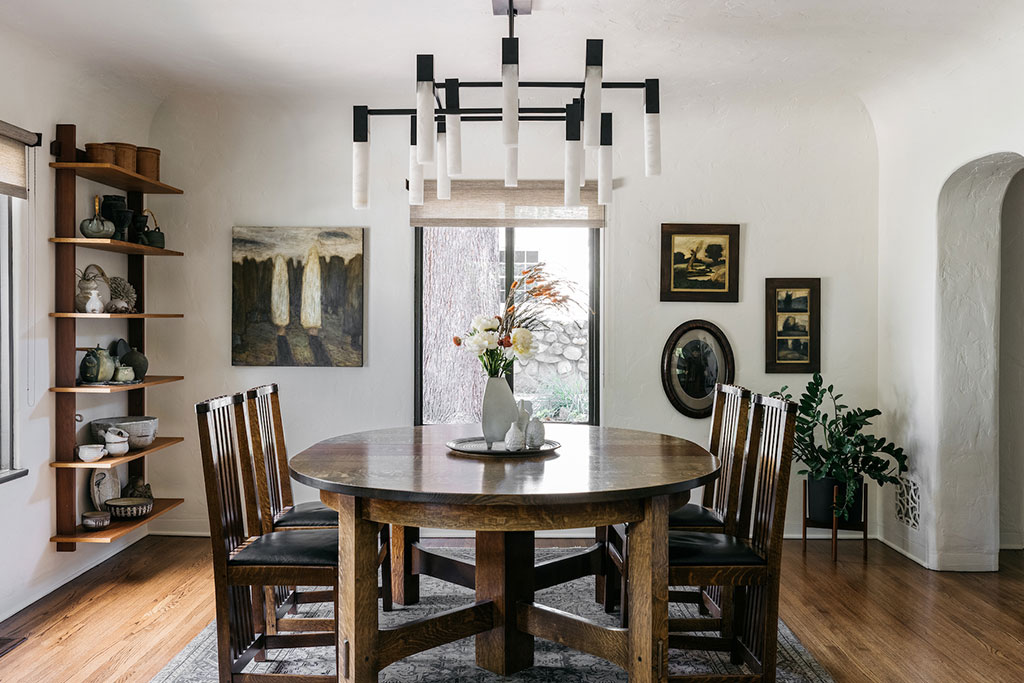
It all requires balance. For instance, I prefer to keep bigger pieces of furniture somewhat neutral but mix the materials, which adds depth. I also enjoy doing unconventional things like hanging art in unusual places, such as under windows, while still ensuring that it pairs well with the rest of the room. The goal is to create visual excitement when you walk in.
Lighting is another of my favorite things to play with; it makes such a difference in a space. One project I did had a room with a big, tall ceiling and a nice view outside the door. I wanted to make the ceiling more interesting but didn’t want to block the view with a solid fixture. So I went with an architecturally quirky hat-shaped wire light fixture that wouldn’t prevent the eye from seeing the beautiful outside.

Your book states that you went into nursing because you enjoy talking to and helping people. Is this mindset invaluable as a designer?
Absolutely. Nursing taught me to have empathy, be kind, and listen. Likewise, as a designer, I genuinely listen to my clients; I can’t just give them what I want because it’s not my house. Ultimately, I want them to feel like the design is faithful to them, so at the outset my team and I discuss in-depth what they want from the project both aesthetically and functionally.
In addition, I learned a lot about relationships through nursing, which is very helpful to me now because you quite often have to negotiate difficult situations between couples who have different tastes.

You wrote that “constantly looking at yourself and finding new things about who you are is one of the great joys in life.” How do you do this?
Traveling is one of the most important ways to expand my mind. Today, for example, I went to the Art Institute of Chicago and took in incredible art. It’s easy to walk through life just looking straight ahead, but when you really keep your eyes open and pay attention to the fine details, even the simplest, most inconspicuous thing can be inspirational. I always do my best to take nothing for granted.
I’m also constantly changing personally, as we all are—change is the only thing we can’t avoid. I’m a much more experienced designer now than when I started, and my tastes have altered even over the last few years. Right now, I’m in a massive seventies kick, but in two years it could be something completely different. That’s what makes life exciting.
For more info, visit a1000xbetter.com
In the world of real estate investment, location is everything. Proximity to amenities, schools, and job centers often dictates the desirability and value of a property. But what about the presence of a sports stadium? For real estate investors, being near a major sporting venue can be a golden ticket—but, in some cases, also a risky gamble.
Proponents of investing near stadiums often highlight advantages backed by real-world statistics. First and foremost is the potential for substantial rental income, especially on game days. Rental properties near stadiums are in high demand as fans flock to the area for pregame festivities and postgame celebrations. According to a report by the National Bureau of Economic Research, properties within a mile of an NFL stadium can see rents increase by as much as 9 percent.

Furthermore, a sports stadium can act as a magnet for commercial development in the surrounding area. As teams and fans provide a steady stream of foot traffic, local businesses, restaurants, bars, and entertainment venues are more likely to flourish. A study published in the Journal of Sports Economics found that housing values near sports stadiums increased by 4.7 percent in the United States.
These statistics are not just exclusive to US cities. For instance, the impressive Tottenham Hotspur Stadium in London has sparked a surge in real estate development. The surrounding area, previously less glamorous, has transformed into a hub for real estate investment. According to property experts, the values of homes within a one-mile radius of the stadium have witnessed a substantial increase, making the locale a lucrative prospect for real estate investors.
Moreover, cities and municipalities often invest in infrastructure improvements around sports stadiums, including better public transportation, upgraded roads, and enhanced security. A survey by the International Association of Venue Managers showed that 82 percent of stadium owners reported contributing to infrastructure and development projects around their venues. These improvements can enhance the overall livability of an area, making it more appealing to both residents and investors alike. Well-planned developments can lead to an increase in real estate demand and, consequently, prices.

However, there’s another side to this story, and it’s not all grand slams for real estate investors near stadiums. One of the most significant challenges is the inconsistency of rental income. You may see rents drop in the offseason if your property is being used by sports fans. And while game days can be highly profitable, they also come with their share of headaches. Parking shortages, increased noise, and potential property damage from revelers are some of the issues you may face. Game days are not for the faint of heart when it comes to managing your property.
Moreover, the cyclical nature of professional sports can’t be ignored. Team performance and economic conditions can influence fan attendance, directly impacting the demand for nearby properties. The same report by the National Bureau of Economic Research found that winning an additional game during the regular season corresponded to a 0.14 percent increase in housing values within a mile of the stadium. Conversely, a losing season can lead to a drop in local property values.
Additionally, the shift toward remote work and the adoption of flexible office arrangements have impacted traditional workspaces. The pandemic demonstrated that many businesses can operate effectively with remote workforces. As a result, commercial real estate around stadiums, which may have once been in high demand for traditional office spaces, is facing new challenges. Investors must consider this when evaluating the long-term prospects of properties in such areas.

Investing in real estate near sports stadiums is generally a good move but can be a double-edged sword. It offers the potential for high rental income, increased property values, and a bustling local economy, but it also comes with challenges like inconsistent rental income, property management complexities, vulnerability to sports team performance, and evolving dynamics in the commercial real estate sector due to remote work trends.
Real estate investors should approach such opportunities with a keen understanding of local market dynamics and the financial strength of the sports team as well as a tolerance for potential ups and downs. Like any real estate investment, thorough research, a solid business plan, risk mitigation strategies, and the guidance of a qualified real estate professional are essential when considering a stake in the property game near sports stadiums.