James Bollig & Hometown Living are thrilled to share this complimentary lifestyle magazine with you today. James created Hometown Living to celebrate the people, places, and experiences that make communities special. Our website brings together hometown photos, lifestyle articles, favorite recipes, local stories, homes for sale, community resources, and trusted local business partners—all in one place. Click on my profile picture for a link to HometownLiving.org for more exciting and helpful information. Enjoy our Hometown Living video below as well.
These peak days of autumn are perhaps the most inspiring. The air has chilled, leaves have turned breathtaking colors, and holidays like Halloween are fast approaching. Let this month’s issue of Good to Be Home magazine motivate you to make the most of this exciting season. From inspiring architectural styles and thought-provoking artwork to delicious recipes and helpful kitchen goods, this issue is sure to help you greet the season with suitable glee.
First, step inside a home redesign project spearheaded by Melanie Giordano of BarnesVanze Architects. When faced with a deteriorating and outdated Georgetown home, Giordano took the reins and brought it into the modern era—while still preserving its historic elements. See how this redesign inspires your own home updates.
One of the most important improvements you can make is in your kitchen. The next article in this issue shares some of the best hosting products out there, including premium cooking devices that help you make the most of seasonal flavors and themed goods that help you bring the fall ambience indoors.
Then get a taste of one of the most crucial elements of October: delicious seasonal foods. This pair of recipes from The Phone Eats First cookbook, including Pumpkin Pie Chia Pudding and Caramel Apple Bark, can prepare you to host a spook-tacular Halloween soiree as well as casual autumn gatherings.
Finally, tour the creative mind of the artist Melissa Helene. This scratchboard artist takes a childhood craft and elevates it to a fine-art level of technique and impact. In the final article of this issue, learn about the natural imagery that inspires her, how she pulls off these impressive pieces, and where you can find her work.
Hopefully, these pieces inspire you to make the most of your home this season, from how it looks to how you enjoy time in it. As always, it’s a pleasure to send you this magazine.
Melanie Giordano, a principal with award-winning BarnesVanze Architects, discusses how she transformed an outdated and dilapidated Maryland lake house into a stunning summer retreat.
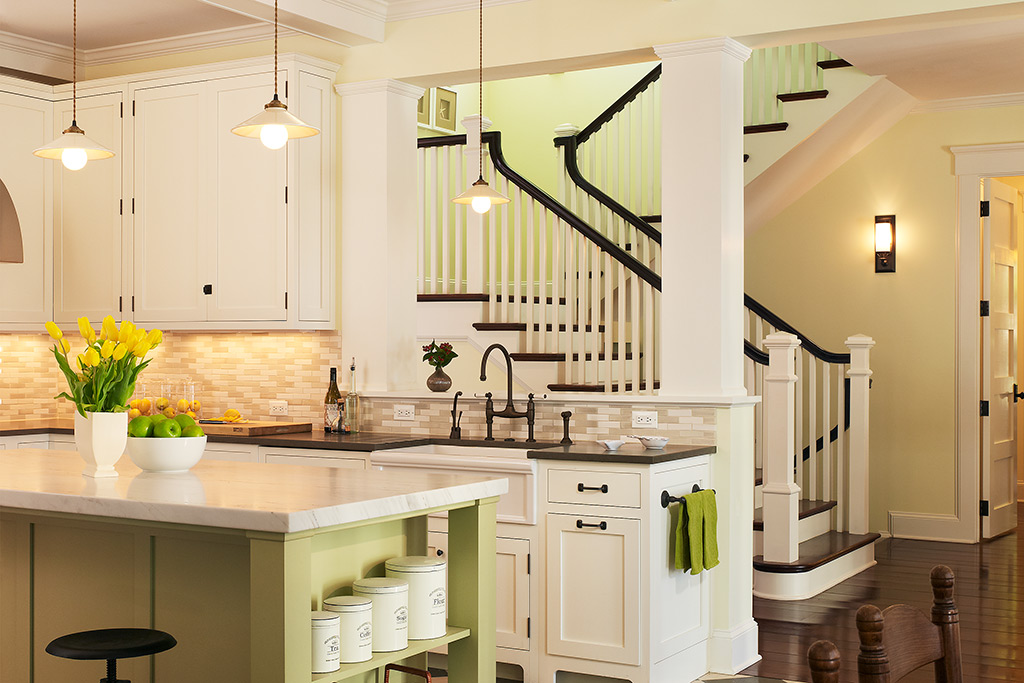
Tell us about your role at BarnesVanze:
I have been working here since 1991 and am one of six principals at the office. We’re located in the Washington, DC neighborhood of Georgetown, and we have about two dozen architects. We are a full-service firm that does most of our work in the DC metropolitan area but has projects all over the country. We primarily do residential work, including a lot of historic renovations.
This home is located on Gibson Island. Would you tell us more about the area?
It’s a private island on the western shore of the Chesapeake Bay near Annapolis. There are about two hundred homes there, and it’s absolutely beautiful. You’ll find a lot of older houses, many of which, like this one, have been renovated or rebuilt, as well as a lot of new construction.
How much of it did you renovate? Was it basically a gut job?
These clients already had a smaller home on the island that they renovated, but it wasn’t a waterfront property. When this house went on the market, they fell in love with it because of its wooded setting by the island’s lake. We initially thought that we’d just renovate the house, but that wasn’t feasible because of its condition. So, we decided to keep the foundation and rebuild the upper structures, designing a home that would fit within the footprint of the original while adding a new garage wing on the side with two guest bedrooms above it.
Perhaps most importantly, the original layout didn’t take advantage of the views. It didn’t have enough windows, and it didn’t open up to the water. We really focused on that with the new plan.
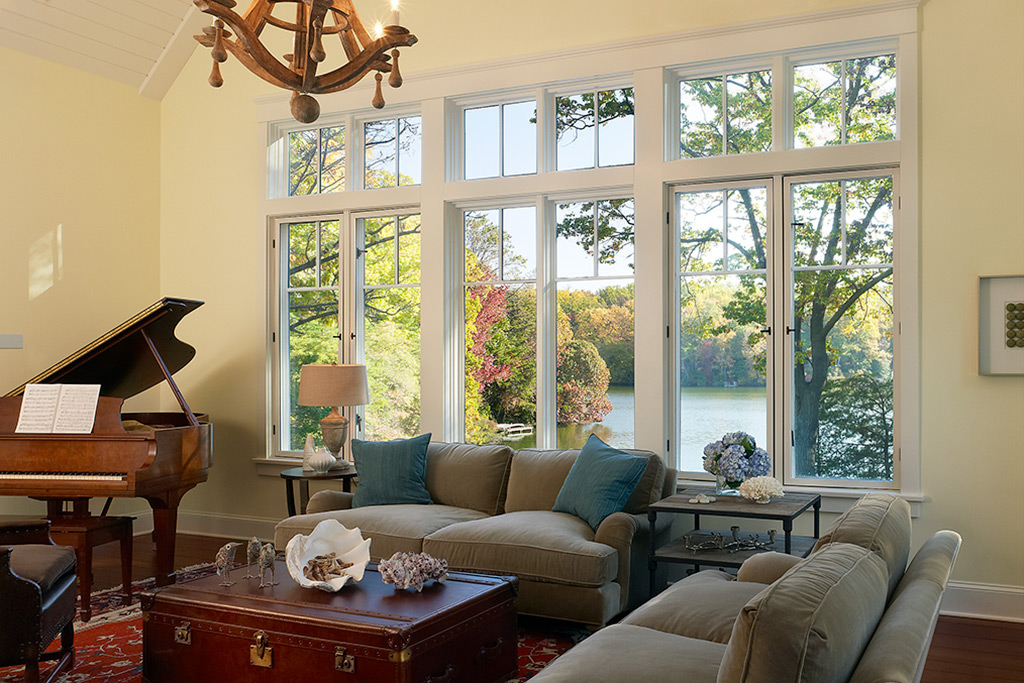
Do all the rooms in the house end up having a water view or only certain ones?
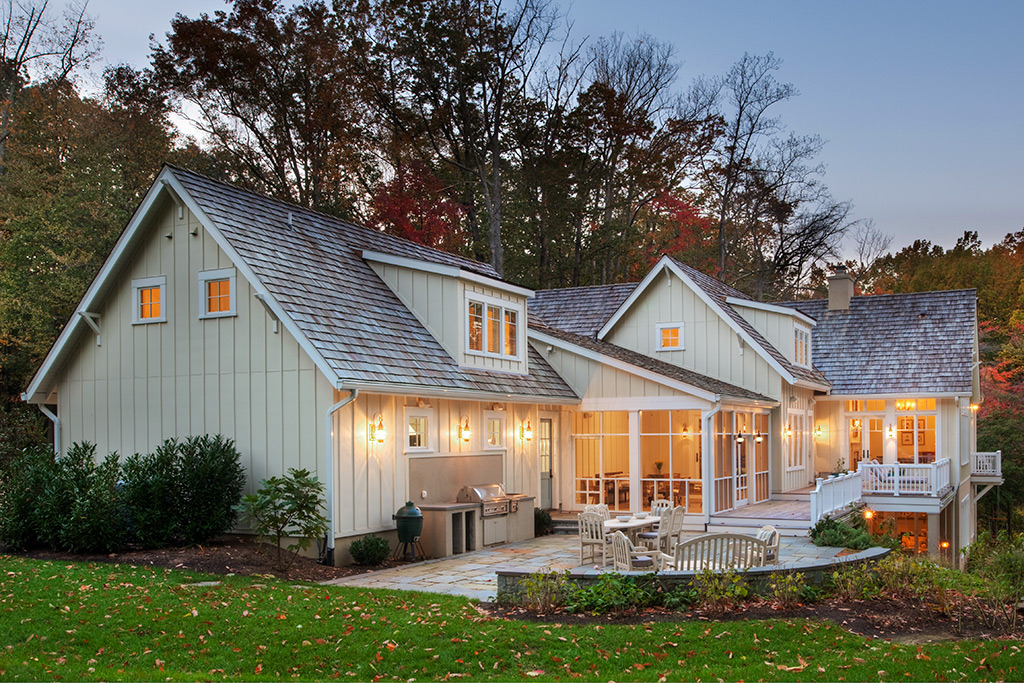
The living room and kitchen are in the back of the house, offering views of the lake and opening to a large deck and screened porch, creating an indoor/outdoor transition. There’s also a walkout basement with an exit to the back, as well as a path from the backyard to the lakefront. So they now have that transition from the upper level to the lower level and then to the water. In contrast, the dining room faces the beautiful, wooded area at the front of the property, but it’s primarily used at night, so that quieter setting works.
We also constructed low walls throughout the home to separate the rooms and maintain a sense of informality and openness while also keeping the sightlines of the water. For example, the walls allow both the kitchen and one side of the dining room to open to the hallway on the interior yet also let people see through the house.
The living room has large windows and abundant light. Would you discuss your thought process for that space?
The whole room was designed around its tremendous view and fireplace, with the goal of it being more than just a living room. We wanted it to be a space you don’t just go to but where you want to spend all your time. The high ceiling was also a priority in designing this space because it gives you a sense of drama, especially considering the scenery. All in all, its abundant light is perfect for the setting, giving off a great room feel.
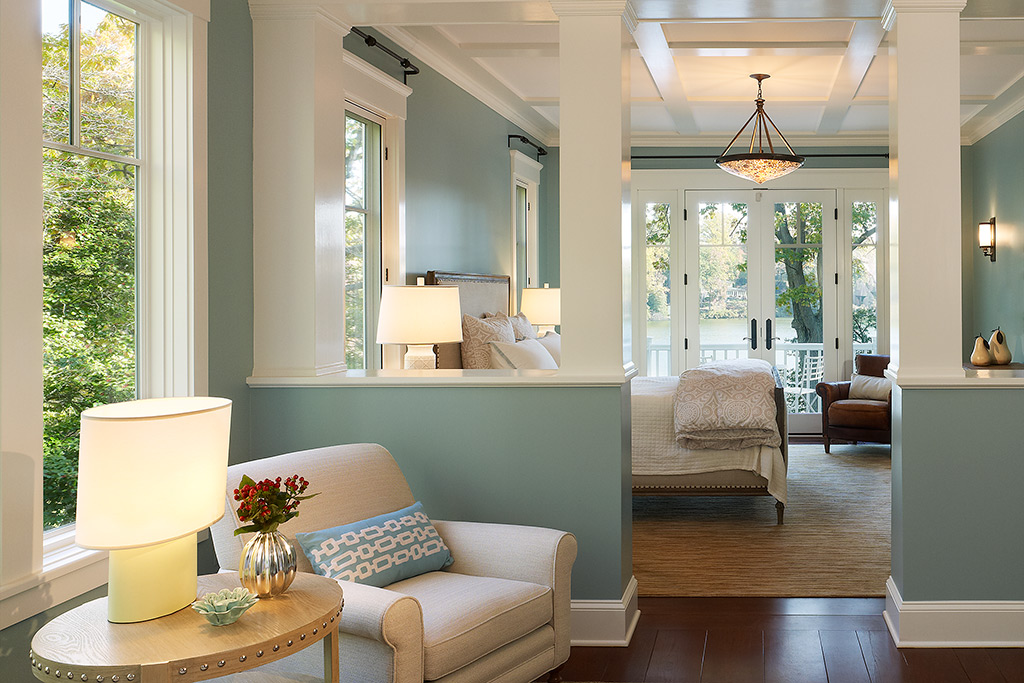
There’s also a luxurious main-floor bedroom. Is that the master? Does it have two sections?
It’s basically two adjacent rooms: a sitting room/bedroom on one side and the bathroom on the other side, but it feels like one room because of the open, low walls. That layout allows the sitting room, which is more toward the middle, to get views and more light.
This is probably the nicest space in the home because it has views on two sides: one of the lake and one of the trees. Also, being on the first floor makes it very livable as an aging-in-place house down the road.
The kitchen is quite impressive. Is it the central hub of the home?
Definitely. The wife is an avid cook and wanted top-of-the-line appliances, so we created a very functional kitchen. It has two sinks, pantry storage, custom-made cabinets, a huge island with additional refrigeration in its drawers, and both an induction oven and a regular gas range.
In addition, the windowed corner, where the breakfast table is, provides views of the outside and opens to the deck, where there’s an outdoor kitchen. On top of it all, she chose a great color, an apple green, and the backsplash and checkerboard floor both feature beautiful stone.
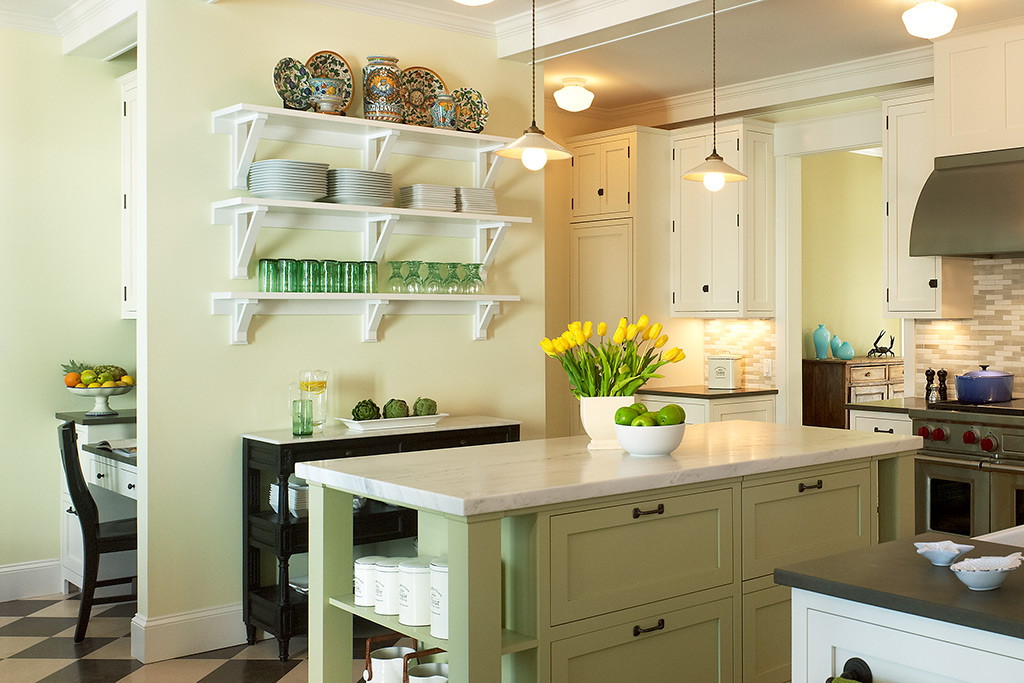
How did you make the ceilings stand out throughout the house?
A ceiling is an opportunity to define a room; that level of detail is especially common in cottages like this. So we were thoughtful about how the ceilings were designed. For instance, those above the kitchen and dining room have beams and the master bedroom has a simpler, paneled ceiling.
Earlier, you mentioned the front of the house, which has a comforting country vibe. What informed your choices for this area?
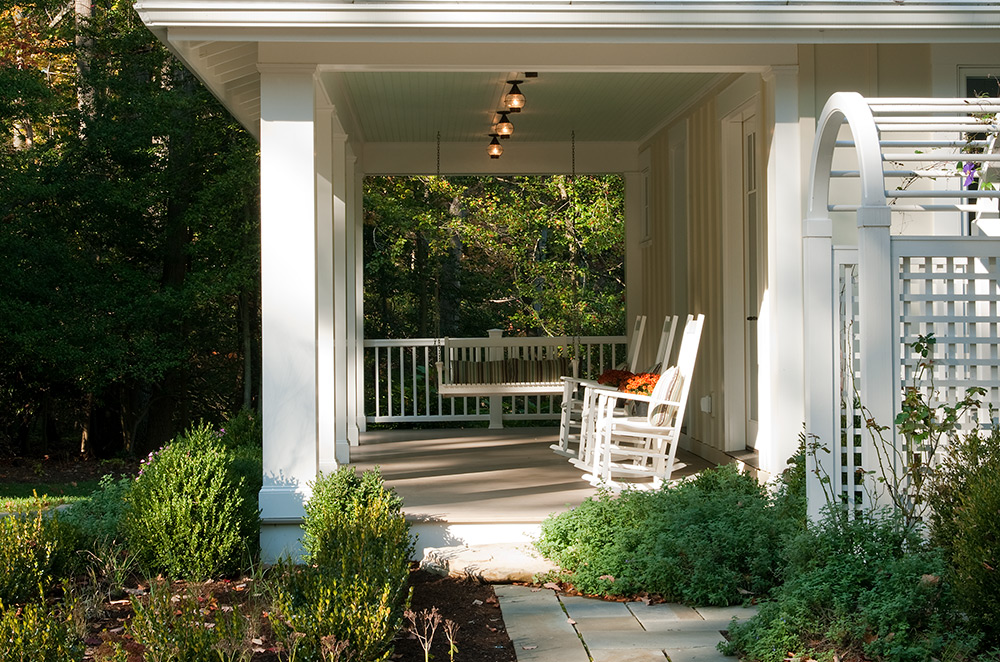
The home sits on a deep, tree-filled, two-and-a-half-acre lot with a long driveway, so the idea was to create a front porch that clearly welcomes guests. It’s very peaceful, a place where you can sit on rocking chairs and look at a woodsy landscape. It also has a small courtyard, which probably gets the most use of anything on that side. Overall, the space is charming while adding nice scale to bring this big house down and make it feel friendlier and comfortable.
Was durability a primary consideration when choosing the exterior materials?
That’s a good question. From an aesthetic point of view, we like the look of board and batten for this cottage style. It is also more durable because instead of wooden boards, we use cement board. As a result, it’s lower maintenance.
Your website says that BarnesVanze emphasizes beauty and authenticity. How do you believe this home epitomizes that?
Definitely. The house’s style is authentic, especially how it fits into and connects with the landscape. I think the project was very successful in that way. And by keeping the spaces informal with less wall space, we created a sense of openness that lets beauty permeate throughout the home.
For more info, visit barnesvanze.com
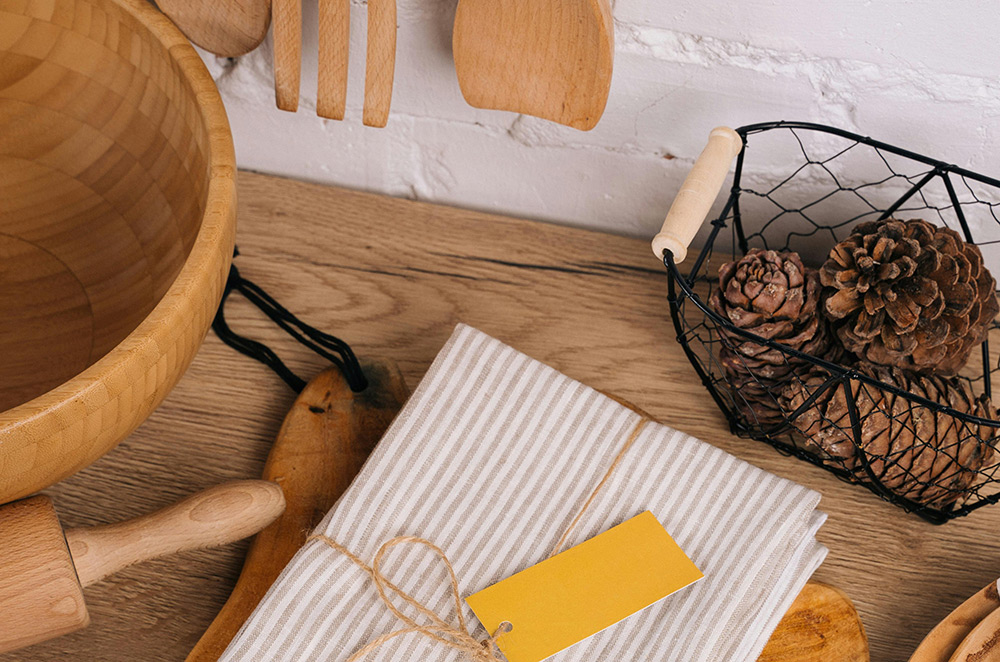
From the scent of a pumpkin pie baking in your oven to the sound of Brussels sprouts searing in a hot pan, this season’s eats are as indulgent as they are rewarding to craft at home–that is, if you have the right supplies in your kitchen. Take a look at ten fun and functional products that reduce stress and eliminate mess while also looking great on your countertop.
Swap typical steel for options with a warm metallic finish. These cups and spoons will resist warping better than plastic while adding a layer of visual warmth and luxury when displayed on open shelves.
Use this simple, functional tool to effortlessly work cookie, pie, and biscuit dough, simplifying your fall baking. Look for a model with a weighty copper build for a chic accessory.
Add fresh zest to your fall cooking, including lemons for baking and nutmeg for warm drinks. Take home a slim option with a long, comfortable handle to make the task feel effortless and precise.
Turn to this functional tool to easily purée butternut squash soup right in the pot. Opt for a stylish version like a control-grip model with a wooden handle or sleek stainless-steel finish for added counter appeal.
Upgrade your kitchen with an essential tool for slow-simmering stews and braising meats. Choose one in a deep autumn color like burnt orange or forest green for an excellent stovetop or table presentation.
If you haven’t used one of these products, you’re about to discover a new kitchen essential. A stylish terra-cotta vessel with ventilation holes can help keep garlic fresh, while a design in a neutral, earthy color will add rustic warmth to your countertops.
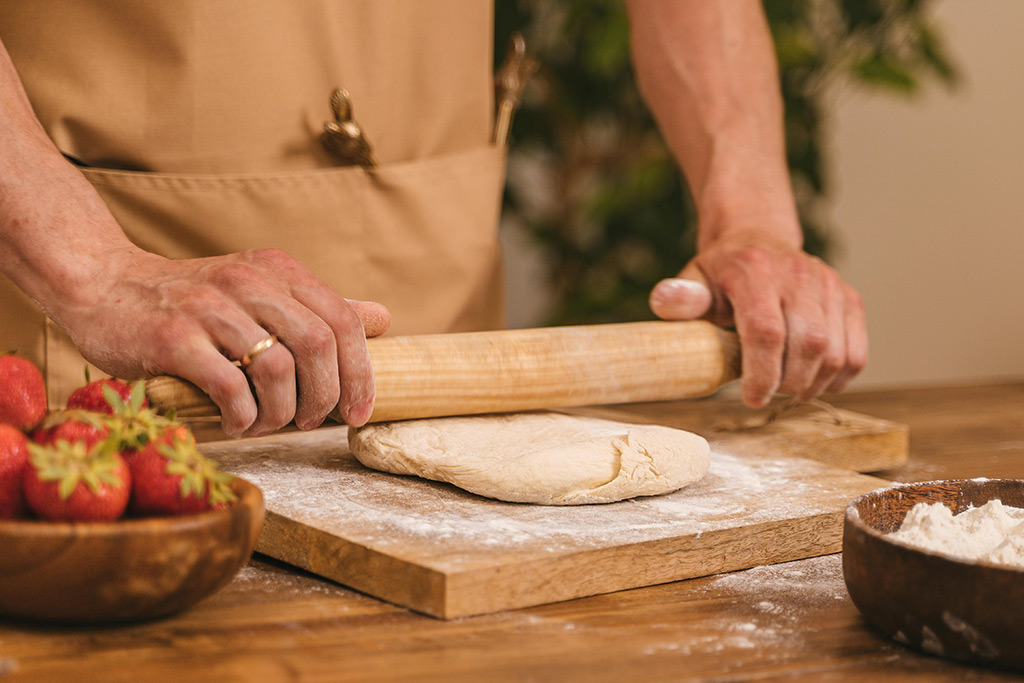
Combine the practicality of rolling dough and protecting counters with stunning designs suitable for serving eats. Choose a large, heavy board like marble, which stays cool for handling piecrusts, or dark wood for a rich autumnal look.
Replace thin cotton or polyester with heavyweight linen in an autumn pattern like plaid or muted-colored stripes. They are super-absorbent for quick cleanup while adding texture and cozy hues to your serving setup.
These adorable, heat-resistant, lidded bowls are perfect for serving single portions of soups, dips, or small side dishes. This creates an impressive look that makes for enjoyable at-home dining.
This is a quick, energy-efficient tool for making coffee or tea or starting soup stock. Choose a sleek, modern model in matte black or cream to blend in with a curated counter display.
Halloween is upon us, and as you hang your most frightful decor for the occasion, don’t forget to plan seasonal eats as well. Whip up these simple yet satisfying recipes from The Phone Eats First cookbook, and you’ll make spook-tacular memories with your family and friends. The enclosed treats—a pudding based on a healthy ancient ingredient and a rich candy featuring fresh fall produce—will have your celebration covered.
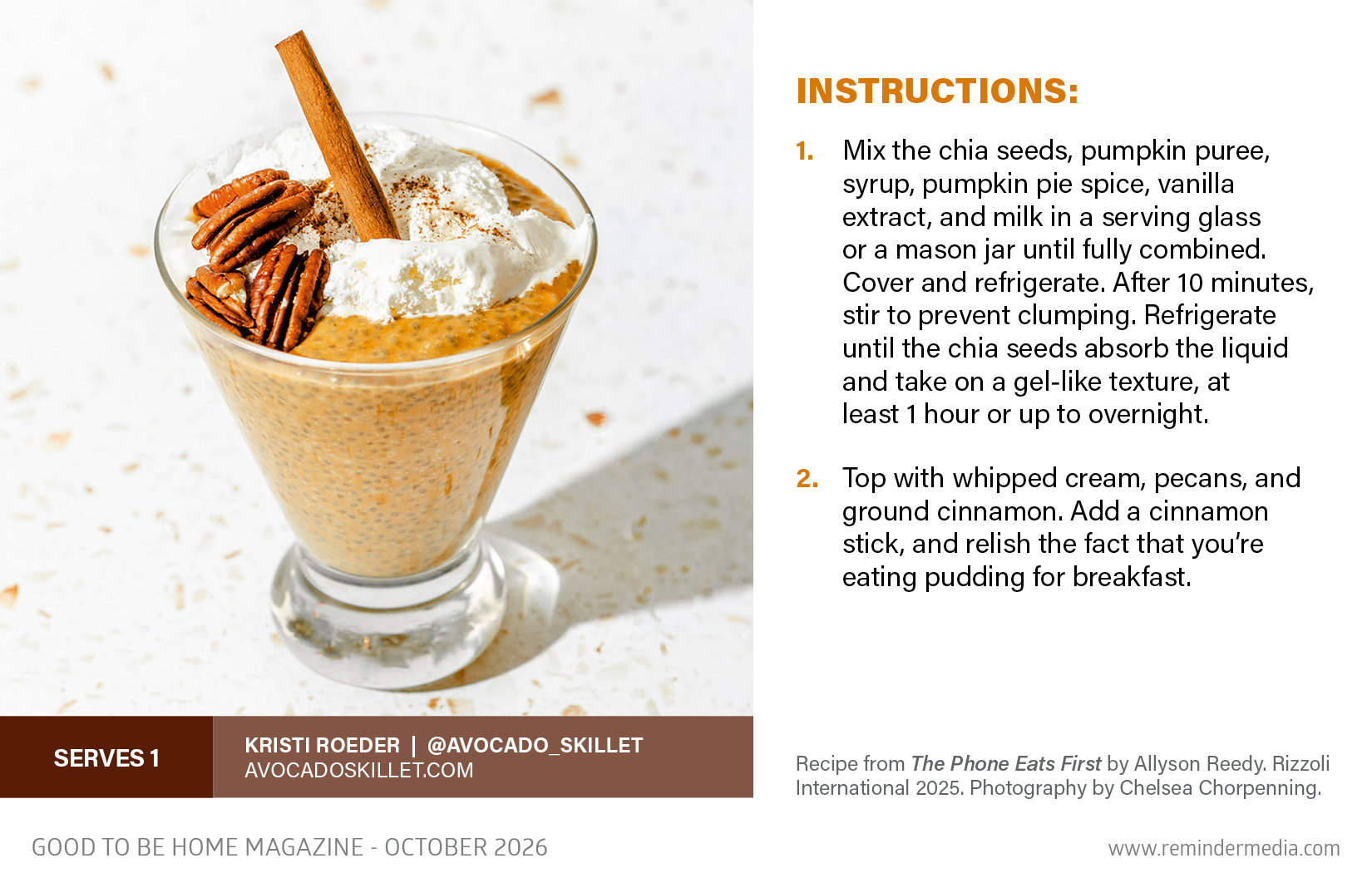
You’ll enjoy every spoonful of this filling and warm-spiced treat that is perfect for autumn mornings.
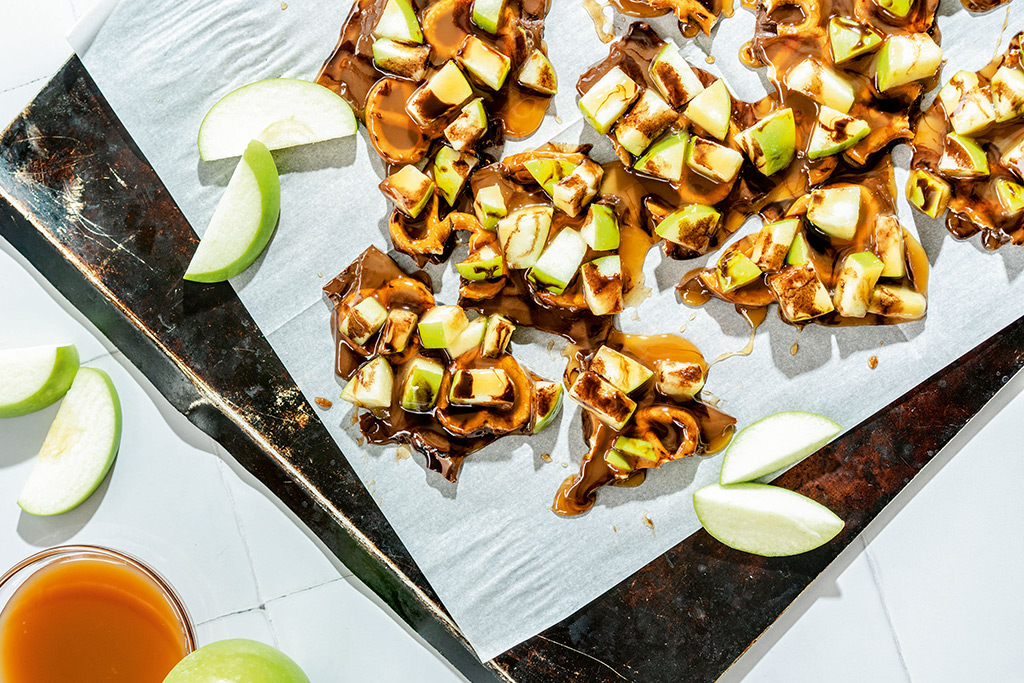
Serve your guests this creative take on a classic sweet that spotlights crunchy caramel and crisp fruit.
Recipes from The Phone Eats First by Allyson Reedy. Rizzoli International 2025. Photography by Chelsea Chorpenning.
recipe by kristi roeder | @avocado_skillet (avocadoskillet.com)
photos by chelsea chorpenning
Older millennials, and people from previous generations, probably remember chia seeds as one thing: Chia Pets. (Ch-ch-ch-chia! Look it up, Gen Z.) It wasn’t until the early 2010s, when Instagram made sharing pics of our virtuous breakfasts so much easier, that we upped our ingestion of the seeds and cut back on growing little chia hedgehogs out of terra-cotta statues.
Of course, chia seeds existed long before camera phones and even before Chia Pets! They were an Aztec superfood, but for some reason the Aztecs didn’t take pictures of their chia smoothies and cereals, so most of us didn’t realize we could consume them until much later. A tasty way to eat chia seeds is in this dessert-for-breakfast pumpkin pie pudding. (It might be a little borderline on the virtuousness, but since chia seeds are loaded with antioxidants, fiber, omega-3s, and vitamin B, we’re going with it.) More than a decade after starting to make the social media rounds, chia seeds are still trending, with chia-related recipes on TikTok racking up a couple hundred million views and counting.
SERVES 1
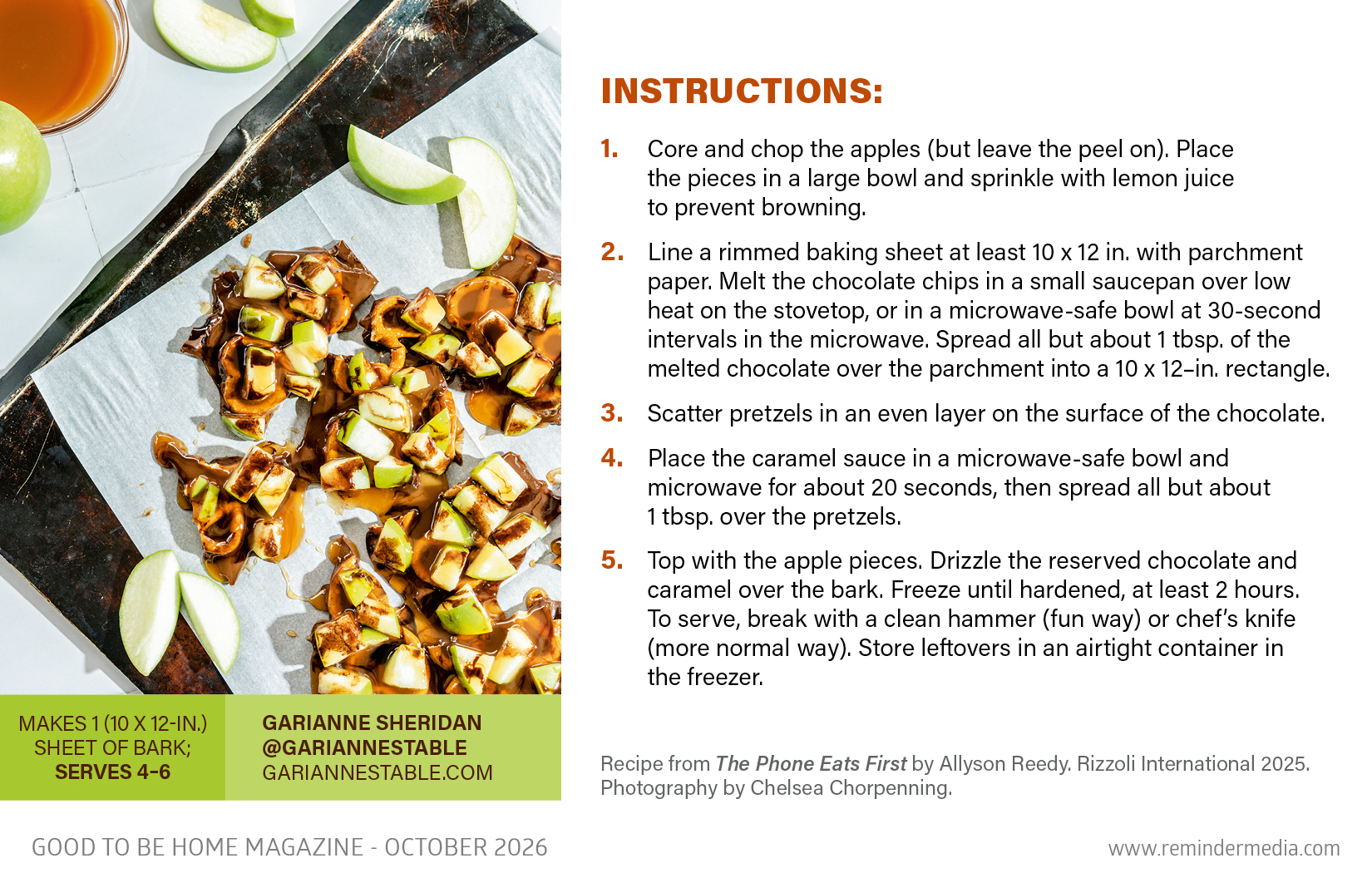
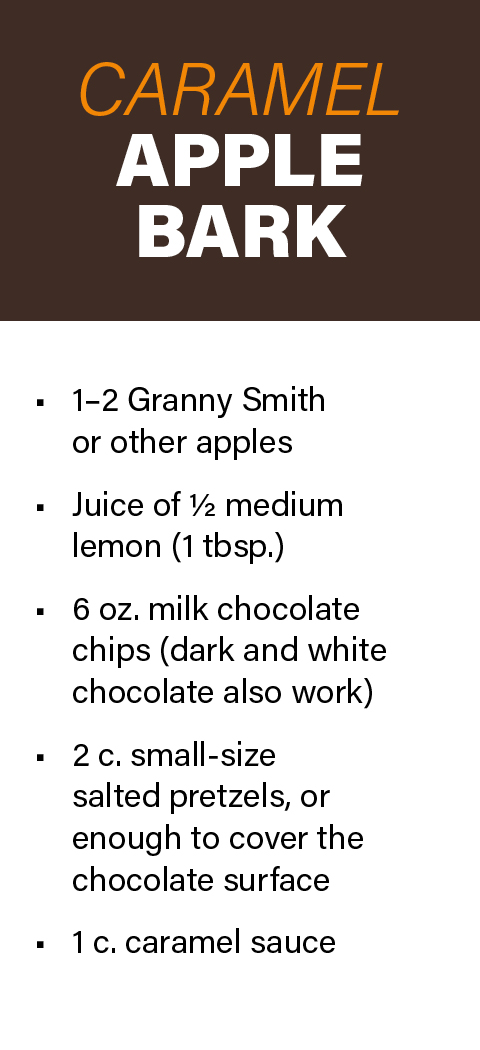
recipe by garianne sheridan | @gariannestable (gariannestable.com)
photos by chelsea chorpenning
Candy bark has been around forever (or maybe not forever, but why wouldn’t cavemen melt down some cacao beans and throw in something crunchy?), but you probably didn’t take notice until recently. Why? Because Instagram didn’t exist until 2010. It wasn’t until our great food trend disseminator came about that we got to know, love, and post pictures of our bark creations. Now we’re all about that bark because it’s super easy to make and endlessly customizable, and you literally get to break it!
@gariannestable’s caramel apple bark went viral in 2022, and not just because all of us basic Bs jump at any excuse to screech, “It’s fall, y’all!” Eating this salty (thanks to the pretzels), chocolatey, caramelly, appley treat in a flat version is way easier than losing a filling biting into an actual caramel apple. You can use any type of apple you’d like, but squeeze a little lemon juice over the pieces to prevent them from browning.
MAKES 1 (10 x 12-IN.) SHEET OF BARK; SERVES 4–6
Wisconsin-based scratchboard artist Melissa Helene discusses her fascinating medium, wildlife subject matter, and ever-expanding business.
Walk us down your path to becoming a professional artist:
I grew up creating art—I was always drawing and took every art class available in junior high and high school. In college, I didn’t know what I wanted to do, but I did know that I didn’t want to be a “starving artist” or an art teacher. So I got my degree in sociology with a minor in youth studies and worked in the nonprofit realm for several years after graduating.
However, I was regularly looking for something different. Since I was already making graphite and charcoal drawings and oil paintings as a hobby, I started planning to do art full-time. Soon after, I discovered scratchboard art, and something immediately clicked. As a very type A person, this medium and its attention to detail were very appealing to me. I founded my business in 2015 and have been working in scratchboard now for over ten years.
What is scratchboard art?
It employs professional-grade Masonite boards that have a smooth white clay base and a black ink layer on top, which you scratch off to create images. More commonly, you’ll find kids’ versions of it that have predrawn images to scratch off with a neon rainbow base underneath.
How long did it take to master your craft?
To be honest, it’s something I took to very naturally. I also had a decade of experience in drawing when I started—a necessity for doing photorealistic work on scratchboard. However, I’m still learning and growing. For example, over the past few years, I’ve finally started coloring my scratchboards, as most artists in this medium do. I’d avoided it previously because scratching is a very time-consuming process and I was leery of ruining something I had already put so much work into.
Eventually, though, I got to a point where I craved something different and wanted to push myself a little bit more. Besides, scratchboard inks come in packs of six—black and other various colors—but I would only use the black to tweak scratches, so the colored ones were piled up, just sitting there for years staring at me. I finally decided to give it a try with something easy: little birds. I love it now.
Why did you choose wildlife as your primary subject matter?
While I did a lot of human portraiture when I was using graphite and charcoal, I’ve always loved and drawn animals. My husband and I are wildlife photographers, too, and there’s an unending subject pool to choose from, both in photography and art. I’m currently working on a brown bear piece, the biggest scratchboard I’ve ever done.
What are your favorite animals to draw?
The majority of what I do is birds and mammals. People are constantly asking for whales or dolphins, but I rarely do aquatic creatures. For a couple of years, I couldn’t keep a big-cat piece to save my life—since that’s what clients were wanting, I actually considered just focusing on tigers, lions, etc. However, when I put the idea out on social media, everyone overwhelmingly told me not to do it.
What are the general different sizes of your pieces? How long do they take?
I work in a huge range, the most common being 4” by 4”. The largest I’ve created for art festivals is 2’ by 3’, and the big one I’m working on now is 32” by 48”. The time varies, even with ones the same size, depending on the subject. For instance, I can do a tiny bird in two to three hours; I don’t have to scratch as much because of its texture.
On the other end of the spectrum, the one that took me the longest, a green iguana, required well over a hundred hours—and it was only 12” by 16”. But because a lizard has scaly skin, the entire piece was almost entirely composed of individual knifepoint dots. I ended up taking five months to complete it. I still haven’t crafted another lizard because that one broke me a little. [Laughs]
Is texture the most challenging aspect of scratchboard art? Which are your favorite tools to use?
Being able to achieve three-dimensional depth in a two-dimensional medium is always the most challenging part. And there’s no real room for error—once you’ve scratched something, it’s permanent. Sure, I can use black ink and different ink pens to help redarken areas, but I can tell the difference between when I’ve done a scratch correctly the first time versus when I’ve had to correct it with ink.
As far as my tools, I have two that I use on every piece: an X-Acto knife and a fiberglass brush. The brush looks like a stylus and has a little protruding stick with strands of compressed fiberglass. So while each stroke seems like it’s making one wide scratch, it’s actually making many incredibly fine ones. That’s my favorite tool. It’s incredibly versatile, and I use it for every texture I create, from scales to fur to skin to glassy eyes.
You also do pet portraits. Would you elaborate on them?
They’re a big part of my business. I grew up with dogs and my husband and I have two, so I know how special they are and how heartbreaking it is when they leave—that’s one of the main reasons I keep offering pet portraits. Those elicit the best reactions when I deliver them. Custom cat and dog requests usually pour in between September and December.
You’ve been running your business for a decade. How does that make you feel?
It’s crazy. A lot of life has happened in that time, like getting married and having our kid. But starting my business was absolutely the right choice since it perfectly merges the two parts of my personality: orderly and creative. That said, being an artist isn’t easy, and trying to make a business out of being an artist is even harder. I’m proud of myself for doing that.
For more info, visit melissahelene.com