With multiple festive affairs on the horizon, many Americans have begun shopping—not only for holiday gifts but also for fantastic real estate. However, low competition and high buyer motivation between November and February may make it easier than you think to buy or sell. And while there are unmistakable challenges you might face before the New Year, including weather and scheduling conflicts, ’tis still the season to be jolly. With the following info in hand, you could very well make your buying or selling dreams come true.
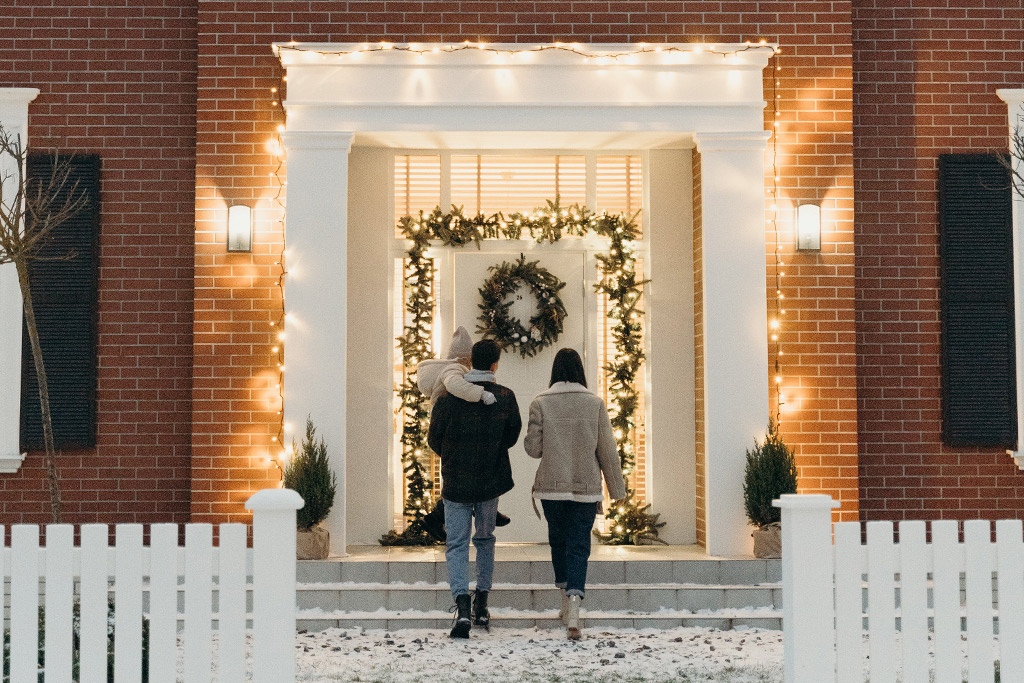
Here are some of the top considerations for eager house hunters around the holidays.
Schedule only intentional viewings
Taking a tour of every open house in town may be a fun way to spend a weekend, but because this time is packed with gatherings, sellers may be less likely to entertain window shoppers.
So if you plan on viewing a home, be sure that you’re serious about potentially putting in an offer. This particularly holds true if you schedule a private tour, which can be especially time-consuming for a seller. That means talking to your agent about the property and considering if its price point, location, and features suit your wish list before arranging a visit.
Look for key features
Thankfully, there’s also a key advantage to house hunting during the festive season: You can weigh how holiday-friendly each home is. Does a property offer enough living and dining space for entertaining? Does it feel cozy and welcoming? Most importantly, does it give you that palpable sensation that leaves you speechless, ultimately inspiring you to make new memories in its ambience?
Consider winter weather
Every season comes with its trials, but it’s especially pertinent to determine how well a home handles cold conditions. Depending on your region, they may include risks of frozen pipes, increased heating costs, and deteriorating plants in the landscape.
Taking this cautious approach can protect you from making an unwise investment. A good place to start is to carefully review each home’s disclosure form, which must list any notable flaws about the property. Additionally, scheduling a home inspection will grant you an expert’s latest perspective on the home’s condition. Depending on the feedback, you may even want to draft a contingency into your offer proposing that the home must pass a new inspection and that the seller will make any necessary fixes before you buy.

If you’re hoping to hand over ownership of your home for a great price, here’s what to deliberate first.
Consider investing more
Starry-eyed house hunters eager to make their holiday wishes come true could have higher or even unrealistic expectations at this time. Moreover, savvy buyers may know that many owners are eager to sell and try to take advantage of your situation. As such, these choosier individuals could express stronger criticism of any flaws they identify in your home (or hear about from an inspector or agent) and use them to request a lowball offer. You may therefore need to invest accordingly.
Ask your agent if any features need improvement, and then use this list to plan upgrades. Focus on what buyers will be more likely to see in listing photos or on tours, including the front entryway, kitchen, and primary bathroom.
Pare down your trimmings
Staging your home to sell means something different around the holidays. While the usual tenets will still apply, such as painting your walls in neutral colors and eliminating clutter, seasonal decorating becomes an additional concern. Should you charm buyers with the holiday spirit or shirk all timely decor and risk appearing like a humbug?
It’s a good idea to display simple, tasteful decor that represents winter generically, not a specific religious holiday, such as dressing your coffee table with white-and-silver centerpieces. If you intend to keep your holiday traditions alive while selling, show restraint. For example, choose a smaller tree and neatly decorate it, and minimize other decorations so buyers can still envision their belongings in the space.

Remember that a real estate transaction requires several hands on deck, not just the seller, buyer, and respective agents. Mortgage lenders, inspectors, real estate lawyers, and other professionals may be integral to your purchase, but keep in mind that holiday schedules can limit each of these parties’ availability.
This means that it may take more time than you’d like for you to close the deal. Talk to your agent about establishing a realistic timeline that factors in seasonal delays, and consider adjusting your moving schedule accordingly.
Though the holidays are a season of whimsy, high spirits, and delight, avoid getting caught up in these feelings as you approach either buying or selling a home (or both). With these tips in mind and an agent’s consistent guidance, you can make prudent moves and ring in the New Year with a successful transaction under your belt.
On a winter street, doors communicate something subtle yet powerful. Some remain bare; others carry a circle of green. You may notice the adornments without even stopping. There’s a fir bough here, a frosted ribbon there.
The wreath is one of the few decorations that lives between private life and public space. It marks the season without demanding a religious belief. For centuries, this ring of greenery has signaled continuity during the year’s coldest stretch. Today, it is displayed for a few weeks, then returned to the ground or the closet.
Though artificial wreaths are all too common nowadays, framing your entryway with a natural piece will add an authentic, warm touch that nods to the natural environment.

The wreath’s shape carries ancient meaning. The circle, unbroken and without beginning or end, was long understood as a sign of eternity, life’s unending cycle, and renewal. Humans have cherished this simple geometry across time, not only for its beauty but also for what it quietly suggests about continuity and return.
Before wreaths adorned front doors, they encircled heads and hearts across ancient worlds. In Greece and Rome, laurel wreaths were worn like crowns, symbols of triumph, honor, and status. Victorious athletes at the original Olympic Games received wreaths made of olive branches, a practice that later spread into art and public ceremony.
Later, in the forests of northern Europe, evergreen wreaths took on a different life. Made from branches that kept their color even in winter, they became signs of resilience and hope through the darkest days. People in Germanic and Scandinavian cultures hung evergreens at the solstice to celebrate life enduring against the cold.
Over time, this form moved inward. As doors became personal statements, we adapted how we used wreaths. They stopped speaking for a village and began speaking for households.

A wreath’s lifespan is decided long before it reaches a door. Species, cut date, and weather shape its endurance. Evergreens harvested in colder conditions last longer; those cut too early fade quickly. If you plan on purchasing an organic wreath, late November through early December offers a narrow window when freshness and durability briefly align.
People who make wreaths speak plainly about materials. Fir and pine hold their scent. Cedar dries faster, taking on a silvery softness as it ages. Juniper keeps its color but sheds when disturbed. And once you hang a wreath, it responds to the cold, sun, and wind.
Your doorway adds its own limits. South-facing doors with glass panels introduce warmth that speeds drying. Windy entries tug at fastenings and loosen needles. Dense forms tend to withstand exposure better, while looser arrangements belong on sheltered porches.
When you hang a wreath, you should balance the dimensions and finish of your door, the weather, and the wreath’s weight. Over-the-door padded hooks can protect your door’s finish. Adhesive hooks can work outdoors if rated for cold and load, though they require patience and a clean surface.
Caring for a wreath is mostly a matter of attention. In colder climates, the season often does the work on its own, preserving the greens through consistent low temperatures. During a brief thaw, you can lightly mist it with a spray bottle to keep the branches flexible. In milder or drier regions, you can soak the greens before hanging.
When the season has passed, removal completes the ritual. On a dry day, cut away wire frames and synthetic ties and set them aside for reuse.
The greens themselves still have a role to play. Evergreen clippings break down slowly, making them useful long after they leave your door. Layered onto garden beds, they insulate soil and protect roots from sudden cold. Tucked around shrubs, they shield against wind and temperature swings. Many towns collect wreaths after the holidays, sending them to farms, shoreline-restoration projects, or municipal compost sites.
Being true to its longtime tradition of renewal, the wreath lingers after the holidays. It simply takes its place for a while, then steps back and returns to the soil, making the next season possible.
As the exciting holiday season approaches, take time out of your busy schedule to enjoy the little moments, including casual gatherings with your family and friends. Take, for example, these recipes from The Brunch Club cookbook. The rich potato side and pillowy French toast are simple to make and even simpler to enjoy with people you love.
This cheesy, herbaceous, and elegant potato dish is surprisingly easy to whip up at home.
Fresh fruit, vanilla, and spices make a childhood breakfast comforting yet elegant.

Recipes from The Brunch Club: Delicious Recipes and Hosting Tips for Feeding Friends by Georgia Hearn. Published by OH. Photography © Danielle Wood 2026.
There is nothing more comforting and special than a plate of tartiflette! It’s decadent, cheesy and indulgent and I hope it transports you straight to any previous mountain trips where you may have partaken of it during après ski. The addition of truffle makes it just that little bit more special.

SERVES 4



Many of us have nostalgic memories of the way we ate French toast as kids. For me, it was in summer with chopped strawberries, a drizzle of cream and lashings of maple syrup. While that still sounds absolutely delicious, I wanted to make a more grown-up version with the addition of vanilla, sumac and mascarpone.

SERVES 4


Designer Renée Gaddis of Renée Gaddis Interiors shares how she shifted from the fashion world to the design world and discusses a high-rise Naples, Florida project.

Tell us about yourself and your path to interior design:
I was born and raised in Des Moines, Iowa, and studied fashion design at Iowa State. After getting engaged, I moved to Florida with my college sweetheart, but I wasn’t able to find a job right away. I eventually connected with an interior designer who offered me a position, insisting that many design principles translate between fashion and interiors, such as how fabrics drape and the importance of space planning.
I dove headfirst into it, getting my interior design certification and license. While I fell into this field at the beginning, it’s now a passion. In hindsight, I feel like I should have always been on this path.
Does fashion inform your design?
Yes. I still look at fashion magazines and Instagram sites in my spare time. Doing so makes me feel a little ahead of the game since interior design is actually somewhat delayed from fashion. Something like a new color or color combination that’s on the runway today will slowly trickle into home fabrics, for example.
Is this project a primary home or a vacation home for the clients?
A vacation home. They’re a husband and wife from Chicago with a daughter and son. Their daughter, who’s probably in her early thirties, was heavily involved in the process as well because her parents are planning to keep the home in their family for a long time. She was more focused on the look and design, yet her parents highly valued comfort. It was a refreshing balance and a fun project.
Did you have to run any ideas by a condo association?
I do a ton of condos down here, around a 75/25 split with houses. This one was a new build, so the association wasn’t even created yet. The developer owned everything, and we worked with them pre-close on all the finishes and other touches. Once the clients bought it, we added details like built-ins, paint colors, and ceiling touches.
With the property being a Florida high-rise, did you have to factor weather into its design?
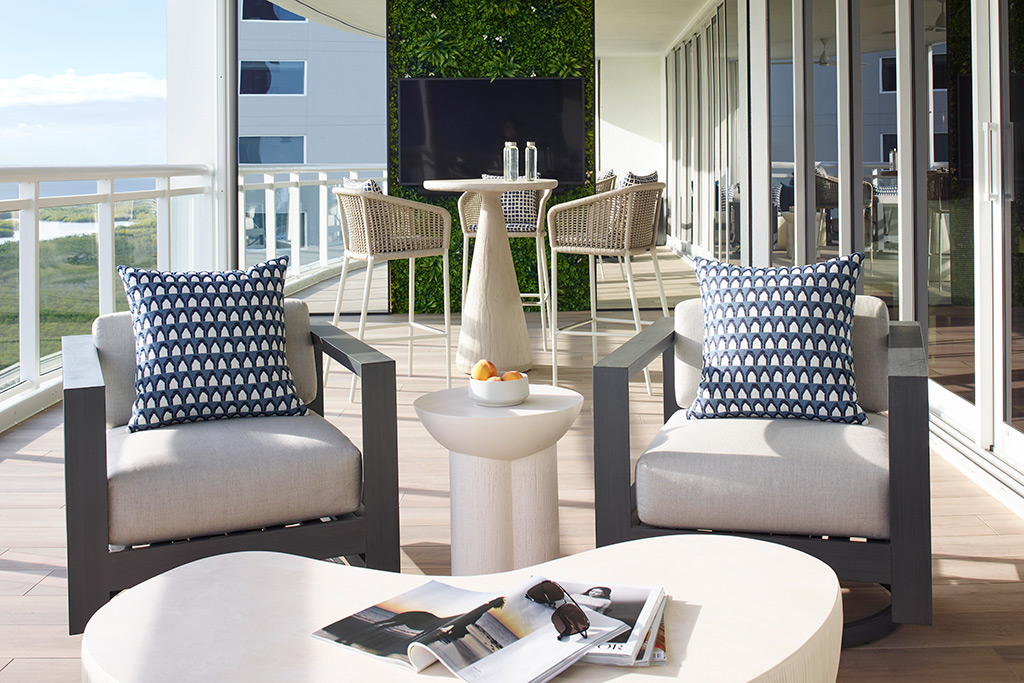
Definitely. This condo’s on the twentieth floor, a big consideration for hurricane season. Most transplants close everything up outside before returning home for months. But we created two layers of protection here: The hidden sliders in the windows are hurricane-proof, and the lanai shutters allow the clients to keep their balcony furniture in place if there’s bad weather.

Would you talk about the openness of the condo?
The elevator leads you right into their unit. When you step off and look to the right, you get a spectacular, unobstructed view of the outside. This required a very open floor plan in the main area with few walls. In addition, we made subtle tweaks to make it feel even more open, such as doorless kitchen cabinet uppers.
What do the decor’s natural elements add to the home?
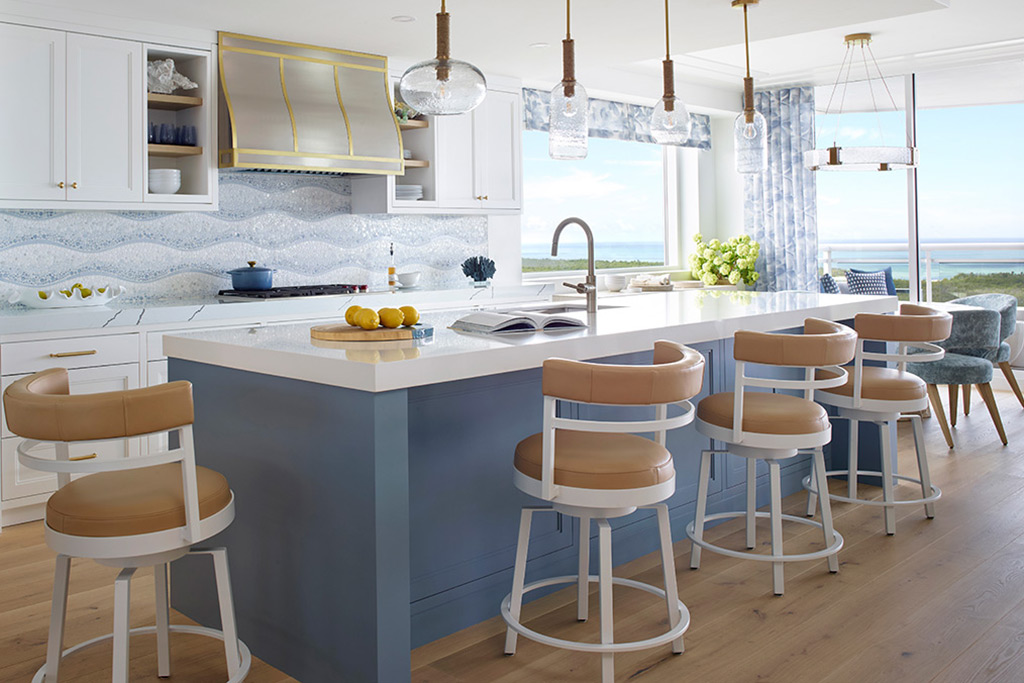
The clients wanted the unit to have a coastal vibe, which we included with some of the furniture and fixture choices. A fun example of this is the kitchen table, which looks and feels like a giant tree trunk—it’s very heavy. Another is the woven raffia light fixture in the guest bedroom, which provides an earthy, natural feel. I also love the wave in the pretty blue-green kitchen backsplash.
Are the colors informed by the locale as well?
Very much so. I like to say that down here, the green from the palm trees and the blue from the sky and water serve as neutrals. Basically, anything you’re seeing outside your window is considered a neutral inside.
What were the clients’ goals for the kitchen?
The wife loves to cook. She knows where she wants things and how she wants to do things, so we added a lot of intentional touches in the kitchen to make it a comfortable yet practical space. I wanted it to feel like her kitchen at home.
It was just one example of the custom design that we did for them. Another is the massive ottoman. They wanted a spot to put their feet up as well as a place for cups or snacks. The two tables on the ottoman are on casters so they can easily roll back and forth. On the window side, we also chose these cool, amazingly comfortable open-backed chairs that allow the clients to enjoy the view outside.
The ceiling fixture choices are also very interesting.
Very much so. The master bedroom has lights that look like conch shells made of blown glass, adding a touch of beachiness. I am not a huge lover of regular ceiling fans, so we instead added some “fandeliers,” fixtures that look like chandeliers but are fans. A fandelier is my new favorite thing! I wish I invented it.
Do you enjoy finding unique items for each client?
I love it. I find them all over the place, whether through traveling, looking through magazines, or scrolling through social media. And if a client’s budget allows for something custom-made, that’s even more fun. For example, we spent ample time designing this project’s wine wall. The clients don’t drink a ton, but they wanted a cool wall that stood out in the living room.

Do you lean toward a particular design style, or are you a chameleon, changing based on what your client needs?
I think I’m a chameleon. I’m always trying to truly understand what home is to clients and what they’re looking for. My job is to do the best I can to exceed their expectations. I also have a passion for learning, so I love getting to discover more about whatever my clients are looking for.
Some designers have a style they do over and over again, creating the same look with different materials, lighting, and furniture. I don’t know if I could do that. I’m constantly evolving, and I think that once I try one thing, I want to do something different.
You’re a big supporter of children with heart disease. Would you share why and how you advocate for them?
Our daughter has a rare heart condition that was discovered when she was just eighteen months old. At age three, she received a pacemaker, and now, in her twenties, she is 90 percent dependent on it.
It was a huge learning curve for my husband and me. She was our first child, so we were already navigating the uncertainty of new parenthood when we were suddenly faced with serious medical challenges. Those early years were scary, filled with countless doctor appointments and surgeries. At the time, there were no pediatric cardiologists or even a hospital system in our area, which meant we had to drive hours to Tampa or Miami to get her the care she needed.
Those experiences shaped us deeply and are the reason we are so passionate about this cause today. We are actively involved with the American Heart Association and helped get a local children’s hospital up and running so that other families wouldn’t have to endure the long-distance travel we did. Anything we can do to help children with heart disease feels even more meaningful than bringing a design project to life.
For more info, visit reneegaddis.com