As technology changes, our homes often do as well. For example, modern houses are now being equipped with an array of energy-efficient technologies, so how well are you keeping up? Implement the following simple upgrades, and you’ll utilize some of the most powerful, environmentally friendly, and cost-cutting solutions out there today.

Start with a simple yet essential swap—hunt down any incandescent bulbs throughout your home and replace them with LED ones, which not only consume less power (about a fifth as much in many cases) but also last longer on average. For added efficiency, install timers, dimmers, or sensors in both indoor and outdoor areas to limit overuse. You can even find smart bulbs that are compatible with your phone or smart hub, allowing you to voice-activate them and set up low-use modes like “Ambient evening” and “Reading light only.”
Outdoor lighting features could be some of the most helpful tech you install; however, they don’t have to draw from your home’s electric current to operate. Swapping to solar lights can save you money because they’re essentially self-sustaining illuminators that never need to be plugged in. Some types offer even more benefits, such as water resistance, motion detection, and shatterproof bulbs.

These preventative services can help keep some of your home’s most energy-sucking components in top shape. By checking for potential issues, doing cleanings, and testing mechanical performance, technicians can help promote the most efficient cooling and heating possible. Spring is an ideal time to request a service because it can help prepare you for the hot months ahead, but be sure to make an autumn appointment as well for help with winterization.
Upgrading your HVAC control unit offers a variety of benefits, not the least of which may be compatibility with a smartphone app. The Sensi app, for example, which works with thermostats of the same brand, enables you to regulate the temperature settings while you’re away, build detailed heating and cooling schedules based on your routine, and even track your energy use in real time so you can ascertain periods of overuse and take corrective steps to save money.

Instead of solely turning to your thermostat to enhance indoor comfort, though, evaluate how well insulated your home is. An insulation professional can identify any potential faults in your current protection, which may include temperature variations by room or heat collecting in your attic, and then suggest upgrades. These changes can significantly lower your energy bills by reducing heat transfer—in fact, according to the EPA, homeowners can save an average of 15 percent on heating and cooling costs by air-sealing and adding insulation. And because unprotected areas, like your basement, attic, and garage, can trap heat and radiate it indoors, insulating them can provide supplementary savings.
For a quick, simple DIY upgrade, install this equipment virtually anywhere you plug in at least two electronic devices. More than just handy forms of protection against electricity currents (like their older cousin, the surge protector), smart plugs can help eliminate phantom power, whereby idle electronic devices such as TVs and set-top boxes continue using energy, needlessly adding to your utility costs. Addressing this problem can potentially save you upwards of $200 per year. For even greater control over your utility usage, opt for a version that can detect energy use, identify major power drains, and even flip on and off in response to your vocal commands.

Did you know that professional energy assessors may be available from your local government or utility company? Book an expert to thoroughly review your property, identify wasteful features, and recommend personalized efficiency upgrades. You can even talk to them about other smart swaps in this guide to determine how else you can make a major difference for the environment while saving serious money.
Azali Kassum, owner of Azali Kassum Design, offers an inside look into the eight-year renovation of her 1790s home in Washington, DC.
Tell us about yourself:
I live in the Georgetown neighborhood with my husband and three children. Though I was born in Boston, my family is from East Africa and India; my heritage is a big part of my love of architecture and design philosophy. I not only draw inspiration from my background and travels but also like to use natural materials and different design styles to create spaces that truly represent who my clients are. I tend to gravitate toward a minimalist yet warm and textured aesthetic, which pulls from multiple eras, and use a lot of sculptural and organic forms, pure materials, and neutral colors to create timeless spaces.

Have you always been interested in design?
I’ve loved architecture and designing spaces since I was little. Whether I was working on an art project or endlessly redecorating my childhood bedrooms, I would immerse myself in these imagined spaces. I also learned how to curate a room from my mother. She would take us to antique shops and auctions when we were young, and I’d watch how she’d gather treasures and place them in different spaces of our home. She would also collect items from our trips, which I enjoy doing as well.
I had hoped to study architecture and design after high school, but I ended up pursuing law instead. However, I continued to use design as my refuge throughout college, law school, and beyond. I lived in New York for a while, and my tiny walk-up rental became a canvas for me to experiment with different color palettes and furniture layouts. It wasn’t until a friend asked me to help with their renovation that I seriously considered a career change, and my design work slowly transitioned from a beloved hobby to a business.
Would you tell us more about your property’s history?
It was built in the 1790s and is sometimes called the “Seam House” because of the visible vertical seam running down the front. It’s actually composed of multiple parts that were constructed at different times and then connected later. There is an original two-story core at the center of the house that was used as a workshop. Then, Washington Bowie, a prosperous Scottish tobacco merchant and godson to George Washington, purchased the home in 1814. In the middle of the nineteenth century, he added a larger two-and-a-half-story addition to the front of the house to bring it forward to meet the sidewalk. Later, the walkway between this house and the one next to it was closed in with new brick to create a front door at the street, hence the presence of the vertical seam.

How did you approach your home’s renovation? What was your primary goal?
The design evolved a lot during the renovation. The whole project lasted eight years, and when we started, it was just us and our dog. But, by the time we had drywall up, we were expecting twins. So we wanted to keep the spaces as open and fluid as possible, which really guided the design as the project progressed. Rather than following the more expected path of a traditional restoration, though, I embraced a pared-down, edited, and fluid approach, exercising more deconstruction and restraint. This was inspired in part by the history and character of the house itself.
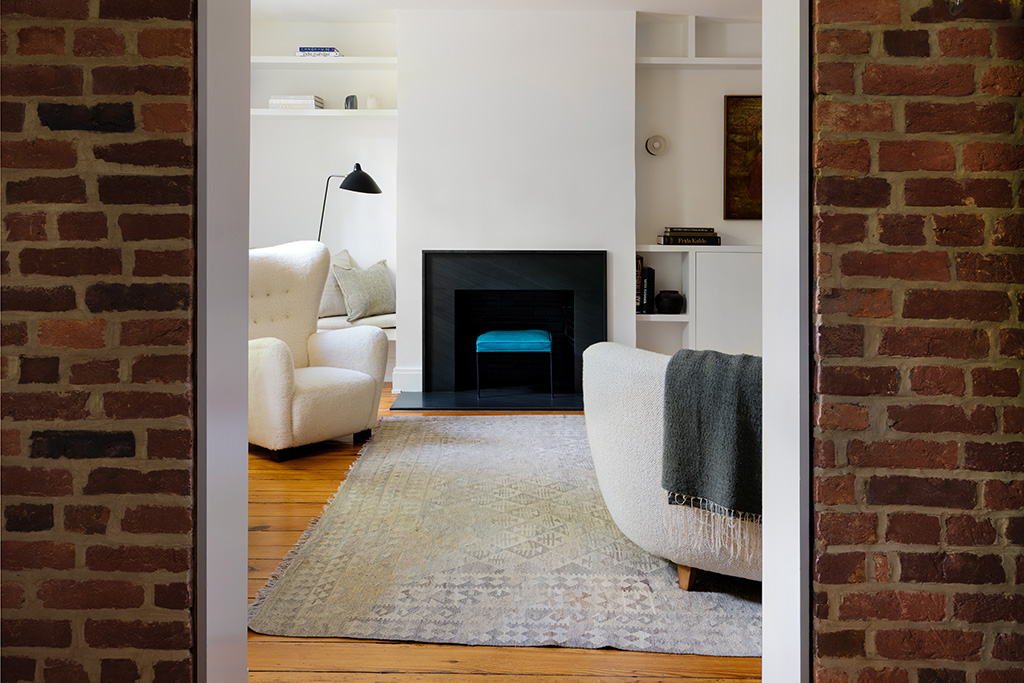
I really wanted to maintain the original envelope but create a sense of lightness as you moved from old to new. This meant balancing new items, such as the sleek white-lacquer cabinetry, with the original heart pine flooring and exposed beams.
Did you take on this project yourself, or did you have help?
I collaborated with architect Christian Zapatka throughout the process. As with any home in a historic district, we had to consider how we could make the design feel seamless within the context of the surrounding homes. We drew from renovations of row homes in Amsterdam and apartments in Paris to help us find that intentional balance between old and new.
Overall, the project quickly went from a light remodel to a full-fledged gut, and we ended up designing a new three-story addition in the back. I also wanted to bring in as much natural light as possible, which resulted in us adding the large steel-cased window at the back of the house. It spans two floors and anchors the floating stairway we designed into the kitchen.

How did you decide what to strip back and what to leave as is?
When my husband and I bought the house, the beams in the dining room were heavily coated in layers of paint. At first, stripping them down was a necessity so that we could repaint them. But once we saw them in their natural state, with only echoes of paint remaining, the whole room came back to life. This area also had a heavy chair rail and a small staircase in the southwest corner, which we removed to gain space on the floor above; that area’s now the primary bath. With these features removed, the beams really took center stage and floated on the plaster ceiling. The room is truly the heart of this house and has been the stage for all our family celebrations.
What was the biggest challenge you encountered along the way?
We initially wanted to knock down the wall in the foyer to create an open plan, but once the drywall was removed, it revealed an original double parlor door. We decided to preserve the brick and the opening instead, so a challenge became an opportunity. Now, when you walk through this space, you see the powder room nestled into what was once the back entrance in addition to the original weathered stone threshold.
How did you go about curating furniture and decor for your home?
It was an evolutionary process. At first, I was driven purely by utility and sought functional items that the twins could easily navigate. But these ended up overwhelming the space and felt too forced. Living in the house helped us figure out what would work best. Ultimately, my love of vintage and midcentury modern pieces drove the design and allowed the house to breathe.
I also wanted to bring in pieces that draw you in with curves and natural materials, as well as ones with history. The first item I found was the Matégot-inspired rosewood console in the dining room. It provides such a fun and unexpected contrast to the cabinet my mother gave me from India, which dates back to the British colonial era. And it proved to be a perfect object to tie the older part of the house into the new steel-cased windows. Pairing this with vintage glass paintings from Asia—which are also from my mother—and modern-day ceramics represents how we blended different eras in the house.
I also found an antique mirror (which actually came from another house in the neighborhood) at a shop down the street from us, and it now anchors the living room. When you sit at the end of the kitchen island, you can see all the way through to it, and it reflects the entire parlor floor. It’s perhaps one of my favorite spots as it reveals each design detail and pulls the house together.
For more info, visit azalikassum.com
As spring ebbs and summer approaches, thoughts increasingly turn toward blissful warm-weather locales. You can capture this essence in culinary form with these selections from Ricky Lauren’s cookbook The Hamptons: Food, Family, and History, both of which are inspired by the author’s beloved beachside memories.
A hearty breakfast classic with custardy challah, warm cinnamon, and a crown of fresh summer berries.
This sweet, simple bake enhances the season’s first berries with a buttery oat topping and bright lemony zest.

Recipes excerpted from The Hamptons: Food, Family, and History by Ricky Lauren. Rizzoli New York, 2025. Photography by Anne Stratton.
I love to start my family’s day at the beach with this lovely, warm, delicious breakfast. If I can sell seconds to them, then I am the Queen of the Kitchen! I use an egg challah. I cut it 1 inch thick and as much on the diagonal as possible to get the largest slices. French toast is best when it’s crispy and golden on the outside and rich and custardy on the inside. The trick is for the bread to soak up the maximum egg mixture without falling apart in the pan. I love the smell of the vanilla and the sound of bread frying. Top it with cinnamon or powdered sugar, then berries on top for the visual effect after plating. You may also present this with grape jelly, strawberry preserves, a “honey bear,” and a bowl of cinnamon sugar on the side.

Serves 6



Aunt Susan and I went blueberry-picking together with our young children in Amagansett. We decided to have a contest to see which team could pick the most berries. The smushed ones did not count. We had so much fun that we all forgot who won! I still remember how much we laughed. This crisp always reminds me of that magical day.

Serves 6


When it’s at its best, your garden should feel like your own private slice of paradise, replete with colorful flowers, lush shrubbery, and the cooling shade of proud trees. But the intense maintenance required to keep up this area can sometimes make it feel more like a burden.
Why not take some of the sweat out of gardening so you can enjoy your outdoor space? Whether caring for greenery is one of your favorite hobbies or you’re looking to invest less time and money into yard care, try these five solutions. They’re suitable for landscapes in just about every American climate.

Butterflies, bees, and other beneficial species aren’t just pretty to look at; according to the experts at the Pollinator Project, they’re also responsible for supporting between 75 and 95 percent of all plant life. So rather than deterring them with toxic insecticides, attract them by putting out small cups of water.
Providing pollinators such hydration stations in floral shades like light yellow and pink can draw them into your garden. Apply just one teaspoon at a time to each container (to prevent mosquitoes from breeding in them), and change the contents often to keep them fresh—pollinators will thank you by helping your flowers bloom brighter and produce plants that yield more.
Grass lawns are incredibly high maintenance, and depending on where in the country you reside, they can be far too water-demanding for the environment, local ordinances, or your utility costs. To save resources, plant a more resilient herb garden. Paring down an expanse of troublesome grass with even a small section of these plants could make a significant impact.
Opt for species like oregano, mint, and chamomile, all of which can grow into eye-catching and healthy ground cover because they’re hardy, tolerate direct sunlight, and don’t need to be trimmed until you’re craving their fresh flavors.

Alternatively, you could go even hardier with boulders, colorful pebbles, pond stones, and other rocks. Talk about low-maintenance—such materials will create a striking garden while having minimal tending needs. Simply lay a variety of them in areas where your landscaping is struggling, and watch as the occasional wildflower, tree sapling, or other pleasant growth sprouts out of them. (If you find some unsightly weeds, they’ll be easily removable.) You could also plant vines to sprawl across your rock garden for a lush look.
For the most attractive results, try this simple approach: Imagine a series of ribbons extending from your curb to your foundation, then set down rocks in alternating heights within each row. The variety of sizes, colors, and textures will catch the eye and elevate your curb appeal far beyond what a struggling lawn could.
There are also fun, virtually effortless ways to plan your garden, such as by utilizing Plant by Number. This company takes the stress out of installing a new green space with its easy-to-follow layout maps that you can customize based on your property, have shipped to your home, and position in the area of your choosing. From there, you simply fill them in with the best flora for each numbered spot—much like filling in shades in a paint-by-number coloring book.
Designs come in templates like Driveway Design and Privacy Hedge, so you can transform just about any zone of your yard into a lush garden. Intentionally planning your landscaping in this way helps ensure that you find the best species for each space’s watering, draining, and sunlight needs. That way, your investments can not only survive the heat of summer but also flourish through the seasons beyond.

Once it’s time to install flora, your instincts may be to grab a shovel and prepare to dig a trench so deep you’re practically drilling for oil. But the width of the hole you dig actually matters more than its depth. Rather than boring to the exact deepness of the pot a plant has come in, create a wider, shallower circle that is two to three times the roots’ diameter. This will allow you to work with softer, more malleable topsoil while also helping you prep your new plants correctly, granting them space for their roots to expand and seek nourishing earth and hydration. Using this technique also encourages you to leave ample space between plants so they can mature horizontally as well as vertically and not compete for precious resources.
Following these hacks can help you cultivate a garden that promotes relaxation instead of causing stress. To make caring for these spaces even easier, don’t burden yourself with chasing perfection. After all, every garden is a work in continual process, so if you experience setbacks, there is always room to grow.