Spring’s arrival brings warmer days and more colorful landscapes, but it also ushers in a surge of pollen and other pollutants that can easily make their way indoors. In fact, the EPA notes that indoor air can be two to five times more polluted than what’s outside, a staggering figure given how much of your life takes place at home. Managing your environment isn’t necessarily complex, though. Simply pay extra attention to the areas where allergens gather.

Your HVAC system works steadily through the season, drawing air through filters that may not capture enough particles. A high-efficiency pleated filter—MERV 11 or higher—can capture finer pollutants like pollen. Just be sure to change it every sixty to ninety days.
To manage humidity, which can encourage mold and dust mite growth this season, aim for a range between 30 and 50 percent. Use a hygrometer to monitor levels accurately, and consider using a dehumidifier to bring levels back into balance.
Further, be mindful of when you let spring breezes indoors. Early mornings tend to carry greater pollen counts, while late afternoon may be more ideal for opening your windows and doors.

Make spring-cleaning a priority, especially to target top allergen trappers like fabrics. Wash your bedding weekly, including pillow covers and mattress protectors. Curtains can also collect dust over time, so launder them or use an upholstery attachment to remove what’s settled.
As for floor care, vacuum at least twice a week with a sealed HEPA machine, then follow up with a damp mop to gather what suction leaves behind. Dry dusting can scatter particles, so use a lightly damp microfiber cloth to grab more allergens.
Also, leave your shoes at the door. This simple habit keeps significant outdoor allergens from being tracked indoors.

If your home has older carpeting, consider replacing it with hard flooring in areas where you tend to linger, like the living room and bedrooms. To reincorporate softness, lay washable area rugs.
Your ductwork also needs periodic attention. A professional cleaning every three to five years can clear out built-up debris, particularly in older systems. If you’re renovating, consider using a whole-home air purifier integrated with your HVAC system for steady, unobtrusive filtration. Window maintenance can be effective too; reseal frames where air escapes to help keep outdoor irritants at bay.
Spring doesn’t have to feel like a trade-off between fresh air and comfort. Make a handful of deliberate choices, and your home will support the season rather than resist it—something you’ll notice when you feel yourself breathing more easily.
Seth van den Bergh, founder and creative director of The Drawing Room ATL, shares how he helped a longtime client reimagine her life through design at Atlanta’s historic Adair Estate, creating a home rooted in story, individuality, and emotional connection.

What’s your design story?
My family moved around constantly when I was growing up, so reinvention was part of our home life. Every move became an opportunity to rethink how we lived and what we carried forward with us. Looking back, that probably planted the design bug early in me.
I initially studied biology in college. I remember venting to my mom during my sophomore year about feeling disconnected from what I was doing. She suggested interior design because of our family’s long history with home renovations, antique shopping, and DIY problem-solving. I transferred to another school and eventually studied in Washington, DC, before receiving a scholarship to study interiors in Dubai.
Dubai changed the way I thought about design, exposing me to a level of ambition and experimentation that was completely different from what I had known. It also taught me that constraints can actually sharpen creativity. Budgets, architecture, and history create tension, where the most compelling ideas often emerge.
Afterward, I ran a showroom in Atlanta before eventually launching my own company. Ten years later, I’m still designing homes that feel deeply personal, layered, and impossible to mistake for anyone else’s.
Who is this client, and how did you become involved with this project?
I’ve known this client for years. After being married for four decades, she used this home as an opportunity to rediscover herself.
She’s an avid cyclist, painter, sculptor, and collector with a wonderfully contrarian spirit. Honestly, those are often the clients we work best with. At The Drawing Room, we are not interested in creating consensus-driven interiors. We’re interested in helping people uncover spaces that feel authentic to who they are, even if those ideas challenge expectations.
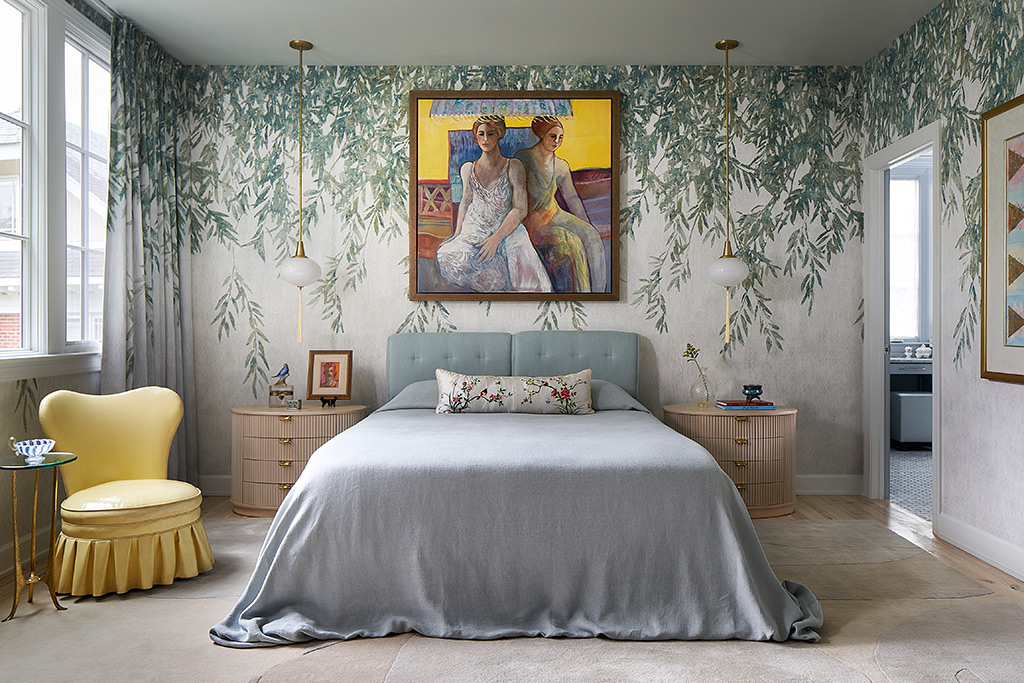
Early in the project, she leaned more heavily on my direction. But over the course of six years, I watched her confidence evolve. By the time we designed the primary bedroom, the final room we completed, it carried a softness and emotional clarity that reflected her personal evolution.
Tell us about Adair Estate. What drew her there?
Adair Estate carries this fascinating tension between history and reinvention. The original mansion was converted into residences, while surrounding townhomes borrow from its Tudor vocabulary and architectural style.
Both the architecture and the lifestyle surrounding it appealed to her. The property sits near trails, green space, and parks, which support her love of biking and being outdoors. It also brought her closer to her son and granddaughter. Equally important, the scale of the home felt manageable, intimate enough to personalize fully yet still architecturally rich enough to create moments of drama.
What were her goals for the home?
It was a new beginning, so she wasn’t interested in re-creating her previous home or preserving things out of obligation. Outside of her artwork and a few meaningful objects, there was a real willingness to experiment. That openness allowed us to create spaces that feel collected emotionally rather than simply decorated.
At our studio, we often talk about homes as autobiographical. Our goal is to create interiors that reveal something about the people living inside them. The powder room here is a perfect example. Every decision carried a certain emotional weight. It became unapologetically expressive, almost like a small jewel box hidden within the larger home.

Tell us more about that room:
Originally, it had a fairly traditional trompe l’oeil mural featuring a fountain and garden fence. We transformed it into something moodier and far more seductive. I always describe it as a “stiletto” of a room: There’s tension, glamour, and a sense of intrigue packed into a very compact space. Even the composition of the photography pulls you inward intentionally. Moments like that are important to us. We believe homes should evoke emotion and curiosity rather than simply function.
Did her artwork influence your design choices?
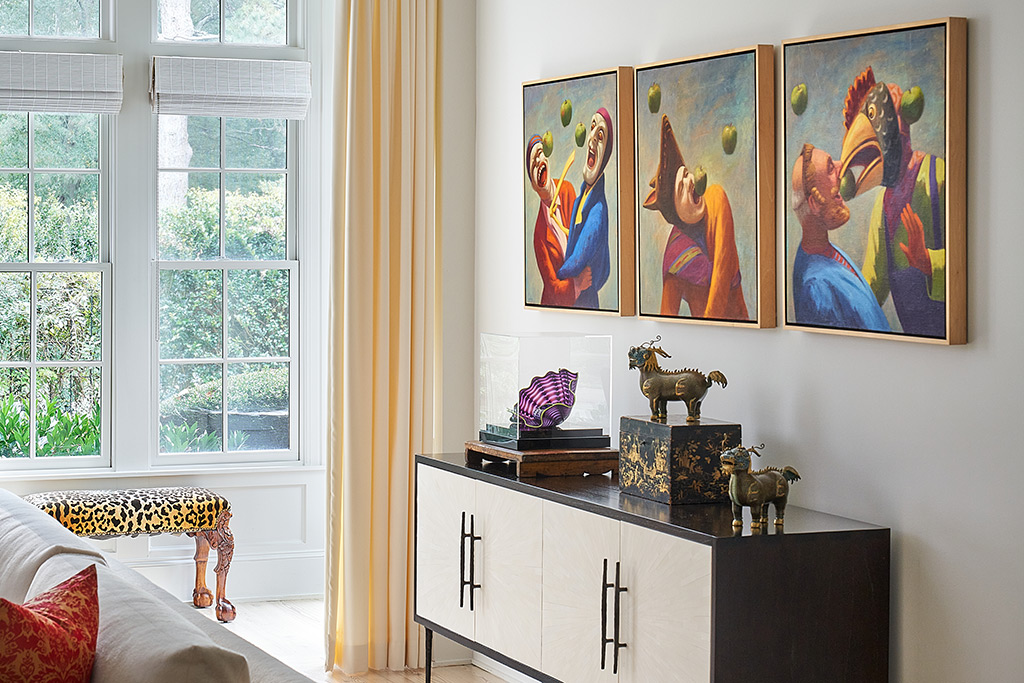
Completely. Here, art served as an anchor point in many ways, and many carry emotional history. There’s a triptych in the living room painted by one of her former college professors. The painting in her bedroom was created by a close friend in Montgomery.
We often approach interiors cinematically. Not every object can be the lead actor—some pieces support the narrative, while others command the scene. In her bedroom especially, the artwork became the center of gravity and everything else was designed to orbit around it.
How did you approach the dining room?
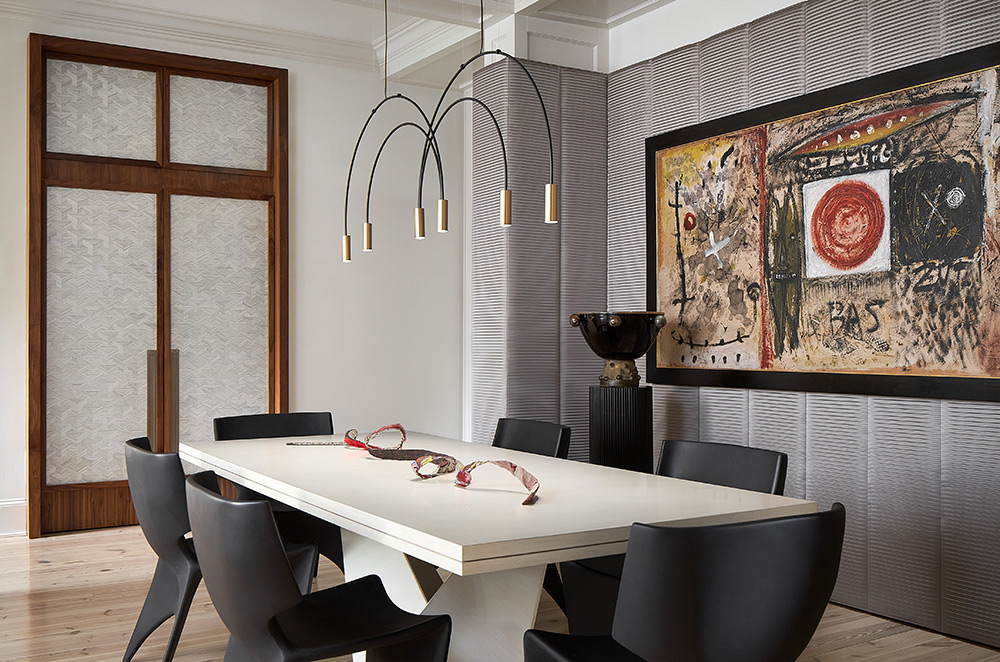
The room needed softness. Architecturally, it was filled with harder elements, including millwork, flooring, sculptural furniture, and strong geometry. So we introduced a large, custom pleated screen that wraps the room almost like fabric drapery would. It softened the acoustics and atmosphere while adding movement and rhythm.
There’s always a push and pull in our work between restraint and drama. The best interiors rarely sit entirely in one camp.
The living room feels especially personal. Would you elaborate on your choices there?
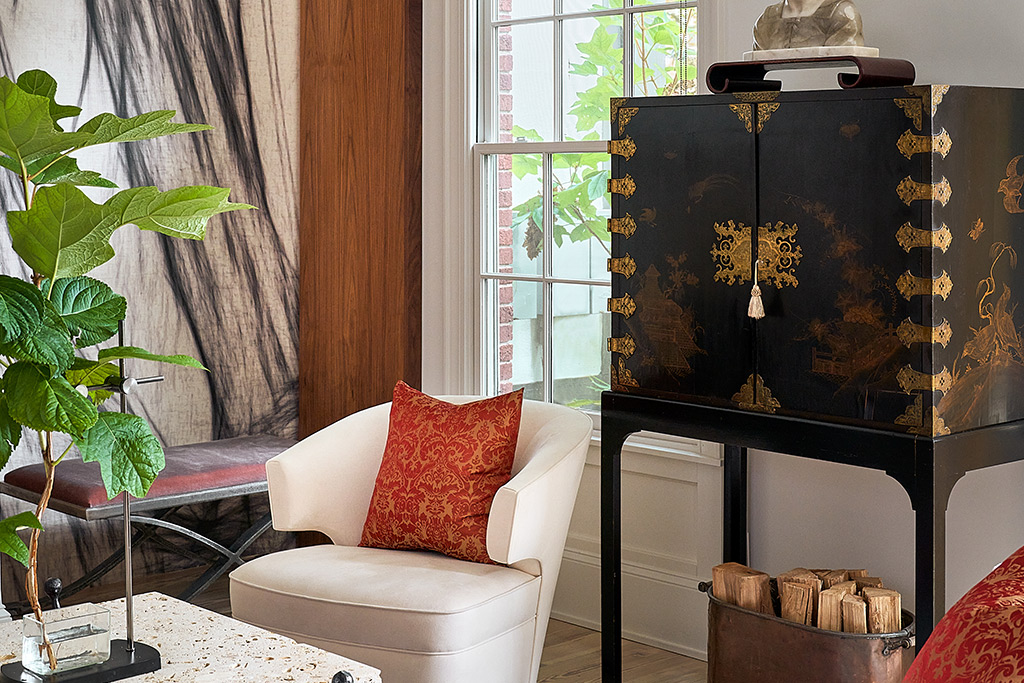
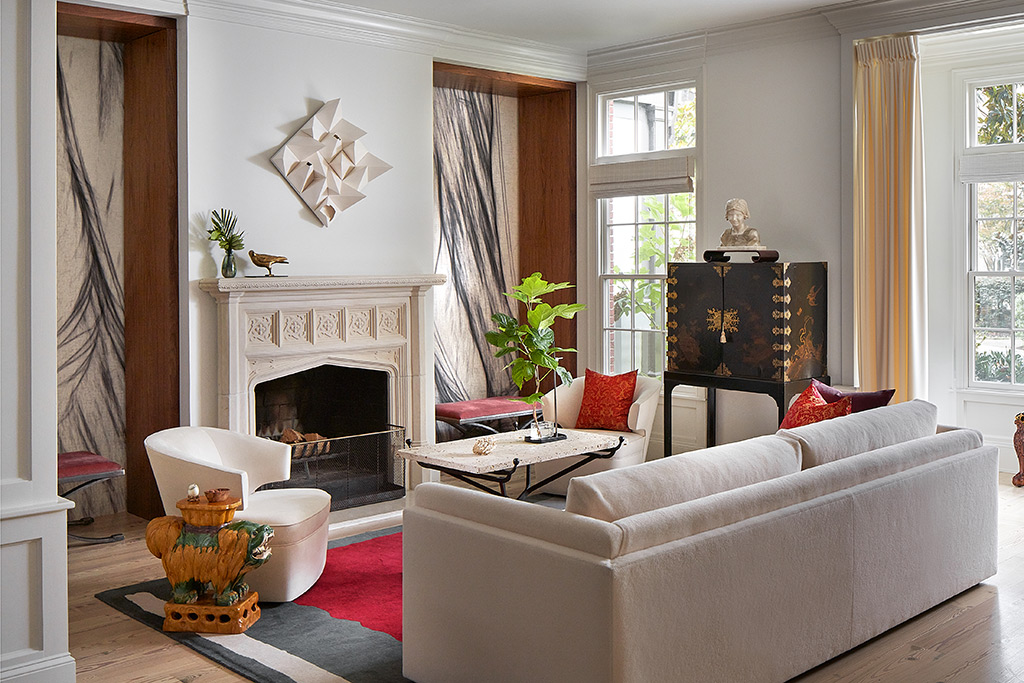
Absolutely. The built-ins surrounding the fireplace were reworked in walnut and backed with a printed grass cloth featuring a black-and-white Xerox image of a feather. That detail references a deeply personal moment involving her late daughter while she was in Santa Fe: She asked for a sign, and a feather fell at her feet. That’s the kind of storytelling we care about. Design becomes far more meaningful when it carries emotional memory rather than simply a visual trend.
The room itself also demonstrates our philosophy of layering eras and energies together. There are contemporary furnishings, inherited pieces, whimsical objects, and deeply personal artifacts all coexisting in dialogue. That tension creates richness.
Overall, was it a challenge balancing Tudor architecture with a more modern sensibility?
Not really, because we never tried to erase the Tudor character. If anything, we leaned into it selectively while introducing moments of contrast and clarity.
We love juxtaposition. In fact, we believe that every project should contain something historical, something contemporary, and something unexpected. That balance keeps a home from feeling frozen in time or overly trend-driven.
The client ultimately embraced that philosophy fully, becoming fearless in the process. Many of our clients are empty nesters entering a new chapter of life, and there’s something beautiful about watching people finally give themselves permission to live with what genuinely inspires them.
What does she love most about her home today?
Her bedroom, without question. It represents the clearest expression of who she’s become. For perhaps the first time, she created a room entirely for herself emotionally, visually, and spiritually. There’s a lightness and intimacy there that feels incredibly personal. She jokes that she barely used to spend time in her bedroom beyond sleeping. Now she takes lunch there.
Ultimately, that transformation is the most rewarding part of what we do. At The Drawing Room, we often describe ourselves as storytellers as much as designers. Our role is not simply to make homes beautiful. It’s to help people articulate who they are and, sometimes, who they’re becoming.
For more info, visit thedrawingroomatl.com
When you envision comfort food, fish may not be the first thing that springs to mind. But these two recipes, courtesy of content creator chef Davon Moseley’s new cookbook, Let’s Get Into It, prove that a seafood meal can inspire your loved ones to dig in just as well as any other meal would. They are indulgent, easy to follow, and abundantly tasty.
Herbs and two cheeses elevate the classic Southern side to mouthwatering levels.
Cayenne, paprika, garlic, Old Bay, and more—this recipe boasts an invigorating mix of flavors.

Recipes from Let’s Get Into It: 130+ Comfort Food Recipes for Novice Cooks by Davon Moseley. DK Publishing, 2025. Photography by Stephen Buchanan.
Growing up, I remember eating grits often on Sundays at my Aunt Patricia’s house. She added so much cheddar cheese and butter that the grits were practically orange. We’re not going to that extreme, but my grits are still packed with smoky gouda and sharp cheddar and are rich from just enough butter and cream.

Serves 6



My family often has fish fries to bring everyone together and eat good food. My dad would go on fishing trips and come back home to fry up the fish he caught for us. That will always be a core memory for me. Crispy fish is best served on sandwich bread with hot sauce—if you know, then you know. It’s also great served with grits for breakfast.

Serves 6


While many household spaces prioritize function, including the kitchen and home office, these areas may not tempt you to stay once they fulfill their purpose. But a clubhouse, an exclusive golf or resort lounge, serves different impulses: It’s shaped to encourage long conversations, calming rituals, and unhurried time. Take your opportunity this spring, with its longer days and renewed social energy, to redecorate your dwelling to embrace such soothing sophistication.

Traditionally, these spaces serve as private refuges: places to read, enjoy beverages and finger foods, and meet like-minded individuals. The best versions balance comfort with restraint, and nothing feels incidental. Seating can help start conversations, lighting is low but deliberate, and materials are chosen for ultimate comfort as well as class. This isn’t a theme, necessarily, nor does it belong to a certain time period; rather, it’s about making choices that favor ease and privacy.
To grant your home such clubhouse comforts, start by selecting which area you’d like to restyle. You don’t need to commit to changing your whole home or even a dedicated wing of it. Choose one room, such as a den, an underused formal living room, or even a corner of a larger bedroom, then define it with intention.

Next, consider color. Deep, mature tones can instantly relax you and create a feeling of privacy. Alternatively, light shades can complement open windows for an outward-facing look that welcomes natural tranquility.
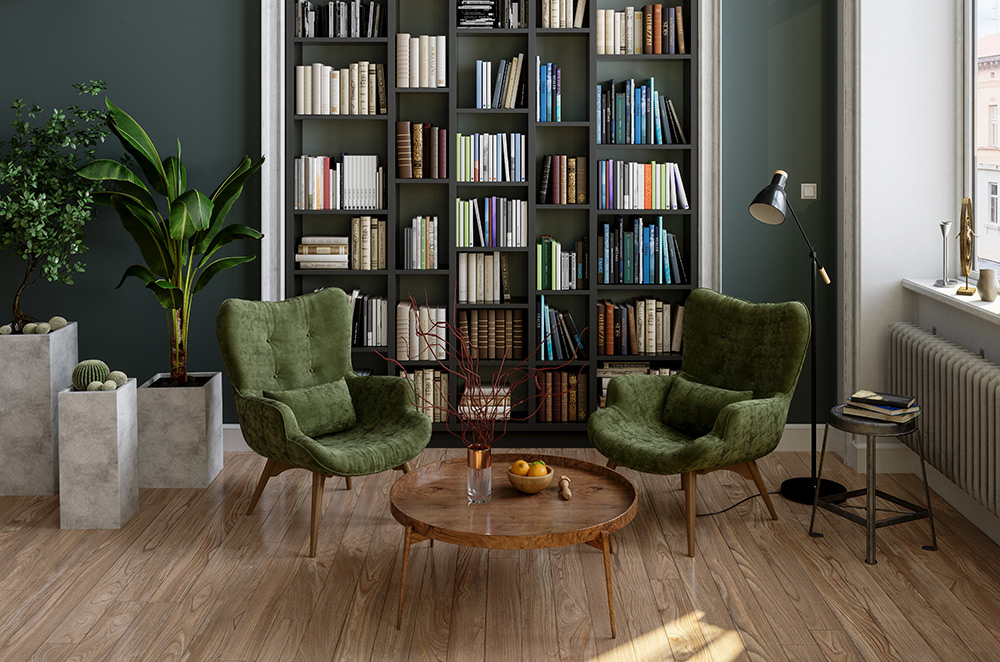
Perhaps the most important step is turning your seating inward. (This is where the classic club chair, named for its environment, is especially handy.) A pair of inward-facing upholstered chairs with a cocktail table between them will encourage conversation better than a long sofa pressed against a wall. If space allows, introduce a second zone, like a card table or writing desk, so the room can hold more than one activity at a time.

Your lighting will be the hero of the space. Unlike rooms designed to flood with daylight, a clubhouse earns its mood from light that’s been tamed. In spring, let daylight filter through linen or cotton drapery that softens rather than blocks sunshine. By evening, the room should feel settled and swanky. Trade overhead glare for shaded lamps, sconces, and directional fixtures.
Be sure to prioritize excellent materials too. Wood with visible grain, high-quality leather, and wool rugs, for example, are materials that elevate the room.
Importantly, give the room a purpose beyond sitting, and set boundaries for how the space is used. This isn’t where laundry collects or the television runs in the background. The room’s character will ultimately be defined by the comforting habits you indulge therein. Incorporate a bar cart, bookshelves, and entertainment items like tabletop games or a projector screen—small cues that motivate use.

Clubhouse aesthetics don’t always have to be masculine and formal. For a sense of spring levity and positivity, replace heavy throws with lighter ones in neutral tones. Introduce a floral or botanical arrangement (e.g., branches, flowers, or even a bowl of citrus) rather than cluttering with smaller objects. When the weather allows, open a window for fresh spring breezes.
Colors can change with the season without disturbing the room’s restraint. Incorporate mint-green pillows, pale-blue lampshades, washed linen slipcovers, and other subtle adjustments to acknowledge springtime while keeping the palette restrained.
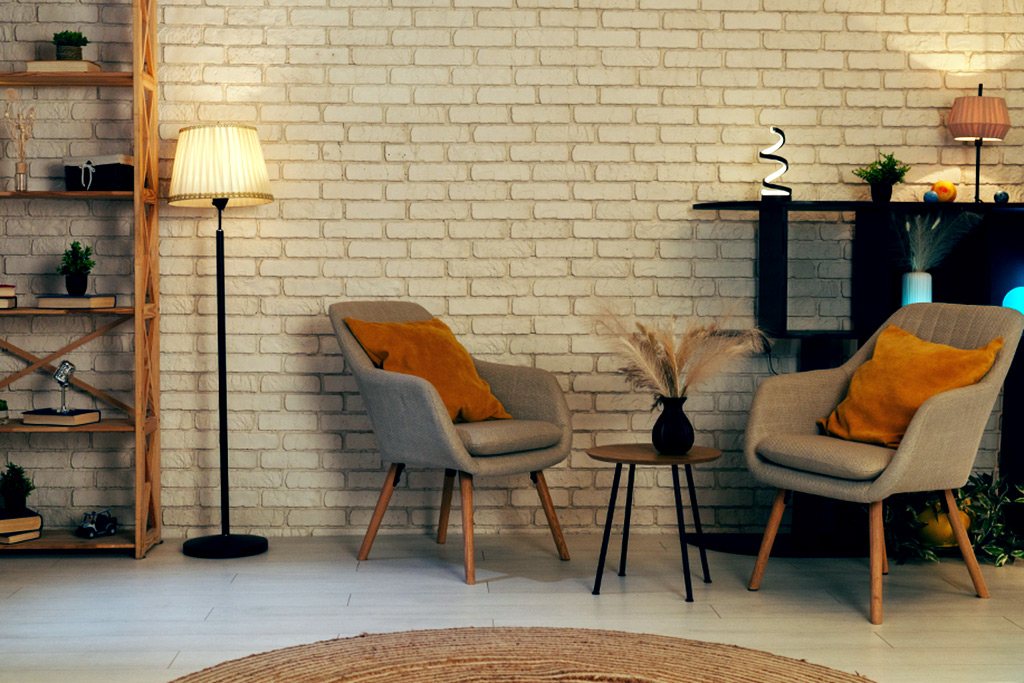
If your budget or time is limited, you can still craft an exclusive ambience. Focus simply on your lighting (a well-placed lamp), layout (turning seating inward for conversation), and entertainment elements (bookshelves), which will revamp and repurpose the room without a total renovation. Secondhand items suit this approach too; after all, a clubhouse aesthetic welcomes history.
Draw the furniture closer. Remove anything that doesn’t invite comfort. Add one substantial piece, like a quality chair, a floor lamp, or a small cabinet, rather than a collection of smaller ones.
Creating a clubhouse at home can change how you spend your time. You’ll begin to look forward to the room itself—the way it invites afternoon coffee, easy conversation with loved ones, and long hours with a book in your hand and your mind at rest.