For many homeowners, the garage is a largely overlooked space, serving as a place to store everything from their car to holiday decorations to old paint cans. But it doesn’t have to be a standalone dumping ground—remove your vehicle, enlist your imagination, and make a few practical upgrades, and it can become a highly functional part of your home. Here are four ideas for transforming this area to better support your lifestyle.

If your work-from-home experience feels cramped or noisy, your garage can offer a quiet retreat away from distractions. Start simple with essentials like a desk, a comfortable chair, and a soft rug underfoot to cover the hard concrete, adding more items as needed for your workday. You could even consider a total conversion, building a wall to close off the garage door and installing insulation and a mini-split HVAC unit for year-round comfort. Note, however, that if you’re doing a major renovation, you’ll need to check your local regulations to see if any permits are required. A licensed contractor can help you navigate this process safely and efficiently.

Skip the commute and membership fees by creating your own gym right in the garage. Lay down rubber mats to protect your floors and your body, then add equipment—such as free weights, a weight bench, and resistance bands—as well as good lighting to keep your workouts effective and enjoyable. Depending on the size of your space and your fitness goals, you can also add larger items like a treadmill and stationary bike. Other options include a wall mirror to help you check your form and a Bluetooth speaker to keep your energy up with invigorating music. As a bonus, you can open the garage door on sunny days for fresh air and a boost of motivation.
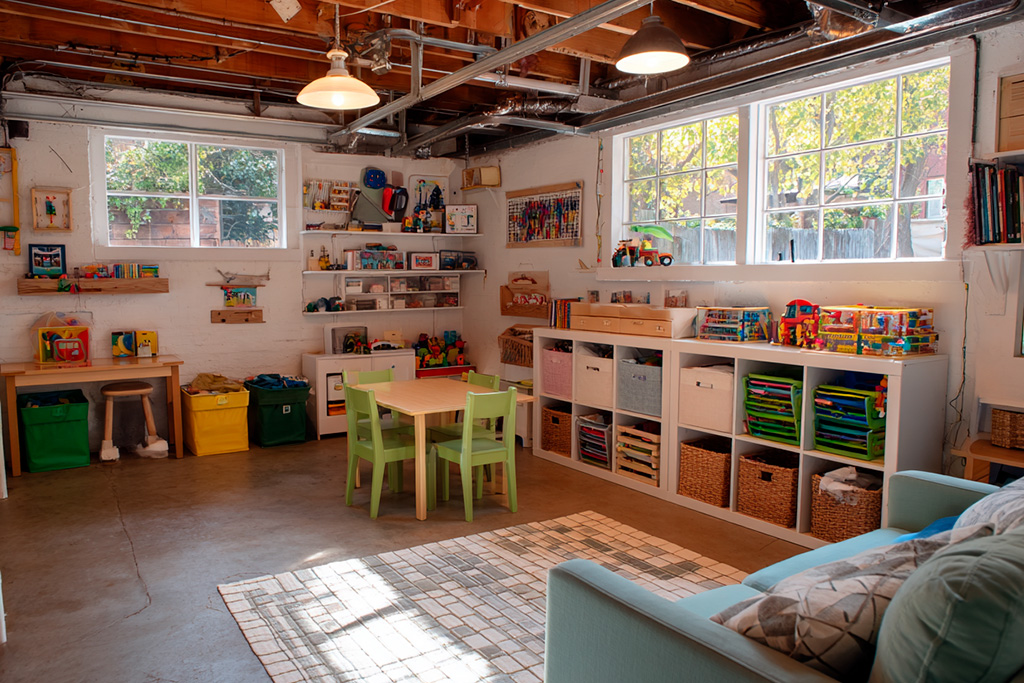
Do you need extra room for the kids to play? An emptied-out garage could be the perfect spot. Start by ensuring that it is fully clear of any hazards, including stored chemicals, rickety shelving, and oil on the floor. Once that’s done, install soft flooring like foam mats over the entire area for comfort and safety, and add storage bins and bean bag chairs around the room for easy organization and soft spots to rest. Throw in a Ping-Pong or pool table, and it will work as a playroom for children and adults alike. And similar to the office, it may be worth closing off the garage and insulating it, making it feel like a true extension of your home’s living space.

For hobbyists and DIY lovers, a garage workshop can become a creative haven. But rather than just carving out a cramped corner, allow yourself to expand so you can fully embrace the potential of your craft, investing in the appropriate equipment for your niche. A sturdy workbench, for instance, is always a good option. Just make sure it has enough surface space and drawers for your needs, and consider adding wheels to make it easier to move around as your projects demand. Pegboards and crates can also be useful to keep certain tools visible and easily accessible. And don’t forget the lighting! Combine bright overhead fixtures with task lamps so you can work at any time of day, whether the garage door is open or closed.
No matter how you choose to transform your garage, the key is making the space suit you and your family. With thoughtful design and a bit of creativity, it may soon become one of your favorite rooms.
Whether you’re planning ahead for weekday lunches or settling in for a cozy family dinner, these recipes from Emily Ley’s The Simplified Cookbook deliver big flavor with minimal effort. The bright, refreshing salad keeps things light during the day, while the hearty pot roast simmers until it’s melt-in-your-mouth ready.
With a vibrant mix of cucumbers, tomatoes, olives, and feta, this salad is perfect for make-ahead meals or serving a crowd.
This melt-in-your-mouth dish features tender meat, carrots, and potatoes, plus a fun flavorful twist—soda.

Recipes from The Simplified Cookbook by Emily Ley. Thomas Nelson, 2025. Photography by Kris D’Amico, Whitney Hawkins, and Carly Tanner.
This salad is great for make-ahead lunches or for serving to a crowd. Add shredded chicken or chopped salami for some extra protein.

Serves 4
PRO TIP: There are a number of wonderful premade salad dressings out there. If you have a jar and a few extra minutes, try making your own. This recipe was my grandmother’s go-to and I can promise you, it will not disappoint: simply combine equal parts vegetable oil, white vinegar, and sugar (or sugar substitute). I like to add a little salt and pepper to my salad, but you can also add those straight into the dressing.



I swear my mom shared this recipe with me, but she also swears she doesn’t put Coca-Cola in her pot roast. I, however, do! And I think if you try this, it’ll become your go-to pot roast recipe. It’s so easy that I can throw it together while making lunches on a busy school morning.

Serves 4-6


Seth Ballard, founder of Washington, DC-based Ballard + Mensua Architecture, discusses a grand renovation he did for a couple’s property overlooking Narragansett Bay.
Have you always been interested in architecture?
As a kid, I wanted to be a fireman. But when I was seven, I visited the National Gallery of Art’s East Building and was blown away—everything had so much order. My parents, knowing that I loved drawing, explained what an architect is and what they do. I immediately wanted to be one, and the feeling never wavered.

What led you to open your firm twenty years ago?
I worked for well-known architect Douglas Soe Lin for eleven years, building everything from resorts in Southeast Asia to country clubs and office buildings in the States. But I wanted to focus more on residential architecture, and, on top of that, I wasn’t seeing my young kids enough. So I started my own firm.
How did you get involved with this project? What were the clients’ goals?
I’ve been friends and worked with Bill and Tina for years; they’re quite a couple. Bill’s a commercial real estate developer and Tina’s the daughter of one, and both have backgrounds in construction. When their boys relocated to New England, they started looking at real estate in Rhode Island so they’d have a place nearby.
They found this house on a beautiful four-acre lot on the water and wanted me to make it like a private bed-and-breakfast—complete with seven en suite bedrooms and three bars—because they entertain so many friends. I appreciate how much faith they had in me, allowing me to shop for everything from the furniture, art, and paint right down to the dishes and linens.

What was the home’s original style?
It was a late sixties/early seventies hodgepodge with very minimal trim and a mix of flat and angled roofs—and it felt very dated. Ultimately, we ripped out the roof, most of the walls, the plumbing, and all the wiring and basically used the remaining structure as a starting point. We then created additions up and all around it, swallowing it within them to make the great room.
How did the water setting influence your design?
We wanted the home to feel like a big ocean liner because it overlooks vast Narragansett Bay. For instance, we weathered seasoned timber with a coastal color for a driftwood feel and sculpted waves in it, making it look like hand-hewn ship beams. We also incorporated other nautical details, such as round windows, copper lights, a ship-style railing above the garage, and two stories of glass in the great room. You can even walk across what feels like a bridge on the upper level.

Were the exterior choices based on withstanding bayside elements?
Yes, but Bill and Tina wanted authentic, historically correct materials as well, so I pulled inspiration from New England. The pergola’s timber frame is western red cedar, for example, which we stained to make it long-lasting, while the garage doors are custom mahogany and the roofing is slate and copper for beauty and durability. Similarly, the flagstone and bluestone around the perimeter are maintenance-free, and the subterranean patio is made out of Nantucket Stacked Stone; I designed the latter with civil engineers to withstand a hundred-year storm.
The octagon tower is breathtaking. Would you discuss it?
The tower offers a water view on every side but one, and each level and room has something special. On the lowest level, for example, visitors can step out onto the beautiful 1,000-square-foot patio. But Bill and Tina’s bedroom in the middle level is the biggest highlight of all because when you’re in it, you’re surrounded by water and the beautiful rolling hills of Barrington; you can even see a lighthouse in the distance. In fact, many guests paint that scene because it’s so picturesque.
So the project’s name, All Points of View, is appropriate—for both the spectacular vista in all directions and how Bill and Tina are very welcoming to everybody. They used to host guests 300 out of 365 days a year in this house before retiring there.

You mentioned the home being like a B and B. How did you achieve this?
Every guest room has a built-in desk, dedicated luggage area, and en suite bathroom with two sinks. We also included a wing above the garage with colorful, children-oriented spaces that are still welcoming for adults. It features custom bunk beds and window seats, a play zone for young kids, and a separate area where older ones can play video games. Such details make guests very comfortable, knowing how much thought the owners put into their stay.
Is it challenging to craft homes that are grand yet welcoming?
The main reason this dichotomy fails in such houses is because they have no scale, resulting in a cold, lifeless furniture layout. That’s why we always make plans with proportion and scale top of mind. So in this house, you want to sit and relax, not only because of the view but also because the furniture is comfortable and lets you sink into it and there’s ample space between each piece, creating a cozier environment within the larger environment.

Do you also consider all points of view when you do a job?
Yes—it’s a natural fit. I credit my family for instilling that in me from a young age as well as Douglas, my mentor. He’d never go against a client’s wishes, which is smart because they’re proud of their ideas and won’t like or trust you if you push back too hard. Instead, I’ll say something like “We could definitely do that” but keep drawing and then show them what it could be. They’ll often like my option better since I took the genesis of their vision and remolded it using expert principles.
Overall, I see my job as being their editor, making sure there’s tastefulness within the realm of what they want. To do so, I need an open mind to receive their input, give it proper scale, proportion, and color balance, and synthesize everything for them. Only by considering all these points of view can I create their dream house.
For more info, visit ballardmensua.com
Homes throughout the country are as varied as America itself, and each one perfectly represents the unique people who occupy it. So what does yours say about you? Take this quiz to identify your organizational style—and learn how to make the best of your truest tendencies.

1. While getting dressed to go out, I:
A. Browse my choices on their hangers or shelves
B. Move a few things around as I brainstorm outfits
C. Leave what I don’t choose to wear piled on a chair or bench
D. Try on all kinds of combinations and deal with the mess later
2. I think a stylish living room is one that’s:
A. Neat, trendy, sophisticated, and downright impressive
B. Clean and nicely arranged but still relaxed
C. Attuned to my lifestyle and favorite hobbies
D. Unfussy and lived-in, filled with all the things that make me happy
3. When I want to set a drink down, I:
A. Always use a coaster because I have to protect my investments
B. Only use coasters for delicate surfaces like wood
C. Will use a coaster if it’s within reach
D. Put it down wherever I want; it’s my home, after all
4. My pantry is:
A. Categorized neatly with food stored in matching containers
B. Organized by food type, each having its own dedicated shelf
C. Arranged intentionally, though some things might end up out of place
D. A bit messy—but who’s going to look in it anyway?

5. When I finish using dishes, I:
A. Scrape them off, rinse them, and place them in the dishwasher
B. Put them in the sink to soak
C. Set them on the kitchen counter, maybe somewhere near the sink
D. Leave them where I was eating to deal with later
6. My home desk is:
A. Clear of any clutter, with supplies arranged neatly
B. Decorated to feel fun and engaging with everything in its place
C. A pretty laid-back spot where I can get some tasks done
D. Where I store my chargers and junk mail
7. My bathroom counter looks like a:
A. Magazine-ready space adorned with a decorative plant or candle
B. Collection of fun beauty products and decor I enjoy
C. Relatively clean surface (just don’t look in my medicine cabinet!)
D. Practical space with all my toiletries within reach
8. When I change my clothes after a long day, I:
A. Put them all in the appropriate hamper or closet
B. Toss them in a bin but don’t necessarily hang up what I plan to reuse
C. Drop them in the laundry room or closet so I can go relax
D. Leave them right on my bedroom floor—I want to sit and unwind ASAP

The results
Tally your score by letter, find which color category you fall into, and then discover more about your organizing personality.
Red
Your home is your realm, and like the color red, you’re passionate about how it looks and feels. You aim to not only keep each room clean and organized but also craft your spaces to evoke feelings of sophistication through eye-catching design. To achieve this lofty goal, you run a tight ship, holding both yourself and your loved ones to a high standard.
For consistent order without conflict, arrange a detailed cleaning schedule so everyone can chip in. Tackling just one room at a time or one major task per day (e.g., sorting laundry) can help take the stress out of the ongoing work of staying neat. But keep in mind that you may need to let go of perfectionism—whether for yourself or for others—especially during busier periods. Releasing this pressure can allow you to appreciate your home as a work in progress and accept that living comfortably may mean being a tad messy sometimes.
Yellow
Your approach to home care is as positive as this sunny color itself: fairly particular but not to a degree that makes you sweat. Everything has its place, and you recognize that spaces feel that much brighter when they’re neat.
You probably already have good home organization skills, but to enhance your abode’s cheery vibe even more, aim to get ahead of the clutter that tends to build up over time. Devote a spot, such as in the garage or laundry room, to collecting unwanted, broken, expired, and outdated items from around the house, and aim to clear them out once a month. You’ll love the extra space and breezy ambience such a strategy helps create, including in your typical go-to storage areas.

Green
As with outdoor enthusiasts, you prefer to let your environment lead the way rather than strictly dictating your surroundings. For example, you may feel that the kitchen and bathroom need to be clean and tidy in order to feel sanitary, but because the living room and bedrooms are for relaxing, they can handle a little more cozy clutter.
Home organization is about convenience for you, and improving your approach involves making such tasks feel more like natural parts of your routine. Try placing storage bins under your TV, swapping shelved furniture with concealing cabinets, and setting a hamper beside your bathtub. These efforts could make it simpler for you to stay consistently neat, enabling your entire home to feel more charming throughout.
Blue
If you belong in this category, you may have other priorities and passions beyond home decor and cleaning. Fitting the relaxed vibes of the color blue, your chief domestic concerns are mostly about comfort—why should remotes, chargers, pajamas, and other everyday essentials be tucked away when it’s more convenient to leave them within reach?
You might find chores to be taxing, but here is some motivation to stay on top of them: remember that your home is a major investment, and to safeguard the equity you hold in it, you’ll need to keep it in solid shape. For starters, devote at least an hour each weekend to tackling basic cleaning and organizing, relying on hacks like using a robot vacuum and electric scrubber and working to a soundtrack of great music to keep you energized. You’ll be surprised by how quickly new habits form after just a few consistent sessions.