In the twenty-first century, the way businesses raise capital has evolved dramatically. Traditional methods such as pitch meetings, formal introductions, and financial projections are still important, but they no longer operate alone.
Enter: online communities, potential gold mines that allow business leaders to cultivate trust, demonstrate traction, and attract investors faster than ever before. When used strategically, such platforms can spotlight progress that encourages supporters and investors alike to participate in your company’s growth.

Investors often say they “bet on the jockey, not the horse,” meaning they look closely at the founder just as much as the business model. One of the most significant advantages of social media for business leaders is its ability to amplify personal branding. This tool allows leaders to not only show their expertise and communicate their vision but also build their credibility with the public.
For instance, there are countless examples of home experts who have built large followings by breaking down complex issues into easily digestible content. When you do something similar online, you can position yourself as knowledgeable and trustworthy, making investors more comfortable about a potential partnership because they can clearly see how you think and lead.
Beyond personal branding, social platforms serve as a showcase of traction by providing a live pulse on engagement, customer interest, and community sentiment. When business leaders share milestones like new partnerships and product launches, or even just positive reviews, they provide vital social proof that their business is gaining momentum. For investors who want early indicators of a product-market fit, these real-time signals can be far more compelling than a static PowerPoint slide, demonstrating that people enthusiastically care about what the business is doing.

Community building is another crucial element of securing funding through digital platforms since a strong and engaged community bolsters investor confidence. Whether it’s a LinkedIn following, a Facebook group, a Discord server, or even a subreddit dedicated to the product category, having a group of people who regularly engage with a company’s content and use its products shows that the business has a reliable base of early adopters. A well-known example of such a success is the clothing brand Bombas, which gained a massive following by utilizing and promoting its buy one-give one model of business. Even better, these communities regularly share testimonials, serving as unofficial ambassadors for a brand—all without being prompted.
Just as important, they are often the earliest supporters of fundraising campaigns, especially on crowdfunding platforms like Kickstarter and Wefunder. Such passionate enthusiasm for, and belief in, a business can drive momentum that attracts institutional investors by signaling that demand exists for what the supported company offers.
Because of this, prioritizing engagement within these communities is a must. When you are visible, approachable, and responsive as the lynchpin of the company, you can cultivate trust not only with customers but also with potential investors observing from the sidelines. Host live Q&A sessions, share behind-the-scenes updates, and even consider asking community members for insights into product decisions—whatever keeps the discussion flowing. Such efforts can foster a sense of ownership among followers, compelling them even more to become vocal advocates of your business. In turn, these voices often catch investors’ attention by validating the company’s growth potential.
To that end, many entrepreneurs also announce their fundraising efforts on social media and highlight their progress along the journey. These enthusiastic updates, such as “We’ve secured 40% of our seed round money!”, create excitement and urgency. And the sense of momentum in the online community often accelerates the fundraising process through sheer enthusiasm and, frankly, a bit of FOMO on an investor’s part.

Another way you can strategically use social media to secure funding may already be familiar to you: relationship building. Platforms like LinkedIn and X make it exceptionally easy for business owners to connect with investors long before they ever ask for money. By leaving thoughtful comments, sharing your insights, or reacting to industry news on their posts, you can organically enter investors’ spheres of awareness and foster familiarity, potentially leading to more productive conversations and higher chances of investment.
Content creation is also a powerful avenue for demonstrating not only your leadership and firm grasp of your market landscape but also your long-term vision to potential investors, who often are on the lookout for founders with such abilities. Utilizing a tool such as long-form content (blog posts, newsletters, YouTube videos, podcasts, and the like) allows you to articulate your strategic thinking while reinforcing your credibility and commitment.
Through social media and community platforms, today’s business leaders have unprecedented tools at their disposal, including the ability to create an online ecosystem that attracts and accelerates investor interest. At a time when transparency and authenticity matter more than ever, embracing these platforms strategically can uniquely position your businesses to grow and thrive.
TAKE ACTION:
Brainstorm the best ways you can engage with your company’s online community to increase your organization’s revenue.
The modern consumer is overwhelmed by a sea of advertising, from promotional social media posts to pre-roll commercials featuring Hollywood and social media elite. While landing such high-profile endorsements might seem like a recipe for success, bombarding consumers with this lofty imagery has led to an unexpected contrary effect: a crisis of trust. Why should your target audience have faith in recommendations from far-off individuals who don’t use your product organically or engage with your customer service directly?
In the face of many audiences’ growing distrust of business marketing, don’t swell your marketing budget to buy the next big endorsement. Rather, adjust your techniques and return them to a more human scale, where greater dependability can sway more consumers.
Welcome to the age of microtrust, which is effectively handing power back to small businesses over corporate giants. This new landscape prioritizes authenticity, relatability, and personal recommendations in marketing. If you own or lead a small business, delve into some of these key approaches to fostering microtrust.

Until recently, celebrity endorsements were the gold standard of marketing. The theory was simple: If a famous person uses it, then it must be valuable. But modern consumers are acutely aware that these rubber stamps are often transactional and not genuine backings. And hard data reflects this skepticism. While brands continue to invest billions in macro-campaigns, consumer trust in traditional advertising is plummeting. The perceived distance between a global celebrity and the everyday purchaser creates a trust gap that even expensive campaigns simply cannot bridge. This may be positive news for you; after all, forking over funds for prominent endorsements may be financially unfeasible.
Luckily, consumers place more trust in messaging that is far less expensive for you to generate. Local praise and referrals from loved ones may surpass other forms of advertising. So to achieve your marketing goals, the smartest play may be leveraging the trust inherent in being the opposite of a celebrity or mega influencer: a local and relatable voice. Doing so can grant you the kind of authenticity that large corporate competitors can’t touch.

The most compelling proof that influence is about resonance, not reach, is the dramatic rise of the microinfluencer: creators with audiences typically ranging from 1,000 to 100,000 followers.
While they lack the audience size of an A-lister, they command something far more valuable in the form of intimacy and niche know-how. Their followers view them not as distant icons but as peers, neighbors, and trusted experts. This personal connection results in startlingly high-performance metrics. According to Sales Hub, microinfluencers often achieve engagement rates of 3–8 percent or higher than their celebrity macroinfluencer counterparts. This enhanced engagement can directly translate to higher conversion rates for the businesses they promote.
For your small business, partnering with such creators to build a more intimate marketing strategy can offer two critical advantages:

Beyond the digital landscape, peer recommendations (or, simply, word of mouth) remain a foundational pillar of microtrust. This is the single most successful marketing tool for small businesses, and no celebrity campaign can touch its efficacy. Consider the following:
Upward of 80–85 percent of US small businesses reportedly cite referrals as their most successful marketing tool. This is the organic bedrock of the age of microtrust. Happy customers become authentic advocates, turning their personal experience into credible social proof.
As a small-business owner, your strategy should be built on cultivating these authentic connections. This new age of microtrust is a reminder that the most compelling influence is always found on a human scale, right in your own neighborhood.
TAKE ACTION:
Research at least three local creators who you could contact to arrange a partnership opportunity and at least three avenues for requesting consumer referrals.
As a business leader, you very well may have experienced the effects of pushing yourself too hard. Decision quality usually shifts before motivation does. While the drive remains and the hours stay long, clarity changes. Fatigue affects how you think, not how hard you work.
The impact rarely shows up as a single failure. It appears gradually: decisions take longer and difficult conversations get delayed. Strategic risks feel heavier than they should. Over time, leaders default to what’s known, even when the business would benefit from a different move.
Because this erosion is subtle, consistency is easily mistaken for effectiveness. From the outside, it still looks like dedication. Inside the business, momentum quietly slows.
Self-care is not about comfort or balance for its own sake. It is about preserving the mental and physical capacity required to make clear decisions when pressure is constant and tradeoffs compound. Burnout can seriously impact not only your business and employees but also your personal relationships, especially your family.

At times, running a business means making decisions with incomplete information and absorbing uncertainty as a daily condition. Determination can carry you through intense stretches, but it does not scale indefinitely or protect judgment on its own.
When you’re depleted, the work only you can do begins to slip. You may still be “showing up,” but the quality of your presence declines. Often, it simply feels like everything takes more effort than it should.
As a founder or owner, you are a big part of the system that keeps your business running. When your energy drops, the organization feels it through delayed decisions, uneven leadership signals, and lost momentum, often without anyone being able to name the cause.
Rest works only when it is treated as a requirement rather than something earned after exhaustion. Vague intentions do not survive operational pressure, especially in environments that reward constant availability.
To prioritize this necessity, choose one activity that reliably improves your clarity or focus the next day and schedule it with the same seriousness as a customer meeting, being sure to protect it. Measure it by the outcome at both home and work. If you find yourself recovering faster, having steadier attention, and making better decisions, you’ve found your winning formula for rest.
The activity itself is secondary. Exercise, uninterrupted reading, device-free evenings, or protected time with family all work when they restore capacity. Just remember, though, that occasional recovery cannot offset daily depletion.

Boundaries conserve decision-making energy. They reduce context switching and constant low-level vigilance. When stepping back feels impossible, delegation is usually the constraint, not workload.
The truth is that total disconnection is unrealistic for most entrepreneurs. What is realistic is defining at least one protected window each day when you are unavailable and treating it as fixed rather than conditional. For example, take a short walk without your phone or schedule a blackout time each night for work communication.
Clear ownership matters. Assign responsibility for specific decisions, and allow others to carry them through without constant oversight. Reinsert yourself only when the outcome truly depends on you. Done well, delegation lowers cognitive load and strengthens your organization. Done poorly, it concentrates pressure at the top and accelerates burnout.
Boundaries are not about disengaging from the business. They are about preventing leadership capacity from being consumed by everything except the work that matters most.
Your development should expand your capacity, not increase strain. When growth is framed as constant accumulation—more habits, more output, and more expectations—it competes with recovery and eventually wins.
Focus instead on personal goals that restore your energy or remove friction, such as taking up a hobby or walking for thirty minutes. Simplifying routines or resolving a long-ignored constraint often produces more impact than abstract self-improvement. Less drag creates more room for good judgment.
Relationships matter here as well. Time with other entrepreneurs can reduce isolation and normalize challenges. The same goes for friends, family, and loved ones; spend time with people who restore you. The right environments offer perspective and clarity, not performance theater or pressure to “do more.”

Learning remains important, but selectivity matters. Information that increases complexity without improving execution adds mental load and slows judgment. It needn’t only be business development; you can take a painting class or bird-watch.
Prioritize education that simplifies decisions: systems that reduce repetition while providing clearer delegation, better financial visibility, and stronger communication. The goal is fewer decisions made with more confidence, not more ideas competing for attention. If learning makes you clearer, it’s working. If it leaves you overwhelmed, it isn’t.
Protecting your health and energy is not a personal indulgence. It is a leadership strategy. Clear thinking, emotional control, and steady judgment come from operating within self-imposed limits you set. Strong leadership shows up as consistency over time, not endurance at any cost.
When you protect your capacity to recover and decide under pressure, your business benefits directly.
TAKE ACTION:
Block thirty minutes this week for a noncancelable activity that can reliably improve your leadership focus the next day.
Samuel Griffin, president of Ryerss Farm for Aged Equines in Pottstown, Pennsylvania, discusses what it takes to run his organization, the country’s first horse rescue and retirement farm and the oldest nonprofit horse sanctuary in America.
Tell us about how Ryerss Farm came to be:
During the Victorian era, horses were considered to be mere machinery. Our founder, Anne Waln-Ryerss, had compassion for these animals and was one of a growing number of people at the time who insisted that horses should be cared for. Our farm grew out of that movement. Anne was a dedicated animal advocate during her lifetime, as were her and her husband’s families, helping to create both the Pennsylvania SPCA and the American Anti-Vivisectionist Society. We opened in 1888, thanks to money she left for building a place that cared for older and injured animals.
How big is the farm today, and what takes place there?
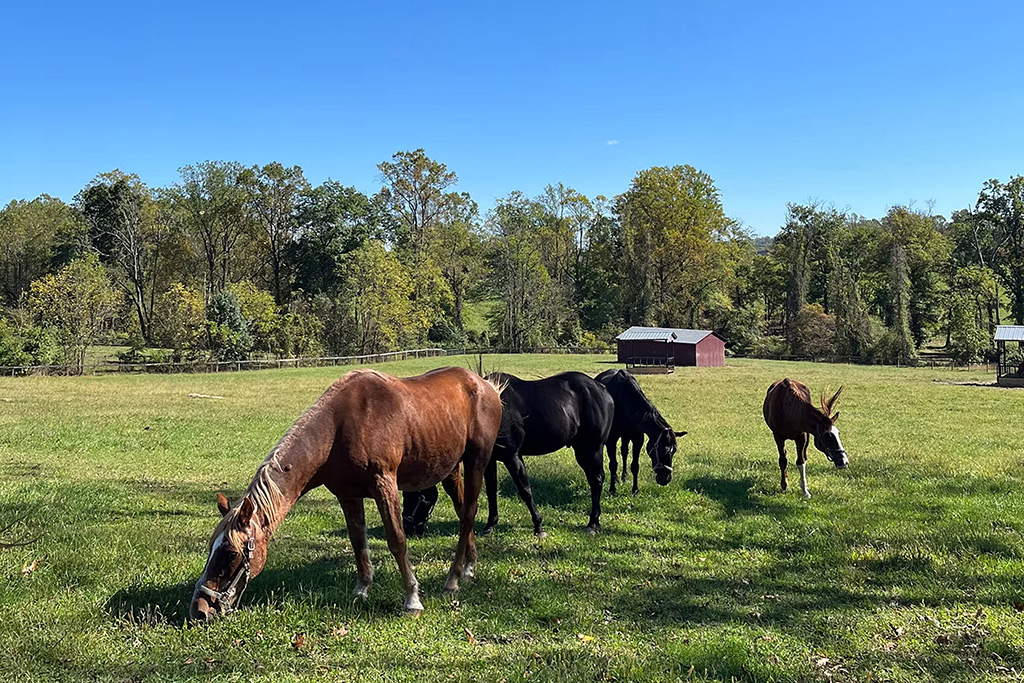
We own around four hundred acres and around eighty stalls. At any given time, we have from seventy-nine to eighty-five equines living here—not only horses but also mules and donkeys. We’ve housed just about every equine other than zebras.
When we settled into our current location, we preserved the land for agricultural use only to support as many animals as we could. Half of it is dedicated grazing space for the animals, and the other half is farmland. We grow our own hay, straw, and corn and sell the corn on the open market. Overall, it’s a big operation.
Are you open year-round?
Yes, 365 days a year from 10:00 to 4:00, with free admission. We’ll sometimes close for a holiday, although people have been known to just show up to see the horses on Christmas morning.
What’s it like to run a year-round organization and farm that cares for dozens of equines?
There’s a huge amount of work involved. Our farm manager, Cory Mowrer, takes care of all the farm operations, doing so much of the overall work. But it’s also handled by a few other full-time employees, including an on-site, live-in veterinarian, and around one hundred volunteers. It’s basically like running a retirement home for horses. However, none of the people who do it would say it’s work because they all love caring for the animals. That’s why we have almost no turnover.
My house is actually right next to the farm, so I can see everything happening firsthand even when I’m at home. For example, we produced about forty to forty-five acres of corn last year. Watching it grow all season and then get harvested in fall just reminded me about how much goes into running this place. I find it astounding.
What’s the most challenging aspect of running the business?
You’d probably get a different answer from every person here. For me, it’s financial because I wake up every morning thinking about how we’re going to make ends meet. For others, the biggest challenge is keeping the farm in order. In addition to caring for our animals, we have a lot of buildings with a lot of roofs and plumbing, for example, and it’s always a roll of the dice every year determining what crops to sow and where—all the worries of a farmer. Cory’s an excellent one, and he approaches it very intelligently.
Supply and demand is always a critical part of running a business. How is that balance for Ryerss?
Demand is not quite as huge as it was when I first got here, only because we accepted most horses on our waiting list, yet we’d never see many of them. That list has only gotten bigger, so for horses to be on it now, we ask their owners to pay a $250 fee, which goes toward their horse’s entrance fee to live here. If they never show up, it’s considered a donation to Ryerss. This better ensures that people who put their horses on our list are serious about it.
Our waiting list extends out about two and a half to three years. To secure a spot, some people put their horse on the list when it’s quite young and then wait years for it to turn twenty, our minimum age limit. Others put it in their will that their horse is to come here if it outlives them.
Being a locally based nonprofit, how do you raise capital?
About 40 percent comes from charitable donations, and we have a $10,000 admittance fee for each horse that’s brought in, which pays for its care for a year and a half to two years. We also hold annual events to raise money.
We’re playing the long game here as far as I’m concerned. For instance, if we have a thousand visitors and one hundred of them turn out to be well off, maybe two out of that one hundred wind up not having any children and don’t know where they’re going to leave their money. Ideally, we want them to donate it to Ryerss.
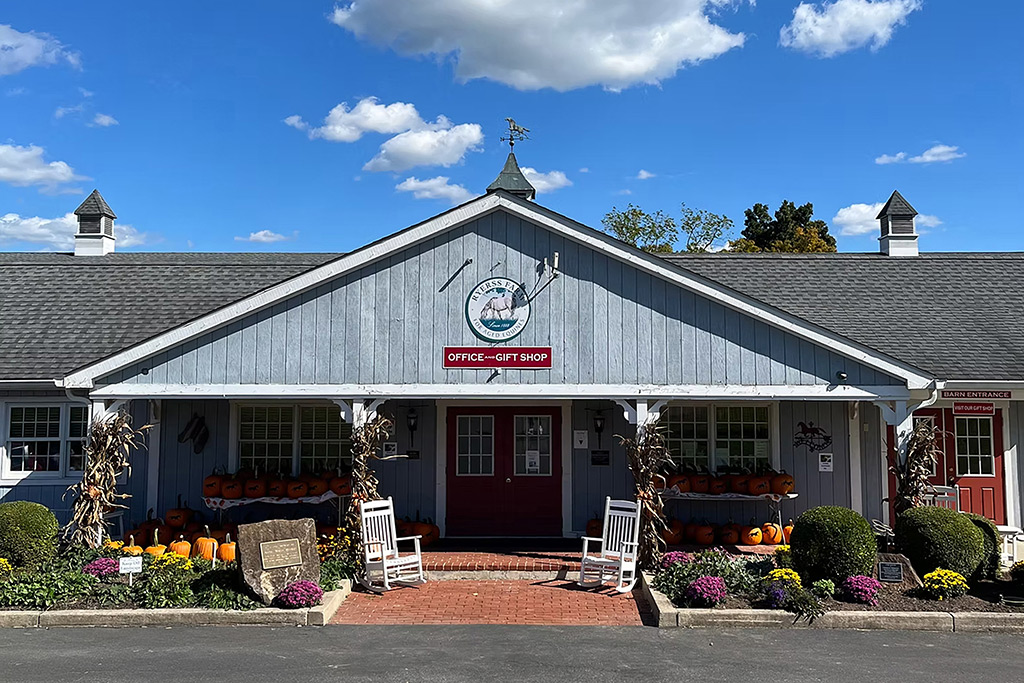
You mentioned events. How many do you have each year, and what role do they serve in the grand scheme of things at Ryerss?
We started holding them for consistent visibility and awareness, so that people would come and see us and know what we do, and to raise a little money. In autumn, for instance, we hold our birthday gala, a fundraising brunch and auction; and in December, a free holiday event, which is a big draw.
In spring, we have a 5K run/1K walk that goes around the farm; that’s gotten bigger every year. And during summer, we have our Family Fun Day, which includes family-friendly food and activities. Everything is bought through tickets, which we sell for a dollar each, and nothing costs more than about five tickets. We also host summer camps where kids learn about horses and farming, encouraging future interest in both.
How crucial are your volunteers to your success?
They’re the key to the whole thing. And I don’t mean just the volunteers cleaning the stables but also our board of managers, which is comprised of nine volunteers with horse backgrounds, and our board of advisors. All these people are normally quite busy, yet they make sure to give their time to the farm. There are only about five or six paid staff in the whole shooting match here, such as the office manager, animal welfare manager, and farm manager.
What does Ryerss mean to its community?
That’s a good question. This part of Chester County is becoming suburbanized, but Ryerss will always be evergreen. People here know we’re never going to move, which provides a sense of stability in changing times. And, of course, because of the influx of visitors we get, it’s great for the community as a whole. I think we’re an important piece of it.
What’s the best part of this venture for you?
I grew up with horses; my grandparents and parents both had them. I was a rider from a young age, which I enjoyed immensely, and I was always very attached to our horses. In fact, I was retired when some friends of mine on the board of managers here asked if I’d like to join them, which was a no-brainer. I’ve been here fifteen years now after my first “retirement,” which is a testament to how much I love Ryerss, its staff, and its residents. Every person is here for a greater purpose, which makes all the effort the farm requires well worth it.
For more info, visit ryerssfarm.org