Amy Beros, president and CEO of the Food Bank of Central and Eastern North Carolina, reveals what it takes to continually serve the needs of the community.

Have you always had a passion for helping people?
It’s actually part of my earliest memories. When I was growing up in South Carolina, a family friend’s husband passed away. She was a stay-at-home mom and suddenly couldn’t pay bills or put food on the table, so the community rallied around her. When she was able, she started an organization that helped others who were struggling to make ends meet.
My family always volunteered and raised money with grassroots events like classic car shows, cake raffles, and food distributions. After I graduated from college and moved across the country, I always found ways to stay involved in helping others. I previously worked in the financial banking sector, though, which is very different from food banking. I felt pulled to the latter and transitioned into nonprofit work about sixteen years ago. I have been working professionally in hunger relief for about twelve years now.
How helpful was your background for that transition?
Very, especially in the past few years. People often think of nonprofits differently from corporations because of the mission, but 501(c)(3) is simply our tax status. If we’re not making decisions like a business, we won’t be here for the long term.
Approximately how many people do you serve, and how much food do you distribute?
We provide nearly one hundred million pounds of food each year to over 600,000 individuals. One in seven people in the thirty-four counties we serve, including one in five children, are food insecure, meaning they’re not sure where their next meal will come from. That’s unacceptable in a country like ours. It takes tremendous resources to meet that need, and, unfortunately, the demand continues to grow.

What strategies have you implemented to meet that demand?
We are one of the ten largest nonprofits in the country when measured by the value of the food we distribute. Alongside donations and charitable gifts, we also receive government support. Because of the scale, we have to make business decisions, often tough ones. We have eliminated some programs so we can focus more on immediate needs, for example. Our 2030 strategic plan focuses on a culture of doing better rather than doing more. That means using data to guide our decisions and ensuring that our neighbors help shape our strategies through ongoing feedback from the community.
We are also investing deeply in agricultural partnerships, including farmers who grow specifically for our food bank. One in North Carolina alone has three hundred acres dedicated exclusively to it. That allows us to help determine what is grown so we can fill the gaps that donated products might not cover.
Is access to such a large farm unusual for a food bank?
It is, but I think it is something we’ll see more of in the future. We certainly plan to keep investing in that area. In 2025, we lost out on the equivalent of about $7 million in direct food donations, along with around $5 million in government investment and several truckloads of food.
Because of that, we are thinking about how neighbors support neighbors. We’re looking closely at strengthening local food systems, growing philanthropy, and increasing advocacy and public policy work. There is also a real opportunity to partner with the business community on these issues.

What are some other drivers of food insecurity?
Access is a major factor—to resources and opportunity. Housing costs, childcare, healthcare, and grocery prices all contribute. Many families are just one emergency away, such as a missed paycheck, a broken car, or an appliance that needs replacing, from needing help.
For instance, I received an email from a father who worked at a federal prison. He told me he had never asked for help before, but after missing two paychecks he didn’t know how he would feed his five children. Situations like that highlight how quickly people can find themselves needing support.
Would you elaborate on your mission statement?
Our core mission remains the same: Hunger is unacceptable in our community. What has changed is how food banks operate. Years ago, people pictured warehouses filled with canned goods. Today, the model is very different. In 2025, about 63 percent of the food we distributed was fresh produce, protein, dairy, and eggs. The goal is not just providing calories but providing healthy calories.
We also invest in nutrition education. Our staff includes nutritionists who create recipes using foods people might receive from food banks or partner pantries. They conduct demonstrations and help families learn how to prepare those foods. We also focus on chronic disease prevention because food truly functions as medicine.
That idea has led to partnerships with healthcare providers. We work with about eighteen of them and sometimes use food as part of a medical prescription approach. These programs help address both hunger and health outcomes.
How important are partnerships to your efforts?
They are essential. Simply put, we do not open our doors without them. It takes about seven hundred partner organizations working directly with neighbors. It also takes thousands of business partners who support us through donations, food contributions, and volunteer hours.
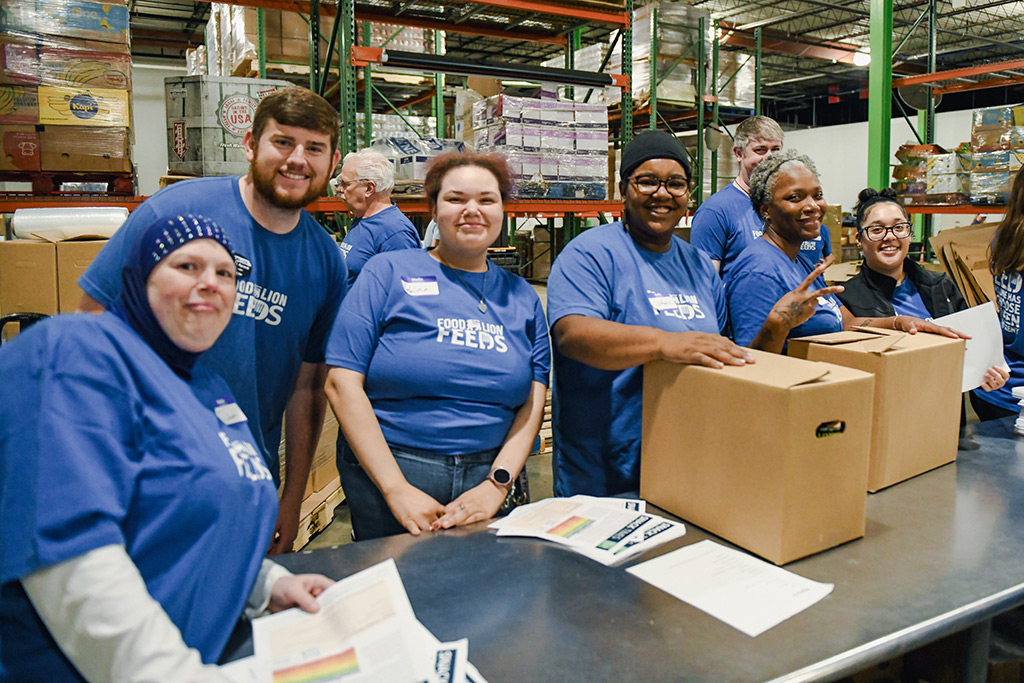
Each year, around 60,000 volunteers help us operate by sorting food, packaging it, and helping prepare distributions. If volunteers don’t show up, the food does not move into the community. That makes volunteer engagement truly business‑critical for us.
Logistics must be extremely complicated with so many counties involved.
Food banks are essentially large logistics organizations. Unlike many industries, however, we often work with incomplete information. Donations arrive unpredictably, and we don’t always know what types of food will arrive or when. At the same time, we must distribute those foods quickly because many are perishable.
Each of the counties we serve has different needs. Some areas are urban, while others are extremely rural. We use a fair‑share model that distributes food based on food‑insecurity rates so that rural areas receive equitable access rather than resources flowing only to major population centers.
How much do donations fluctuate throughout the year?
Like many nonprofits, we receive much of our annual revenue, about 40 percent, during the holiday season. Yet summer is when demand is highest because children are not receiving meals at school. That means we must carefully plan inventory and finances months in advance.
In your experience, do nonprofits compete for funding?
Fifteen years ago, I might have said yes. Today, I think about it differently. Our partner organizations rely on us for some resources but not all. If they don’t receive support from their own communities, they cannot stay open. We are only as strong as the partner network around us.
In fact, instead of competing with one another, several large partner organizations in Durham formed a coalition to fundraise together for hunger relief called End Hunger Durham. That type of collaboration may represent the future of nonprofit fundraising.

You also respond to disasters. How does that affect your operations?
Disaster response is a major responsibility. What used to be seasonal—such as hurricane season—now feels year‑round across the country. We maintain a reserve fund specifically for disaster response so we can act immediately when communities need help.
In Wilmington, for example, we operate a commercial kitchen designed to support disaster relief. It can function as a twenty-four‑hour response center, providing prepared meals during emergencies. We also partner with organizations such as World Central Kitchen during large‑scale disasters.
Would you share any stories that illustrate the impact of your work?
The farmer partner who has three hundred acres dedicated to our food bank told our board that working with us gave new purpose to his farming. He even said his family farm might not have survived without the partnership.
Another experience involved a grandmother raising her two teenage grandchildren after her son passed away. She received vouchers through a farmers market nutrition program and was so excited to take her grandchildren to choose fresh produce together. Moments like that remind us why the work matters.
What do people in your community say they need most?
Our strategic plan reflects four major themes we hear consistently. First is equitable access, especially in rural areas. Second is dignity. People want respectful treatment when asking for help. Third is healthier food, particularly fresh produce and protein. Surveys show that more than 80 percent of respondents want fresh food such as produce, eggs, and protein. And the fourth is advocacy to address policy issues that influence hunger.

What one misconception about hunger do you wish people understood better?
One of the most frustrating misconceptions is that people who need food assistance are unwilling to work. In reality, many use food banks only occasionally during difficult months. Hunger often results from unexpected circumstances, such as medical bills, job loss, or family emergencies.
When we say one in seven people experience food insecurity, those individuals may be your neighbors, coworkers, or parents of children in your child’s classroom. Hunger is often invisible because people feel stigma about asking for help.
How can business leaders support food banks?
Volunteering is incredibly valuable. Businesses can organize team volunteer days or offer employees paid time to volunteer. Advocacy also matters—business leaders can help raise awareness about the connections between food security, public health, and economic stability. And businesses can share their expertise with nonprofits to help strengthen operations and strategy.
For more info, visit foodbankcenc.org
The problem with marketing acronyms is that they get introduced as definitions and applied inconsistently across campaigns without a clear sense of how they connect to each other or to the business outcomes that actually matter. The result is a team that can report the numbers but struggles to act on them. Data gets presented, and execution continues largely unchanged.
The fix is a different frame. Every marketing metric is a diagnostic tool, and each one answers a specific question about where a campaign is working. Understanding them in that order (question first, metric second) changes how they get used.
Let’s discuss four common ones that you’re likely to see.

Cost per acquisition (CPA) is where marketing performance connects directly to business viability. It measures the total cost required to convert a prospect into a customer. It must be evaluated against the revenue or margin a customer generates. If the CPA exceeds the value of the customer, the campaign is consuming more than it produces.
CPA is also the metric most sensitive to what happens after the click. A campaign with high CPA almost always has a conversion problem: a disconnect between what the ad promised and what the landing page or sales process delivers. Fixing CPA without examining that gap is an exercise in adjusting spend rather than solving the actual problem.
Cost per click (CPC) measures how much is being paid for each engagement. It is shaped by competition, audience targeting, platform dynamics, and the quality score the platform assigns to the ad. A low CPC isn’t inherently good, and a high CPC might not be bad. The number only becomes meaningful when compared against what those clicks produce downstream.
A campaign generating clicks at a low CPC but failing to convert is a cheap traffic problem, not a cost-efficiency win. CPC describes the economics of attention. It says nothing about the economics of the business. That requires the next metric.

This answers the question “Is the message earning attention?” Click-through rate (CTR) measures the percentage of people who saw an ad and chose to engage with it. A high CTR signals that the message is relevant and the creative is doing its job. A low CTR signals the opposite: that the audience, the message, or the placement is misaligned.
CTR is the top of the diagnostic chain. When it is low, everything downstream suffers regardless of how strong the landing experience is. But a high CTR isn’t a success signal on its own. It confirms that the first filter, attention, has been passed. What happens next is where the more consequential metrics begin.
Return on investment translates marketing activity into a commercial outcome. It answers the question every operator ultimately needs answered: Is this worth doing? A positive ROI means the campaign is generating more value than it costs. A negative ROI means it is not, regardless of what the other metrics suggest.
ROI is the final check, but it is a lagging indicator. By the time ROI deteriorates, the contributing failures, such as weak CTR, high CPC, or poor conversion, have already been present for weeks. This is why the earlier metrics matter. They provide advance signals that allow course correction before the ROI damage compounds.

The four metrics form a diagnostic chain, and each failure mode points to a different intervention. Low CTR indicates a message or audience problem; the solution is a creative or targeting adjustment, not a budget increase. High CPC with acceptable conversion may simply reflect competitive market conditions and require a margin-based judgment about whether the economics still work. High CPA with strong CTR points to the post-click experience: the landing page, the offer, or the sales handoff. Negative ROI with acceptable CPA suggests a customer value problem—the right acquisition cost for the wrong customer.
Reading these metrics in sequence rather than in isolation is what separates operators who manage campaigns from operators who are managed by them.
The practical failure is tracking too many simultaneously. Impressions, reach, engagement rate, and frequency are easy to generate and easy to report, but most are disconnected from commercial outcomes. They measure visibility, not performance.
A tighter approach (CTR, CPC, CPA, and ROI, reviewed weekly against defined targets) creates a shorter feedback loop and forces clearer decisions. When CPA rises two weeks running, that is a pattern requiring a response. When ROI is negative at the current CPC, that is a business decision about whether to continue, adjust, or stop.
Marketing data does not produce clarity by existing. It produces clarity when connected to specific decisions and reviewed with enough frequency to act on them before the window closes.
TAKE ACTION:
Master these metrics before your next campaign review, and you’ll spend less time reporting and more time deciding.
Oversaturated marketing across smartphones, TV, and print ads can barrage your audience with noise. To compete with all this outreach and make a greater impact, don’t just shout louder; feature your USP to speak with greater clarity.
Unique selling proposition (USP): (noun) The distinct advantage that makes your business superior to its competitors and highly relevant to your specific target audience.
Identifying a USP is more than just a branding exercise. It is a mechanical necessity for any business that transitions from chasing cold leads to building a sustainable, relationship-based enterprise. Try these foundational strategies for defining your company’s distinct value, and you could shift the perception of your business from an ordinary commodity to a trusted forerunner in your industry.

Many professionals operate under the assumption that they must be everything to everyone, possibly fearing that a narrow focus will exclude potential clients. Wouldn’t gearing a retail shop to outdoors enthusiasts, for example, turn away urbanites? However, failing to define a specific identity often results in a marketing strategy that feels unfocused and maybe even ineffective. If you want to maximize your potential, you need to sharpen your edge through the power of a clear USP.
Take Nike’s USP, which you could label as reliable athletic wear that offers superior comfort, performance, and results.
While many people confuse a value proposition with a USP, the former simply concerns how you solve your clients’ needs or wishes without a necessarily competitive focus. The latter, meanwhile, explains what makes your brand greater than and distinct from other brands. If you establish a clear USP, you can avoid being merely another name on a crowded avenue or a sea of social media posts among competitors—and can instead become a resource that your target audience will see as uniquely poised to satisfy their requests.

Take the following steps to shape your USP and help make it definable across your branding, consumer outreach, customer service, and other marketing efforts.
Be audience-focused
Start by identifying who you serve and writing up a customer profile describing them. From there, consider how you offer the best possible solution to your audience’s needs and what ultimately makes buying from you a prudent choice.
Be reflective
To determine what leaves a strong impression on your clients, sift through customer reviews and ask for direct feedback. Why did they choose you, and what did they most enjoy about their experience?
Be a trailblazer
Research your competitors to determine how you can outcompete them and the features that best differentiate you. This investigation phase can offer clever approaches to your USP.
Be bold
Assert what you genuinely think makes your brand superior, whether it’s pricing, product quality, delivery times, etc. (These aren’t USPs, as they aren’t unique, but they are solid features from which to shape this statement.)

Be creative
Refine these features with what makes your brand matchless. Consider how you take a distinct approach to service, use superior materials, or innovate in your field. Surely you aren’t just a photocopy of your competitor, so how do you differ?
Be realistic
Avoid making claims that you can’t back up with results. For example, don’t promise the fastest deliveries or turnaround times if this is untrue. Your USP will set client expectations, so be sure that you can meet them.
Be clear
Write down a rough version of your USP, then share it with other leaders in your organization or even broadcast it throughout your staff. Welcome feedback on what your company’s true unique selling proposition is.
Be considerate
Solidifying your USP requires a customer focus, not an owner one. If you simply concentrate on your own personal or internal business goals, like revenue, you won’t approach the statement from the right perspective.
As you craft this promotional statement, ruminate on consumer pain points relevant to your industry (e.g., slow delivery times, budget limitations, or time limitations) and how you find creative ways to resolve them.

As another route for defining or refining your USP, refer to your prior achievements, such as successful products or campaigns that captured a strong audience response. Identify the specific “how-to” behind your biggest wins, and turn it into your actionable playbook.
Then ask yourself questions like “How do we help keep our clients clued in to product updates or industry news?” and “Do we use a unique voice on our socials?” Identify the posts that produced the best engagement, including likes, shares, and positive comments, and strategize how you could lean into that post type or tone. Your USP should directly affect how you perform outreach, but if you’re having trouble defining this statement, try reverse engineering it based on the persona clients seem to gravitate toward.

Here are some insights about leading a business to make your USP part of its daily practices.
Place the client first
One of the most effective ways to differentiate yourself is to adopt a “serve first” philosophy. If relationships are the foundation of your business, your USP should focus less on flashy tactics and more on these timeless fundamentals:
By serving first, you grow your reputation and your brand identity simultaneously.
Set expectations, then exceed them
A great USP is only as good as the system that delivers it. To move beyond theory and make your statement clear in practice, you must implement product quality standards that turn your unique value into predictable outcomes.
Taking the example of Nike again, the brand’s distinct footwear for different purposes (walking, basketball, cross-training, etc.) aims to help you find the right shoe to improve your performance in your intended activity. Their customers clearly understand that Nike shoes aren’t just ordinary athletic shoes—they’re tools for enjoying recreational and fitness activities to their fullest.
As you shape your daily business practices and marketing efforts, utilizing a USP helps you move intentionally by spotlighting what your organization does best. And remember: a USP is not set in stone. When the market shifts, you innovate in your field, or you rebrand, treat this statement as a living component of your business that you can rework accordingly.
TAKE ACTION:
Identify the unique value in your organization, and explore ways you can optimize this identity across your marketing and services.
As time goes by, it’s not just our schedules and events that help us stay tethered to the moment. Cultural touchstones like major holidays and fluctuations in weather also help us clearly distinguish jolly and chilly December from sunny and sporty July.
The same rings true for your audience, who are not only looking for more sources of enjoyment throughout the year but also feeling inundated with digital marketing monotony that they rarely absorb before scrolling past it or swiping it into the trash.
As an antidote to readers’ drifting attention spans, consider giving your marketing a touch of seasonal excitement.

If you want to plan effective seasonal email campaigns, first revisit the evergreen essentials of good email outreach. According to email marketing company MailerLite, some of the best general practices across industries include:
As you build your campaigns accordingly, keep a close eye on essential metrics, especially if you test altering your content throughout the year. Data like open and click-through rates will provide feedback on how successful each promotion is and what may require fine-tuning.

While emails that follow best practices are likely to hook some audience engagement, there are numerous reasons why you should imbue your marketing with a seasonal focus, whether it’s for a major holiday like Christmas or notable days like the spring equinox or Mother’s Day.
An excuse to reach out
Every month has something distinct about it, whether that’s a much-anticipated holiday, popular community event, or change of season. Consider these calendar highlights as opportunities to email your contacts more often, peppering in themed promotions so you can pique their interest in a certain product or service.
Moreover, you can take this opportunity to cross-sell or upsell during popular shopping occasions like back to school and Black Friday. And don’t forget the power of simply saying hello. Sending general greeting emails with themed content and imagery that wish your contacts a happy new year, for example, can paint your business in a more positive, endearing light and keep you top of mind with your contacts.
Avoid the trash bin
If your audience begins to find your messaging repetitive, they’ll quickly lose interest in it—and they may even opt to unsubscribe from your outreach if they perceive it as inbox clutter. Giving your emails seasonal variety helps keep your messaging from getting stale.
Alternatively, when you send your audience timely, themed emails with verbiage and graphics to match, they may feel more eager to read them. It’s crucial to any campaign that you maximize opens, click-throughs, and the time spent reading, and leveraging familiar holidays and events can help sustain your recipients’ interest.
Segment your audience
Moreover, seasonal emails offer another approach to segmentation. Use them to capture the excitement of certain targeted reader categories over anticipated holidays and events.

Consider the following seasonal subject lines. How can they help you tailor your outreach to your organization’s industry and unique branding during warmer months?
“Dive into cool summer vibes! 😎”
“New ways to fund your end-of-summer fun ☀️”
Send a summer email that features one of these seasonal subject lines, and fill it with fun outdoor sports images. Then write brief yet engaging copy that orients your unique selling proposition (USP) toward prevailing interests at that time, including travel, children being home from school, and hot temperatures.
A financial service, for example, might craft topical text like, “Reach out for assistance saving up for your next big vacation. Because the most valuable thing you can make this summer is memories. Click here to schedule your consultation.” Such outreach could be far more appealing to readers than a generic evergreen pitch.

Naturally, adjusting your emails throughout the year may require a greater time investment from you or your marketing team. But you don’t need to handcraft a different email for each month. Email marketing companies like MailerLite and Mailchimp can help you create automated campaigns that vary throughout the year. Whether you invest more time or money into such a tactic, taking this approach could pay off in more recipients reading your emails with genuine engagement—and becoming converted or repeat customers.
TAKE ACTION:
Review your current email marketing strategies with your marketing team or outsourced service, and devise messages with more seasonal language.