
Beyond Connected: The Smart Kitchen’s Most Surprising New Features


The first generation of smart kitchens made it possible to preheat the oven from the sofa or receive an alert when the refrigerator door was left open. Useful, certainly. But it stopped short of transformative.
Today’s innovations are becoming far more intuitive. Appliances can identify ingredients, adjust cooking conditions, respond to gestures, and coordinate with the wider home. The smartest technology is also becoming less conspicuous—working in the background instead of adding another screen to check.
Refrigerators that understand what they see

Cameras inside select refrigerators can now identify ingredients as they’re added or removed, log inventory, and suggest meals from what’s on hand. For example, Samsung’s latest AI Vision technology, enhanced with Google Gemini, expands the range of foods its refrigerators can distinguish. The system can help users track ingredients, recommend recipes, and review food-use patterns through features such as FoodNote. Software updates can also bring improved capabilities to compatible refrigerators already in customers’ homes.
Better awareness of what’s in the refrigerator can cut duplicate purchases and forgotten food going to waste—a bigger payoff than convenience alone.
Ovens that identify dinner
Oven cameras started as a way to check a meal without opening the door. GE Profile’s Cookcam™ AI gives that camera a more active job: identifying the food itself. It can identify certain foods and recommend an appropriate precision-cooking mode. The oven then uses algorithms to adjust temperature, airflow, and timing as cooking progresses. Its live video feed also allows users to monitor a dish remotely from a smartphone.
Such technology could be especially helpful for cooks who are comfortable following a recipe but less confident judging when a dish is perfectly browned, crisp, or cooked through.
Cooktops without fixed burners

Induction surfaces no longer require pots to sit on a fixed ring. Thermador’s Freedom induction cooktops use dozens of inductor elements and pot-detection technology to determine the size, shape, and position of cookware. Certain models can transfer settings when a pan is moved, while another feature adjusts the heat according to where the cooking utensil is moved.
An even more minimalist approach conceals induction elements beneath compatible countertop material. These “invisible” systems allow the worktop to function as a preparation, serving, or gathering space when cooking is finished. The technology is still specialized, and installation requirements should be carefully reviewed; however, it offers a glimpse of kitchens in which appliances visually disappear.
Faucets controlled by a gesture
Motion-controlled faucets now do more than turn water on and off. These models can respond to hand movements to alter both flow and temperature.
Moen’s Smart Faucet with Motion Control allows users to adjust without touching the fixture—which is particularly useful when handling raw ingredients or messy dough. Moen’s version can also dispense precise temperatures and quantities through voice or app commands, making it possible to request a measured amount of water for a recipe or a bottle.
Appliances that speak the same language
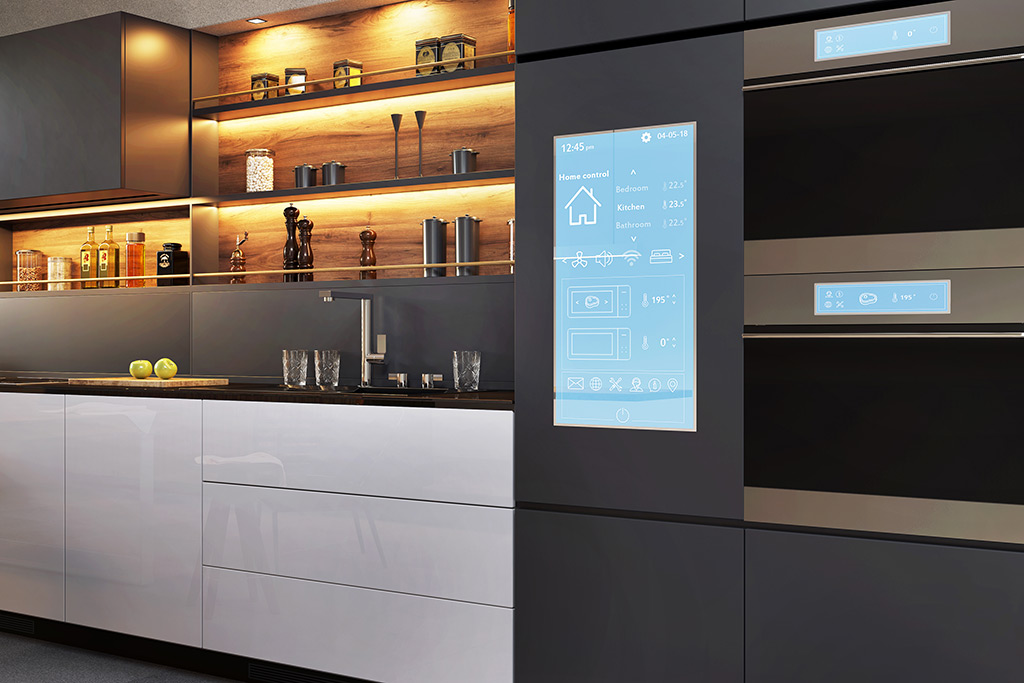
Compatible appliances can connect today with supported smart-home platforms through a shared standard rather than requiring a separate system for every brand. For example, Matter, an open connectivity standard, lets appliances from different manufacturers talk to each other. Bosch is incorporating Matter support for basic appliance monitoring and control.
Over time, this tech could allow the kitchen to operate as part of a broader household routine. An oven completing its cycle might trigger ventilation, adjust lighting, or send an alert through the homeowner’s preferred platform.
Going forward, the smart kitchen will not necessarily resemble a command center filled with screens. Instead, its intelligence may be almost invisible: a cooktop that adapts to the pan, an oven that identifies dinner, and a refrigerator that helps ensure fresh ingredients are used. The most successful innovations will be those that make the kitchen feel not more technical but more natural.