
Home Design for a Healthy Mind


Just as every person is unique, every home is too. Your home functions both as your physical shelter and an escape for your mind, and emerging mind-body research shows that the relationship between environment and health is strong. Read on to find out why your environment can influence your health and ways you can improve your space in light of this knowledge.
Furniture

The psychology
It’s normal to want to rearrange and change your furniture—as you grow, your space should change with you. Furniture placement and the shapes of the pieces themselves can help or hurt your room’s functionality, and, by extension, your stress levels. After all, you can feel your most productive when your furniture works for you rather than against you. As expert feng shui consultant Rodika Tchi puts it, “What feng shui decorating means is that you create an environment that has the best energy to support the specific activity, or activities intended for that space.” Additionally, furniture with a variety of rounded and straight lines is thought by some to create a pleasing balance for your brain.
Tip: Rearrange
To achieve the best furniture functionality, go for light, easily movable furniture. Play with different arrangements to determine what functions best for you and can be adapted for various purposes. Consider placements you normally wouldn’t, such as your bed against a new wall across the room. Additionally, try simple rearranging, like moving a floor lamp to a different corner of the room.
Lighting

The psychology
It’s no secret that lighting can affect your mood: your body responds differently depending on the type of lighting, such as natural or artificial light. For example, many people’s best memories are of places with abundant natural sunlight, like the beach. In fact, studies show that natural light is not only mood boosting but also used by your body’s internal clock, and when your internal clock is ticking optimally, you’re bound to feel more energized, alert, and satisfied.
Tip: Embrace natural light
Bring in natural light wherever possible, such as by opting for sheer curtains rather than blackout ones. Open your blinds during the day, and sit near your windows to work—uniform natural light is best for inspiring creativity. When you don’t have natural light, such as in the evening, choose warmer tones, such as yellow or orange, for a greater sense of calm. To achieve this, consider purchasing adhesive wall lights or smart bulbs that change colors.
Paint colors

The psychology
It’s thought by some that color choices can impact bodily functions, so choosing different shades for different areas can theoretically promote better health. When purchasing new furniture or paint for a space, choose intentionally, understanding that it could influence how you feel there for months and years into the future.
Tip: Create a color palette for every room
Each area of your home should have a color palette that is in tune with the activities you do in that space. For example, using green in an office can help promote creativity depending on its shade. In a dining room, consider red to add a feeling of comfort. Here are a few other general color suggestions for other rooms:
- Orange/yellow can evoke optimism. Recommended place: the kitchen.
- Blue is generally calming. Recommended place: a bathroom or bedroom.
- Purple can also be calming and inspire creativity. Recommended place: a child’s bedroom.
- Neutrals, by nature, are balanced and offer tranquility. Recommended place: an office.
Decor
The psychology
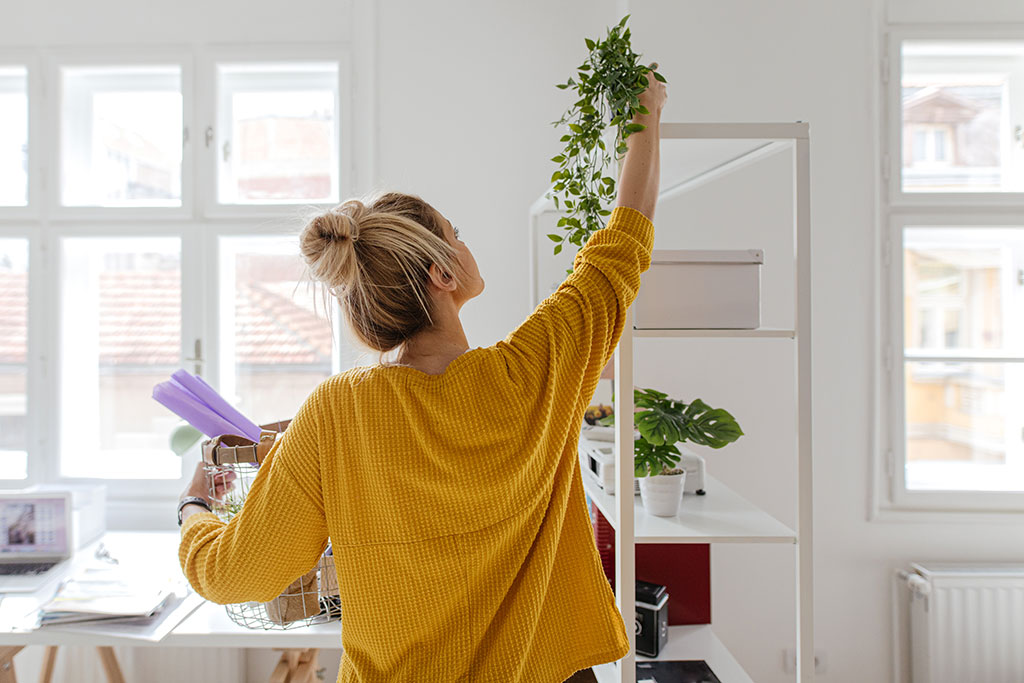
Everyone has a style preference, and one way to reflect this is through your decor. Even though decor may seem purely cosmetic and not as necessary as furniture, it is still important to a healthy design. For instance, touches like photos of loved ones and art of beautiful landscapes can help you feel comfortable and surrounded by positivity. In addition, generic decor like vases ties a room together and can be equally as important to include for a visually and mentally satisfying aesthetic.
Tip: Bring in the outdoors
Natural elements like plants, a small fountain, and an aquarium can promote peace through their visuals and relaxing sounds, making them particularly helpful in a place where you might encounter stress, such as an office. Consider placing a few low-maintenance plants, like succulents and ferns, near or on your desk and windowsills.
The mind is complex and beautiful, and, for reasons still being researched, the design of your home’s environment can potentially benefit your well-being in various ways.