Cash-flow conversations often begin after something in a business goes wrong: A major client pays late, demand softens more than expected, or costs rise faster than pricing can absorb. At that point, the math feels urgent, emotional, and constrained. You’re no longer evaluating options but choosing which problem hurts most and needs urgent addressing. That’s not a cash flow surprise; that’s merely a planning oversight.
The uncomfortable truth is that many businesses could see their liquidity risk coming months in advance if they started treating it as a system under stress rather than a static number. Follow these recommendations to more accurately determine how fragile your cash position may be in times of dips or duress.

Traditional cash-flow management focuses on optimization, such as collecting faster, paying smarter, trimming expenses, and unlocking liquidity. But optimizing this figure assumes stability. In contrast, pressure-testing assumes disruption.
Banks already think ahead in this way. They conduct stress tests to forecast and, more importantly, rehearse for failure. In other words, the goal of such processes isn’t to measure accuracy but to gauge preparedness. Your business deserves the same discipline.
You don’t need elaborate models or dozens of variables. Many cash-flow failures trace back to a small set of repeatable stresses that show up across industries and cycles. Here are three prudent places to begin your pressure tests.
Scenario 1: Late payments pile up
Many business owners model receivables as averages. If most clients pay you for goods or services on time, then you should be in good cash standing overall. But reality is messier.
According to the Federal Reserve’s 2024 Small Business Credit Survey, over 40 percent of small businesses report experiencing payment delays, with many citing cash flow strain as a direct consequence. Late payments rarely arrive one at a time, either. They cluster, often when customers face pressure themselves.
Pressure-test this by asking:
If your answer is “These things usually smooth out,” then you’re not testing. You’re hoping.
Running this scenario often reveals that customer concentration risk is a cash-flow risk long before it shows up as a revenue issue.

Scenario 2: Demand dips modestly and persistently
In many ways, customer demand plummeting for extended periods can actually be more dangerous than a temporary collapse. For example, a 5–10 percent revenue dip sustained over two quarters could cause more damage than a sharp, short-lived shock. Fixed costs don’t adjust automatically, and optimism delays making hard decisions.
Many business owners underestimate how long demand softness persists once it begins, particularly in tightening credit environments. Pressure-test this by modeling:
Then ask:
The value here isn’t in the model itself. Rather, it’s the realization that timing often determines business survivability more than magnitude.
Scenario 3: Costs spike where you least expect
Cost pressure can arrive at the most inconvenient times. Insurance renewals might jump, labor costs could creep, and input prices may move faster than pricing power allows.
The Bureau of Labor Statistics shows that overall price increases across goods and services have moderated. However, some categories, particularly labor-intensive ones, remain structurally elevated. This mismatch could compress your cash before it hits profitability. To pressure-test this, imagine:
How would you manage such a situation? This scenario often exposes thin margins that were invisible during stable periods—and it reveals whether your pricing discipline exists only in theory.

While you could work with a consultant or accountant to execute these processes regularly, you can also run them yourself with just three essential inputs: your current cash on hand, monthly fixed cash outflows, and realistic stress assumptions.
Then model each scenario independently, tracking the monthly net cash change and time to the minimum cash threshold. Review any points where decisions become forced, and write down what you would change before hitting low cash figures.
The information you gain from your pressure-testing can shine light on which of your strategies could be leading to future fragility and what you can do to avoid reaching an emergency scenario.
For example, stop extending generous payment terms to win deals, review whether you habitually hire ahead of sustained demand, and correct any debt structures that assume uninterrupted cash inflow. While none of these decisions is necessarily reckless in isolation, they become unsteady when stacked together under stress.
There’s a misconception that stress-testing is too conservative or fear-driven. In reality, it’s what allows confident action. If anything, it busts the illusion of “good” cash flow. After all, a positive number with low tolerance for disruption actually represents a delayed crisis.
JPMorgan Chase Institute research has consistently shown that businesses with larger cash buffers, not necessarily higher profits, are more resilient during revenue volatility. Liquidity buys time, and time preserves judgment. This can allow you to invest with clearer guardrails, negotiate from a position of calm, avoid reactive financing under duress, and, best of all, improve decision quality when conditions tighten. These are the real assets.

Year-end planning often focuses on taxes, budgets, and forecasts. Pressure-testing belongs alongside them because it informs all three. It clarifies how much cash you actually need to carry into the new year, whether your growth plans increase or reduce fragility, and which risks you may be consciously accepting and which you’re outright ignoring. Most importantly, it positions you as more prepared than reactive going into the forthcoming year.
Many business owners believe they understand their cash flow because they review reports regularly. But if you go beyond familiarity to cautious prospecting, you can better prepare for realistic scenarios and still give yourself time to maneuver.
TAKE ACTION:
Before the year’s end, run three cash-flow stress scenarios and identify one decision you would change in each case—before pressure forces your hand.
Renowned strategist, executive coach, and author Dianna Booher discusses where leaders can fall short in connecting and why the skill is critical to success.

Have interpersonal skills always come naturally to you, or were they learned?
I’ve always thought personal communication was easy. But I also think you can teach yourself many of these skills. The reason I got into this line of work was that I saw so many bad relationships, whether personal or professional, caused by communication issues. Even concerning marriages, it’s always said that people argue over money or how to raise their kids. Most of the time, it’s really about how they talk about those things.
What set you on this path professionally?
Years ago, my ex-husband was suffering from extreme depression. I knew he wouldn’t be able to support my two young kids and me much longer, so I needed to decide how I could support us. I talked about it to a friend, who asked, “What do you like to do?”
I responded, “I used to like to write English compositions in school. But how do you make a living doing that?” He said, “I didn’t ask you how to make a living; I asked you what you like to do. I suggest you find a way to do that.”
So I went to the public library and checked out a bunch of books on how to write a book and how to get published. I penned my first one, and as soon as the book tour and PR started, companies started calling me. For example, IBM reached out about teaching workshops on strategic writing and presentation skills. Eventually, I began to teach anything that had to do with communication, whether writing, leading a meeting, resolving conflict, or interviewing people—just about any situation you need to use words. That’s what I’ve done all my career.

When did you start your company?
1980. I was very young. In fact, I never actually held any other position except teaching for a couple of years. It has been a dream to help improve communication around the world because it’s a critical skill for any endeavor in any country. When I go abroad, I’m amazed that my audiences sometimes speak three or four languages. When I compliment them on speaking English so well, they’ll invariably say that in the business world, they must communicate in English because they have to do business with the US.
Is communication an underappreciated skill in business?
Yes. People point out that we’re born communicating. But giving information is not the same as really connecting with others (communicating). For example, life-of-the-party-type people sometimes assume they’re good at it when they’re not. They merely talk a lot. Talking may come naturally to an executive when speaking to their team, yet when they try to translate their thoughts into a performance review or chit-chat casually at a social event, they struggle.
Our communication skills affect almost everything we do, whether it’s being persuasive to get funding for a department or talking to venture capitalists while trying to start a business. In building a career, excellent communication skills are necessary for anyone who wants to get promoted.
When an executive sends a C-suite candidate to me for coaching, they often don’t even know how to tell me what the person needs to get promoted. Instead, they’ll just comment that the person needs “polish.” And, of course, “polish” isn’t exactly clear feedback to that team member! They need to learn specific skills to enhance their personal presence: how to think on their feet to respond to questions, make a persuasive case, connect emotionally, and express themselves clearly in both writing and speaking.

You’ve published fifty books. Which are your most popular?
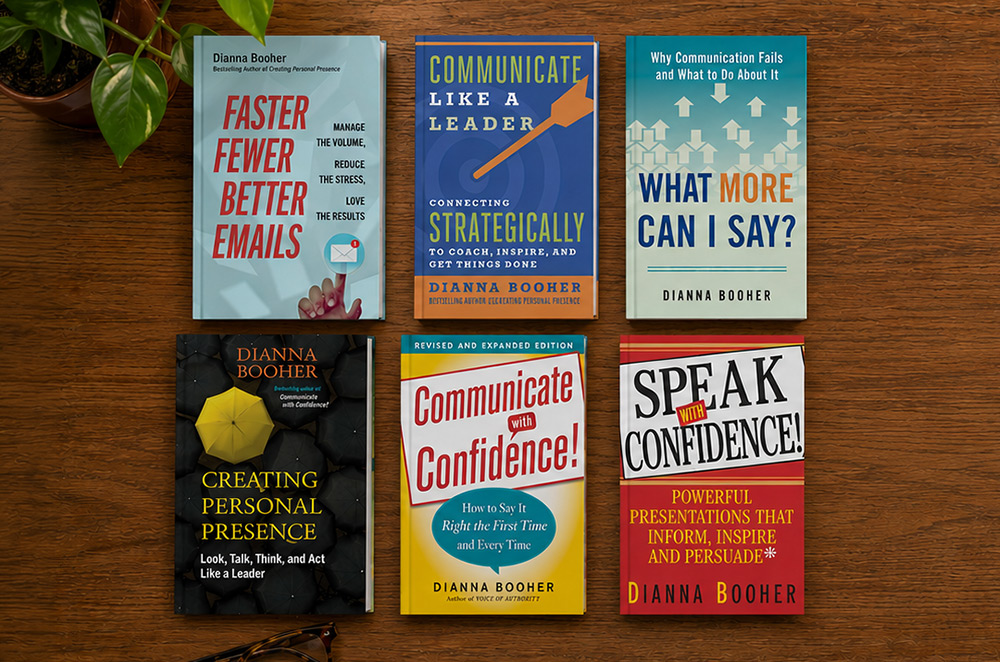
The one that’s been referenced most often is Communicate with Confidence!. I’ve expanded it since it was first published. It now contains 1,250 tips in twenty-three different topic areas, from contributing ideas in a meeting to listening carefully to clients in a sales situation. Yet it’s the easiest book to read because each excerpt is brief: to the point with strong examples.
Another popular one is Creating Personal Presence: Look, Talk, Think, and Act Like a Leader. It offers advice for people who haven’t gotten promoted to the business rung they aspire to. For example, you can actually see someone’s confidence—or a lack thereof—by the way they walk across the room, shake hands, gesture, or maintain good posture as they present ideas to a group. As listeners, we assess someone’s personal presence in several other ways: What words do they choose? What sentence patterns do they commonly use? Are they always throwing out buzzwords and colloquialisms, or are they creative in their speaking?
Why did you start doing book camps?
I started the Booher Book Camp program because people would constantly ask if I had a class on how to get published. The answer was always no. I guess I should have listened to the market back then. [Laughs] I eventually started doing the book camps once or twice a year. And when COVID started, I began doing them online. Now, most often I coach aspiring and seasoned authors one-on-one either in my office or via Zoom. The camps help leaders narrow their subject until—to use their favorite term—it’s polished into a publishable manuscript that a major publishing house would pick up.
In general, people have no idea how difficult it is to publish a book. They don’t learn the real steps in developing a great book proposal, so they take shortcuts and send junk. You have to learn what goes into a solid book proposal and agent query. Once you do, your chance of success increases exponentially!

You’ve touched on nonverbal communication. How key is that in business?
Most people are unaware of their own body language. For example, I once observed a senior executive who leaned back, shook his head, and looked disengaged while others spoke—unintentionally saying to them, “I’m not listening.” Leaders often need a metaphorical mirror to see how their posture, gestures, or facial expressions may undermine their message.
Years ago, I was talking to a major law firm in Washington, DC. One woman there said that she felt invisible, complaining to me that the senior leadership just refused to make the female attorneys partners in the firm. However, when I observed her presenting to the group and in social settings, I had a different take on the situation. When speaking to others, she tended to lean slightly forward and point a finger at her listeners, body language can clearly be taken as lecturing.
Is not adjusting communication to an audience a common mistake?
Definitely. Too many leaders fail because they reuse the same presentation for every audience. But engineers, customer service teams, and executives all have different priorities, vocabularies, and levels of knowledge about any specific topic. Effective communication starts by asking questions like “What’s their primary interest in my topic?” “What terms resonate with them?” “What do they have a bias for or against?” and “What do they already know?” Without those answers, buy-in suffers.
Many executives rely too heavily on slides, cramming dozens of them into a thirty-minute talk. I still recall helping a CEO at his organization’s annual shareholder meeting cut a sixty-slide deck down to three powerful visuals, which made his message far more impactful. The presenter carries the impact; the tools are mere support.
Communication techniques that help keep everyone mentally involved include rhetorical questions, storytelling, and even visual props. Such engagement builds retention of your points. Without it, people very well may tune out.

What other tendencies cause leaders to unintentionally sabotage themselves?
One common issue is confusing information-sharing with real communication. Employees often complain (either in employee surveys or in person) that “There’s just no communication around here!” Leaders shake their heads in disbelief and push back by listing their meetings, emails, and other “official” notices as proof that they communicate frequently—but those are one-way efforts. Communication is about how people perceive and experience the exchange, not how often information is distributed.
Also, many leaders overlook structured ways for employees to initiate communication. They focus on sending information out but don’t create clear channels for incoming ideas and feedback. True listening requires systems that invite input, not just surveys or suggestion boxes but ongoing dialogue.
Frankly, listening signals respect. Without it, people disengage. Leaders must design communication processes that encourage upward feedback, not just top-down messaging.
When leaders appear human and relatable, trust increases. Perfection can distance you, but vulnerability invites engagement.
You’ve helped so many people. What does that mean to you?
I don’t think about it, actually. My husband reminds me of my work if I’m discouraged about something. But what brings me a great deal of satisfaction is seeing situations changed, both in organizational settings and in personal relationships, such as a couple at the point of divorce who are now madly in love again.
Business is dog-eat-dog. Everybody’s competitive. When I work with a business year after year and see the whole organizational culture change, that’s extremely satisfying. So are promotions resulting from better communication.
I’ll always remember coaching Gloria, a lower-management leader at a major telecommunication company. She got promoted several times, from local manager to regional director to an executive role at their headquarters before making her way to a high-level position in politics. She credited her dramatic rise to her improved communication skills and stayed in touch with us for thirty years. Such stories make me beam with pride—not necessarily because of my part in them but because people unlocked communication skills that changed their lives.
For more info, go to booherresearch.com
When growth slows, your instinct may be to add something. During rapid change, however, adding more can make things harder to follow. Often, the better move is to remove what’s causing confusion inside your organization: uncertainty.
Here’s an example from a recent conference. At it, executives were asked, “What’s the number one thing you’re doing to drive growth?”
“We’re adapting to the rapid evolution of technology,” said a CIO. The CFO next to him said, “Affordability is our focus.” Others cited talent development, navigating legal hurdles, or dealing with new competition.
But it was a sales manager who offered the most transparent answer.

She said her team could handle change; what was slowing them down was confusion. When people understood their roles and where the company was headed, performance improved and clients responded. However, after so many shifts in direction, they were no longer sure what the organization stood for.
She pointed to the past few years as evidence. Three years earlier, the company had positioned itself as a sales organization focused on growing transactions, which drew customer attention and attracted ambitious talent. The following year, leadership pivoted to technology innovation, altering hiring needs and leaving customers uncertain. The previous year, the company described itself as a training firm, unsettling technical staff and raising new questions in the market. Now, neither employees nor customers knew what corporate identity might come next.
The most important move, she argued, was to remove confusion inside and outside the organization so growth would return. This is something you may need to do as well. Whether lack of clarity comes from competitors, technology, regulations, shifting priorities, or job insecurity, the result is the same: Your team members hesitate.

Pay attention to small shifts on your team and with your customers. If your people are trained but underperforming, they may be second-guessing themselves. If the latter have money and interest but aren’t taking action, it may be because something is unclear.
You may see it in everyday metrics: fewer inquiries, lower engagement on social media, and more objections during sales conversations. These aren’t always financial problems or training issues. Often, they’re signs that people don’t feel sure enough to act.
Inside your company, hesitation spreads quickly. Salespeople take fewer risks. Morale suffers and affects results. Culture and social interaction decline. Resources sit unused as people hold back “just in case.” Some disengage, while others leave.
As a leader, you’ve been trained to manage change—new markets, new tools, and new competitors. But when uncertainty spreads, you need a different approach, focusing less on adapting skills and more on igniting your team’s confidence and will. If they are unsure about their jobs or your direction, address it directly.
To do so, exhibit supportive behaviors, not directive ones. Ask what’s worrying them, and listen without jumping in to defend your plan. Then engage in open dialogue around their concerns, such as the company’s direction, market changes, or competition, and address rumors quickly so they don’t grow. Communicate more often, emphasizing your shared values and solid commitments.
You can also use stories to steady your team. Share examples of colleagues and customers who moved forward and saw results, and highlight employees who set aside hesitations and pushed forward, even without all the answers.
Finally, remember that people naturally draw strength from a leader’s example, so show up consistently and model the confidence you want your team to embody. By shifting into actively engaging uncertainty rather than change, you can begin to rekindle your team’s beliefs and customer excitement for your value proposition.

These three additional actions help reduce hesitation:
Adapting your skills and tools is certainly necessary, but it’s not always sufficient to maintain momentum and keep consumers engaged. When confusion rears its head, be sure that you set the tone about how to handle it. People don’t need every answer, after all. They need to know where they stand and where their company is going.
An entrepreneur, CEO, professional speaker, online pioneer, and business mentor, Matthew Ferrara has worked with leaders in real estate, sales, finance, marketing, and association management in 49 states and 30 countries. Learn more at matthewferrara.com
Jennifer Villa, owner of MJI Marketing Agency, offers her industry know-how to explain how good marketing messaging isn’t necessarily clever and catchy but clear and direct.

“To start crafting a system for effective messaging, businesses should define their core values and what sets them apart—then distill those into a single, clear message for all communications. I would write this down and review it, coming back to it each time a different platform is used. Ask yourself, ‛Does this match the same voice, tone, and brand?’ This helps keep content consistent across all channels.
“Creating a short playbook with key messages and examples will make it easy for anyone, including yourself, to stay on track. That way, new members to your team can quickly grasp the company’s vision and what sets it apart.”
EXAMPLE: Dove’s Real Beauty campaign, centered on diverse, unretouched, and realistic beauty standards, has a recognizably uplifting tone with signature imagery. The brand spreads this message consistently across different channels, including Instagram and television ads.

“It’s important to know who you’re advertising to and focus on them. You can’t know absolutely everything about them, but if you know a few key details, you can make an educated guess as to what they might like.”
EXAMPLE: Apple markets to a tremendously wide swath of customers, but its #ShotOniPhone campaign united all of them around a common interest: capturing everyday moments and important media alike. Tens of millions of Apple users have shared their photos and videos with the hashtag, demonstrating the products’ capabilities.

“Once you clarify your audience, use emotion, strong visuals, or a good story to help your message be memorable. Also, try to think creatively so your ads don’t look like everyone else’s. Ads that stand out and connect emotionally are more likely to stick.
“Messages that don’t resonate with people or provide a clear next step are quickly forgotten. If we don’t feel something, our brains will just forget it. We remember information if it makes us feel a certain way.”
EXAMPLE: Mastercard’s Priceless series of television commercials formed a seamless, emotionally touching link between carrying the brand’s credit cards and experiencing life’s joys to their fullest.

“Each platform needs the same messaging but shared in different ways. For example, social media ads should be short, eye-catching, and attention-grabbing, often using stories or emotion. Emails give you more room to explain in detail, personalize, and share your product’s benefits. Websites can go into further detail by providing more specifics and, again, repeating key messages. The main goal is to ensure that each platform feels right for users while maintaining a consistent voice, tone, and brand.”
EXAMPLE: Home goods brand CB2 sends marketing emails that focus on imagery to promote the modern elegance of its products, featuring only brief descriptions. Its website, meanwhile, elaborates further on each product’s selling points and quality.

“Messaging is easy to forget when it’s unclear, generic, too busy, or inconsistent—changing its tone or design from one place to another. Some ads also present new solutions and show graphs but don’t provide concrete examples, leaving people confused. Don’t make things unnecessarily complicated!
“I’ve seen ads and articles that sound exciting but don’t clearly explain what they offer or why it matters. I still remember seeing one particular Super Bowl ad a few years ago and immediately wondering, But what’s the product? I felt like that was a waste of money, unfortunately. If a message isn’t clear or easy to act on, it won’t get attention and can hurt trust. Simple and direct messages with a clear point work much better.”
EXAMPLE: Shutterstock marketing emails feature an alluring image above simple text that explains exactly what kinds of materials you could find in its content library.

“You may need a marketing expert to run an ad campaign, especially if you plan on making a sizeable financial investment in ads. Don’t waste money on them unless you know what you are doing. Facebook and Google Ads are prime examples of how many people think they can run campaigns and generate leads. While everyone can technically buy ads, it takes skill to achieve the results you need.”
MJI Marketing Agency is a Roanoke, Virginia-based, full-service digital marketing agency serving startups, small businesses, and growing mid-size companies. It delivers end-to-end marketing solutions, including social media management, email marketing, website design, and SEO, all built to drive measurable results.