
The Magical Art of Melissa Helene

Wisconsin-based scratchboard artist Melissa Helene discusses her fascinating medium, wildlife subject matter, and ever-expanding business.
Walk us down your path to becoming a professional artist:
I grew up creating art—I was always drawing and took every art class available in junior high and high school. In college, I didn’t know what I wanted to do, but I did know that I didn’t want to be a “starving artist” or an art teacher. So I got my degree in sociology with a minor in youth studies and worked in the nonprofit realm for several years after graduating.
However, I was regularly looking for something different. Since I was already making graphite and charcoal drawings and oil paintings as a hobby, I started planning to do art full-time. Soon after, I discovered scratchboard art, and something immediately clicked. As a very type A person, this medium and its attention to detail were very appealing to me. I founded my business in 2015 and have been working in scratchboard now for over ten years.

What is scratchboard art?
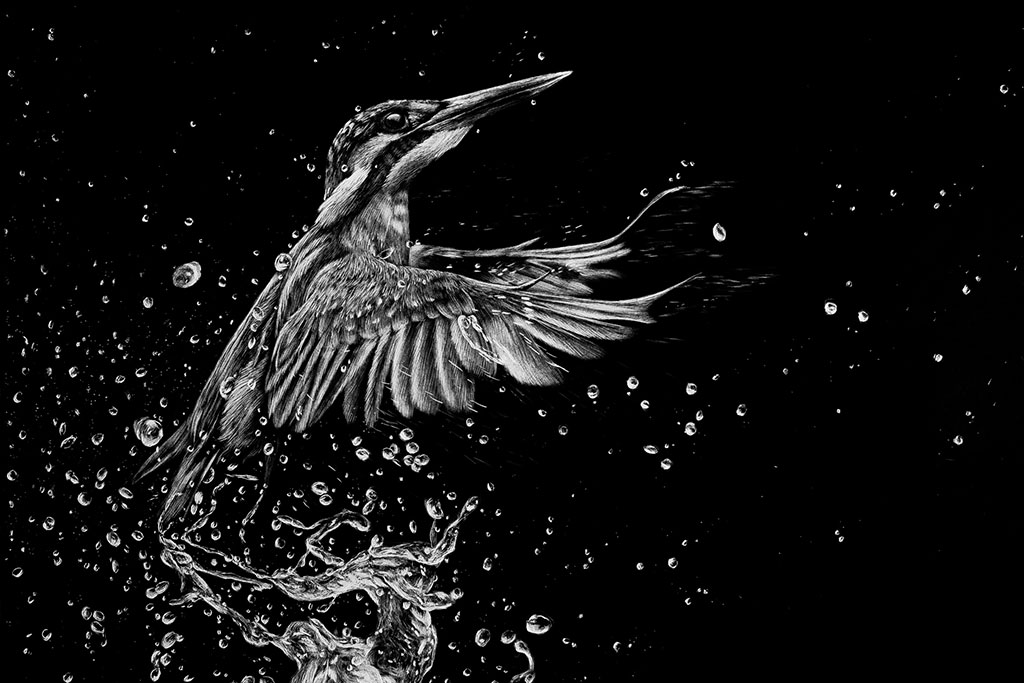
It employs professional-grade Masonite boards that have a smooth white clay base and a black ink layer on top, which you scratch off to create images. More commonly, you’ll find kids’ versions of it that have predrawn images to scratch off with a neon rainbow base underneath.
How long did it take to master your craft?
To be honest, it’s something I took to very naturally. I also had a decade of experience in drawing when I started—a necessity for doing photorealistic work on scratchboard. However, I’m still learning and growing. For example, over the past few years, I’ve finally started coloring my scratchboards, as most artists in this medium do. I’d avoided it previously because scratching is a very time-consuming process and I was leery of ruining something I had already put so much work into.
Eventually, though, I got to a point where I craved something different and wanted to push myself a little bit more. Besides, scratchboard inks come in packs of six—black and other various colors—but I would only use the black to tweak scratches, so the colored ones were piled up, just sitting there for years staring at me. I finally decided to give it a try with something easy: little birds. I love it now.
Why did you choose wildlife as your primary subject matter?
While I did a lot of human portraiture when I was using graphite and charcoal, I’ve always loved and drawn animals. My husband and I are wildlife photographers, too, and there’s an unending subject pool to choose from, both in photography and art. I’m currently working on a brown bear piece, the biggest scratchboard I’ve ever done.
What are your favorite animals to draw?
The majority of what I do is birds and mammals. People are constantly asking for whales or dolphins, but I rarely do aquatic creatures. For a couple of years, I couldn’t keep a big-cat piece to save my life—since that’s what clients were wanting, I actually considered just focusing on tigers, lions, etc. However, when I put the idea out on social media, everyone overwhelmingly told me not to do it.
What are the general different sizes of your pieces? How long do they take?
I work in a huge range, the most common being 4” by 4”. The largest I’ve created for art festivals is 2’ by 3’, and the big one I’m working on now is 32” by 48”. The time varies, even with ones the same size, depending on the subject. For instance, I can do a tiny bird in two to three hours; I don’t have to scratch as much because of its texture.
On the other end of the spectrum, the one that took me the longest, a green iguana, required well over a hundred hours—and it was only 12” by 16”. But because a lizard has scaly skin, the entire piece was almost entirely composed of individual knifepoint dots. I ended up taking five months to complete it. I still haven’t crafted another lizard because that one broke me a little. [Laughs]
Is texture the most challenging aspect of scratchboard art? Which are your favorite tools to use?
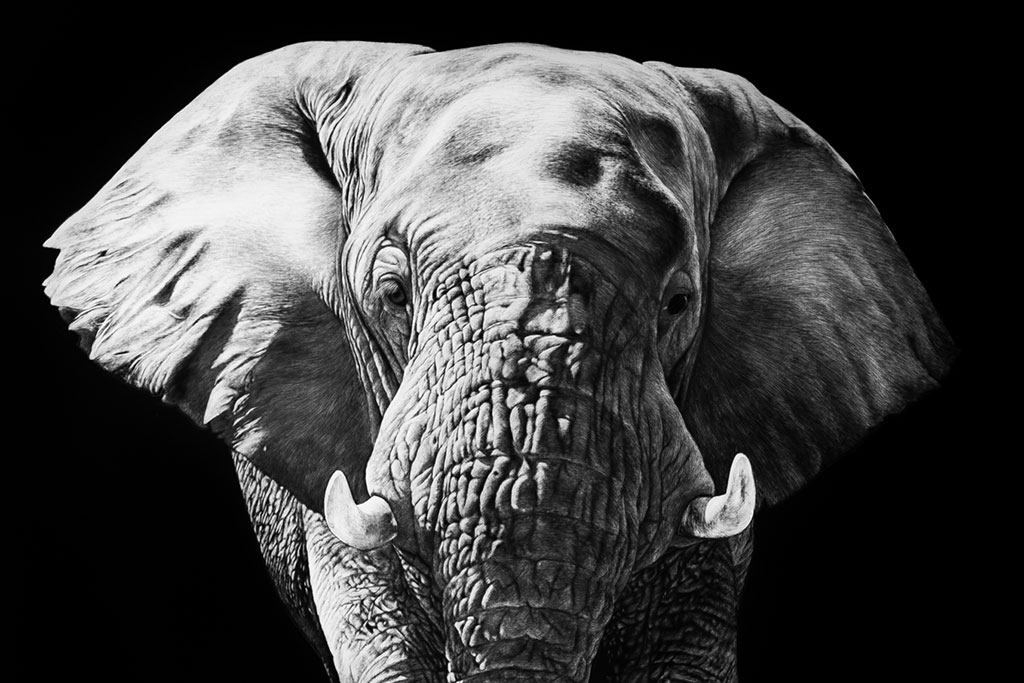
Being able to achieve three-dimensional depth in a two-dimensional medium is always the most challenging part. And there’s no real room for error—once you’ve scratched something, it’s permanent. Sure, I can use black ink and different ink pens to help redarken areas, but I can tell the difference between when I’ve done a scratch correctly the first time versus when I’ve had to correct it with ink.
As far as my tools, I have two that I use on every piece: an X-Acto knife and a fiberglass brush. The brush looks like a stylus and has a little protruding stick with strands of compressed fiberglass. So while each stroke seems like it’s making one wide scratch, it’s actually making many incredibly fine ones. That’s my favorite tool. It’s incredibly versatile, and I use it for every texture I create, from scales to fur to skin to glassy eyes.
You also do pet portraits. Would you elaborate on them?
They’re a big part of my business. I grew up with dogs and my husband and I have two, so I know how special they are and how heartbreaking it is when they leave—that’s one of the main reasons I keep offering pet portraits. Those elicit the best reactions when I deliver them. Custom cat and dog requests usually pour in between September and December.
You’ve been running your business for a decade. How does that make you feel?
It’s crazy. A lot of life has happened in that time, like getting married and having our kid. But starting my business was absolutely the right choice since it perfectly merges the two parts of my personality: orderly and creative. That said, being an artist isn’t easy, and trying to make a business out of being an artist is even harder. I’m proud of myself for doing that.
For more info, visit melissahelene.com